Billable Hours for Freelancers: The Myth That Wrecks Your Rate
Billable hours for freelancers are never the same as hours worked. See the real week, the efficiency math, and what it does to your rate.
Practical guidance, not financial advice. Sukie is a working freelancer, not a licensed accountant or financial advisor. Use this to make a defensible decision, then confirm the specifics for your situation with a qualified professional.

By Sukie · Founder & Writer, FreelanceRateLab
Updated August 11, 2026 · 8 min read
Billable hours for freelancers are never the same as hours worked, and here is the myth that quietly underpays half the people I know: "I work 40 hours a week, so I bill 40 hours a week." It is wrong by a wide margin, and the gap between those two numbers is the difference between a rate that works and a rate that slowly bankrupts you.
Billable hours for freelancers are the hours a client actually pays for. They are almost never the same as the hours you sit at your desk.
The Assumed Week Is Fiction
When you first set a rate, you probably did the obvious math: pick a yearly income, divide by 52 weeks, divide by 40 hours, done. That gives you a tidy number and a false sense of security.
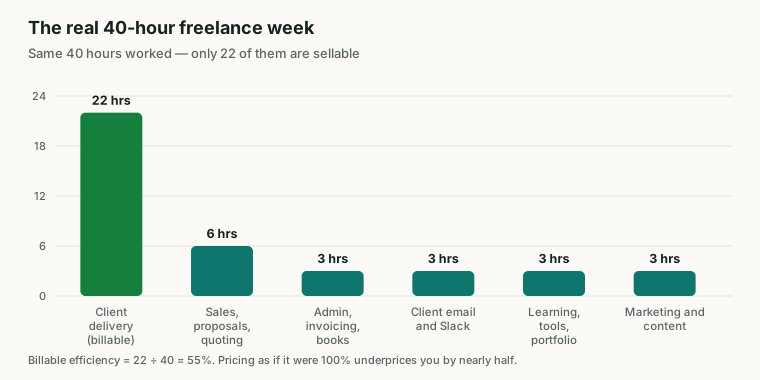
The same 40 hours worked, split honestly. Billable efficiency here is 55%.
The problem is that nobody pays you to write proposals, chase invoices, or answer "quick question?" emails. Those hours happen, they fill your calendar, and they earn you nothing directly. So the "40 hours" you priced against is a number you will never actually sell.
Here is what the two weeks really look like side by side.
| Activity | Assumed week | Real week |
|---|---|---|
| Client delivery work (billable) | 40 hrs | 22 hrs |
| Sales calls, proposals, quoting | 0 hrs | 6 hrs |
| Admin, invoicing, bookkeeping | 0 hrs | 3 hrs |
| Email and Slack with clients | 0 hrs | 3 hrs |
| Learning, tools, portfolio | 0 hrs | 3 hrs |
| Marketing and content | 0 hrs | 3 hrs |
| Total worked | 40 hrs | 40 hrs |
| Total billable | 40 hrs | 22 hrs |
Same 40-hour week. Same effort. But only 22 of those hours show up on an invoice. That ratio, 22 out of 40, is your billable efficiency: about 55%. Everything below flows from that one number.
Billable Efficiency Is The Number That Actually Matters
Billable efficiency is just billable hours divided by total hours worked. If you work 40 and bill 22, you are at 55%. If you bill 30, you are at 75%, which is excellent and usually only sustainable with steady retainers and almost no prospecting.
I tracked my own time for a full quarter in 2024 because I was convinced I was "basically always working." The data was humbling. Across 13 weeks I averaged 38 worked hours and 21 billable hours per week. That is 55% efficiency, and I had been pricing as if it were 100%. No wonder the bank account never matched the calendar.
Most solo freelancers I have compared notes with land somewhere between 50% and 65%. Newer freelancers, or anyone in a heavy marketing push, often sit at 40% to 50% because so much time goes into finding the next client. The point is not to hit a magic number. The point is to know yours and price against it honestly.
Where The Non-Billable Hours Actually Go
When people hear "you only bill 55%," they assume the other 45% is laziness or distraction. It is not. It is the unpaid machinery that keeps a one-person business alive. Roughly, across a typical week, the non-billable slice breaks down like this:
- Sales and proposals (about 30% of non-billable time): discovery calls, scoping, writing quotes, and following up. If you close 1 in 3 proposals, two-thirds of this time produces no contract at all.
- Admin and finance (about 20%): invoicing, chasing late payment, expense tracking, contracts, and setting aside tax.
- Client communication (about 20%): the email and message threads that are not part of a scoped deliverable. Necessary, but unbilled unless you explicitly bake it into your scope.
- Marketing and visibility (about 15%): content, social posts, networking, updating your portfolio.
- Learning and tooling (about 15%): keeping skills current, fixing your software setup, evaluating new tools.
None of that is optional. Skip the sales time and your pipeline dries up. Skip the admin and the IRS or a late invoice eventually finds you. The U.S. Small Business Administration's guidance on managing your business operations treats this back-office work as core to staying solvent, not as overhead you can wish away. For freelancers, that back-office work is simply non-billable, and it has to be funded by the hours you do bill.
The Same Income Needs A Very Different Rate
This is where the myth stops being a vocabulary nitpick and starts costing real money. Watch what happens to the rate when you swap the fictional week for the real one.
Say you need to clear $110,000 a year to cover your salary, taxes, software, insurance, and a little profit. (If you have not built that target yet, the freelance rate calculator formula walks through every line item.)
The myth math, 100% efficiency:
- 110,000 ÷ 52 weeks = $2,115 per week
- $2,115 ÷ 40 hours = $53 per hour
That $53 looks fine. It is a disaster. It only works if every single hour you work is billable, which never happens.
The reality math, 55% efficiency:
- 40 hours worked × 55% = 22 billable hours per week
- 22 × 52 weeks = roughly 1,144 billable hours a year (after a couple of weeks off, call it 1,100)
- $110,000 ÷ 1,100 billable hours = $100 per hour
Same income goal. Same workload. But the honest rate is $100/hr, not $53/hr, nearly double. Charge the $53 and you would have to bill 2,075 hours a year, which at 55% efficiency means working roughly 75 hours every week. That is the burnout trap, dressed up as a competitive rate.
You can run the lever the other way too. If you pushed efficiency to 65% (about 26 billable hours a week, ~1,350 a year), the rate drops to $110,000 ÷ 1,350 = $81/hr. Raising your billable efficiency by ten points let you charge $19/hr less for the exact same take-home. That is the real payoff of protecting your billable time, and it is exactly the calculation the homepage freelance rate calculator automates once you feed it an honest billable number.
The Mistake I Made: Pricing Against My Best Week
For my first two years I priced against my best week, not my average one. Occasionally I would hit 32 billable hours, feel like a machine, and assume that was my baseline. So I set rates as if 30 billable hours were normal.
They were not. My real average was 21. Pricing against the outlier meant that in any ordinary month I came up short and quietly resented every client, when the math was the actual problem. The fix was boring: track everything for a quarter, take the true average, and price against that. My rate went up, my stress went down, and I stopped chasing volume to plug a gap that better pricing had already closed.
If you want to argue about whether a higher target like 7 billable hours a day is even achievable day to day, that is a separate and worthwhile fight. I dig into it in realistic billable hours per day. This page is about the concept: billable versus non-billable, and the efficiency ratio that connects them to your rate.
Non-Billable Does Not Mean Worthless
It is tempting, once you see the efficiency math, to treat every non-billable hour as the enemy and try to crush it to zero. Do not. Those hours are an investment with a return, just not an invoice-shaped one.
The six hours a week I spend on sales and proposals are the reason I have clients at all. The three hours of marketing are why those clients find me instead of the other way around. The learning time is why I can charge a senior rate. Cut all of it and your billable efficiency would spike for one glorious quarter, then your pipeline would collapse and you would be back to 40% as you scramble to refill it.
The goal is not zero non-billable time. The goal is to know what it costs, fund it from your rate, and spend it deliberately on the activities that actually move the business. A proposal that wins a six-month retainer is worth more per hour than the delivery work it unlocks. Treat it that way.
There is a tax angle here too, which is easy to forget when you are knee-deep in delivery. Many non-billable activities, software subscriptions, a portion of your home office, professional development, are deductible business expenses, which softens their real cost. The IRS overview of business expenses is the canonical reference, and I cover the practical version in the freelance expenses checklist. The hours stay non-billable, but the dollars attached to them can work a little harder.
How To Find Your Real Number
You do not need fancy software. You need two weeks of honesty.
- Log every working block for two to four weeks, tagging each as billable or non-billable. A notes app or a free timer is plenty.
- Add up both columns and divide billable by total. That percentage is your billable efficiency.
- Multiply out the year. Weekly billable hours × the number of weeks you actually work (subtract vacation, holidays, and a buffer for slow stretches).
- Divide your income target by that yearly billable figure. That is your floor rate.
- Re-check quarterly. Efficiency drifts with your pipeline, so a rate set once and never revisited goes stale fast.
The freelancers who keep their rates honest are not the ones with the prettiest spreadsheets. They are the ones who never confuse hours worked with hours sold.
Keep Reading
- Build the income target your billable hours divide into: freelance rate calculator formula
- Settle the daily-target debate: realistic billable hours per day
- Plug your honest number straight in: the rate calculator
- Browse every guide: guides hub
Questions people ask
- What counts as a billable hour for freelancers?
A billable hour is time a client actually pays for, tied to a specific deliverable or scope. Time spent on proposals, invoicing, email, learning, or marketing is real work but it is non-billable, so it never appears on an invoice.
- What is a realistic billable efficiency for a freelancer?
Most solo freelancers land between 50% and 65% billable efficiency, meaning roughly half to two-thirds of their working hours are sellable. New freelancers and those doing heavy marketing often sit lower, around 40% to 50%.
- How do non-billable hours affect my rate?
Non-billable hours shrink the number of hours you can sell, so your fixed income target gets divided across fewer billable hours. That pushes your required hourly rate up, often by 40% to 80% versus a naive 40-hour assumption.
- Should I track billable hours weekly or monthly?
Track weekly to catch fatigue and scope creep early, and review monthly to see pipeline trends. Re-run your rate math quarterly using your real billable efficiency rather than your hoped-for one.
- Won't raising my rate fix the billable-hours problem on its own?
Partly. A higher rate means you need fewer billable hours to hit the same income, which eases the pressure. But if you set the rate without knowing your real efficiency, you are still guessing, just with a bigger number. Fix the efficiency assumption first, then raise the rate from a foundation you trust. See how to raise your rate for the conversation side of that.
Put these numbers to work
Use the free freelance rate calculator to turn this into your own hourly rate in under a minute.
Open the calculatorKeep reading
More in Setting Your Rate, or browse all guides.
True hourly rate is what survives tax, unbillable time and overhead. The full trace from a $75 invoice line to the $21 that reaches your account.
ReadFreelance hourly rate from salary, converted honestly: gross up for self-employment tax, replace benefits, add expenses, and divide by real billable hours.
ReadLearn how to stop undercharging as a freelancer with a rate floor formula, 5 warning signs, and a 4-step plan to raise your rate this week.
ReadRealistic billable hours per day for most freelancers sit at 4 to 6, not 7 or 8. See why the daily target matters, the math, and how to raise it sanely.
ReadFollow the freelance rate calculator formula step by step with one real example: a UX designer turning an $85,000 take-home goal into an hourly rate.
ReadROI of hiring a freelancer, calculated the way finance wants it: loaded cost comparison, four attribution models, and the traps that inflate the number.
Read