Freelance Hourly Rate by Industry (2026 Benchmark Reference)
Freelance hourly rate by industry for 2026: low, mid, and high ranges for writing, design, dev, marketing, VA, and consulting, plus how to adjust them.
Practical guidance, not financial advice. Sukie is a working freelancer, not a licensed accountant or financial advisor. Use this to make a defensible decision, then confirm the specifics for your situation with a qualified professional.

By Sukie · Founder & Writer, FreelanceRateLab
Updated August 11, 2026 · 8 min read
Benchmarks are comforting and a little dangerous at the same time. A tidy table of "freelance hourly rate by industry" feels like an answer, but it is really just the average of a thousand situations that are not yours. The number does not know your scope, your speed, your expenses, or how risky your client is.
Here is the trap I want you to avoid. The first time I looked up rates for my field, I saw "$40–$60/hr," anchored on $45, and quoted that for almost a year. That single number quietly capped my business. I was working full weeks and still scrambling, because the benchmark I trusted described average work for average clients, not the specialized work I was actually doing. Anchor too low and you cap yourself before you ever negotiate.
So use the tables below the way a doctor uses a reference range: to spot when something is off, not to diagnose you. Every figure here is a range for 2026, not a guarantee or a quote. Real rates vary by city, niche, and client. Let these numbers inform your assumptions, then feed better inputs into the freelance rate calculator on the homepage.
How to Read These Tables
Each table shows three columns: Low (newer freelancers, generalist work, budget or local clients), Mid (a few years in, some specialization, healthy small-business clients), and High (deep expertise, narrow niche, outcome-driven or enterprise clients). Most working freelancers land somewhere between Low and Mid and assume that is the ceiling. It usually is not.
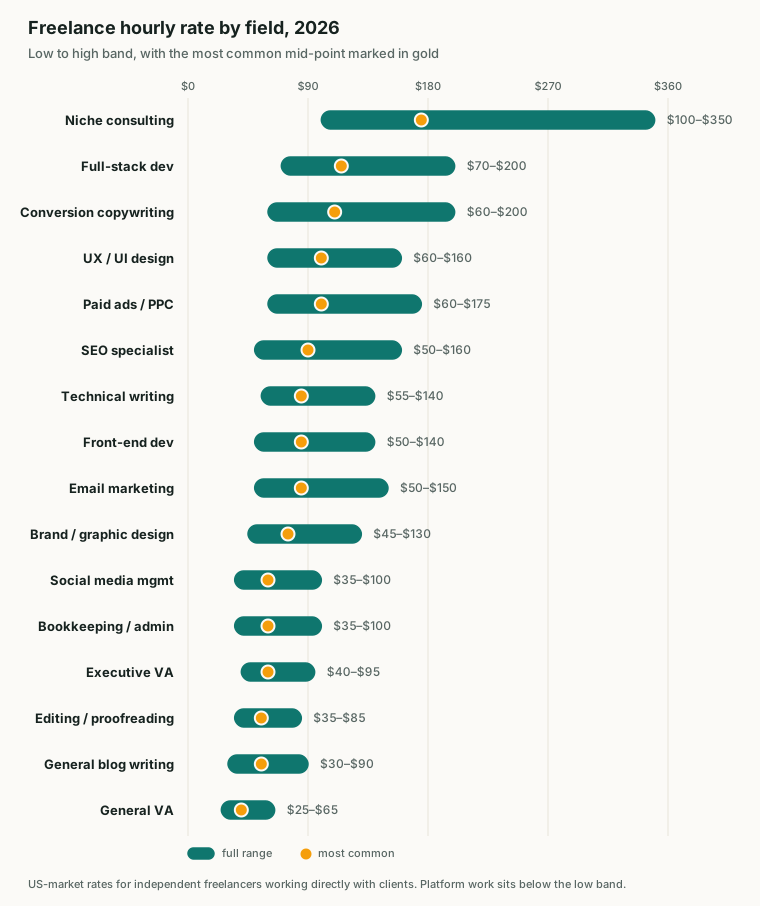
Sixteen fields, 2026 US rates. The gold marker is the most common figure in each band.
These ranges are directional, built from common US freelance marketplaces and my own conversations across fields. For grounded occupational wage context, the U.S. Bureau of Labor Statistics publishes median pay by occupation at bls.gov, though remember those are employee figures and run lower than freelance rates for the reasons in the FAQ.
2026 Freelance Hourly Rates: Words, Visuals, and Code
| Field | Low | Mid | High |
|---|---|---|---|
| General blog writing | $30 | $55 | $90 |
| Conversion copywriting | $60 | $110 | $200+ |
| Editing / proofreading | $35 | $55 | $85 |
| Technical writing | $55 | $85 | $140 |
| Graphic / brand design | $45 | $75 | $130 |
| UX / UI design | $60 | $100 | $160 |
| Front-end web development | $50 | $85 | $140 |
| Full-stack / software dev | $70 | $115 | $200+ |
Notice how much spread sits inside a single label. "Writing" runs from $30 to over $200 depending on whether you are producing volume content or copy that directly moves revenue. The label tells a client almost nothing; the outcome attached to it tells them everything.
The development rows deserve a note too. Front-end and full-stack ranges have stayed strong into 2026 partly because demand outpaces supply for people who can ship reliable, maintainable work. AI tooling has compressed the floor for trivial tasks, but it has actually raised the ceiling for freelancers who can architect, debug, and take responsibility for production systems. If anything, the gap between the Low and High columns is widening in code, not closing.
2026 Freelance Hourly Rates: Marketing, Admin, and Advisory
| Field | Low | Mid | High |
|---|---|---|---|
| Social media management | $35 | $60 | $100 |
| SEO specialist | $50 | $90 | $160 |
| Paid ads / PPC management | $60 | $100 | $175 |
| Email marketing | $50 | $85 | $150 |
| Virtual assistant (general) | $25 | $40 | $65 |
| Executive / specialized VA | $40 | $60 | $95 |
| Bookkeeping / admin finance | $35 | $60 | $100 |
| Niche consulting / strategy | $100 | $175 | $350+ |
Two patterns jump out. First, admin-style work has a lower floor because it is easier to compare and substitute. A client can find another general VA in an afternoon, so the price stays anchored. Second, advisory and consulting rates explode at the high end, because clients are no longer paying for hours; they are paying for judgment that prevents expensive mistakes. A strategist who saves a company from a six-figure misstep is cheap at almost any hourly figure, which is why the consulting row has no sensible ceiling.
The marketing rows sit in the middle by design. SEO, paid ads, and email all attach loosely to revenue, so they earn a premium over pure admin work but rarely reach consulting territory unless the freelancer can prove a direct line to dollars. The closer your work sits to the client's money, the higher in the table you can credibly price.
A Quick Cross-Field Snapshot
If you want one compact view to share or screenshot, here are typical 2026 mid-points by category:
| Category | Typical mid-point |
|---|---|
| Writing / editing | $55–$85/hr |
| Design (brand + UX) | $75–$100/hr |
| Web / software dev | $85–$120/hr |
| Marketing (SEO, ads, email) | $85–$100/hr |
| VA / admin | $40–$60/hr |
| Consulting / strategy | $150–$200+/hr |
Again, these are mid-points, not targets. Plenty of people in each row charge double the listed figure, and they are not doing anything magical. They have adjusted the benchmark for the four factors below.
Adjusting a Benchmark Up or Down
A benchmark is a starting line. Here is how to move from the line to a number that actually fits you.
Experience. Each meaningful tier of proof shifts you toward the high column. A portfolio of results, repeat clients, and testimonials can justify a 25–50% premium over the mid figure. New freelancers should expect to start near Low and climb deliberately, not apologize for it forever. When you are ready to move, the guide on raising your rate walks through the timing.
Niche. "Writer" is a commodity; "email writer for B2B SaaS" is not. The narrower and more profitable the niche, the higher you can price, because there are fewer substitutes and the work ties directly to the client's money. Niching is often the single fastest way to move from Mid to High without learning a new skill.
Geography. This cuts both ways in 2026. Remote work has flattened rates, but clients in high-cost markets (and well-funded companies anywhere) still pay more. If your clients are local small businesses, expect pressure toward Low–Mid. If you can reach national or enterprise clients, the High column opens up regardless of where you live.
Client type. A bootstrapped solo founder, a profitable small business, and a funded startup have wildly different budgets for the same task. Sorting your pipeline toward clients who buy on outcomes rather than price is what lets you live at the top of a band. Pricing models matter too; see hourly vs project pricing once you know your band.
A Benchmark Is a Sanity Check, Not Your Rate
This is the part people skip, so I will be blunt. Your rate does not come from this page. It comes from your own income goal, your real expenses, and your honestly counted billable hours. The benchmark only tells you whether the number your math produces is plausible for your market.
The right order is: calculate first, compare second. Run your real numbers, then look at the table. Here is the simple math the calculator is doing under the hood:
Target income $90,000 + business expenses $15,000 = $105,000 needed. $105,000 ÷ 1,100 billable hours = $95/hr.
If that $95 lands inside or above your industry band, your model is sound. If it lands far above the High column, that is a signal to fix something: narrow your niche, improve efficiency, or move upmarket. If it lands below the Low column, your billable-hours or expense assumptions are probably too optimistic. The full breakdown lives in the freelance rate calculator formula guide, but the principle is fixed: benchmarks calibrate, they do not decide.
Worked Example: Mid-Band Skill, Top-Band Rate
Let me show you the case that benchmarks hide. Meet Dani, a freelance SEO specialist. On pure technical skill, she is solidly mid-band. The 2026 table puts SEO at $50–$90–$160, so a glance says she should charge around $90/hr. Most people in her position do exactly that.
But look closer. Dani works only with e-commerce stores doing $1M–$5M in revenue. Last quarter, three of her clients averaged a 22% lift in organic revenue inside four months. She has a documented process, a waitlist, and case studies with real dollar figures. She turns work away.
Average skill, exceptional results, and scarce availability is the textbook case for charging top of band. Here is why the math works in her favor:
A client earning an extra $180,000/year in organic revenue from her work will happily pay $150/hr. At a 40-hour engagement, that is $6,000 against a $180,000 return: a 30x return for the client.
Charging $90 because "that's the average" would leave money on the table for both of them. The client's decision is not "is $150 more than $90?" It is "is $6,000 worth $180,000?" Dani prices at $150/hr, near the top of her band, and her clients consider it a bargain. The benchmark would have capped her at $90 and called it fair.
That is the whole lesson. A benchmark describes average work for average clients. The moment any of your four adjustment factors is above average, the average number is the wrong number.
Where to Go Next
- Run your real numbers in the freelance rate calculator and compare the output to the tables above.
- Pressure-test your billable-hours assumption with billable hours explained.
- Ready to move from Mid to High? Start with how to raise your rate.
Questions people ask
- What is the average freelance hourly rate by industry in 2026?
It depends heavily on the field. Rough 2026 mid-points are around $50–$70/hr for writing and admin-heavy work, $60–$90/hr for design and marketing, $75–$120/hr for web and software development, and $100–$200+/hr for specialized consulting. Treat these as wide ranges, not fixed prices.
- Should I just charge the industry benchmark for my field?
No. A benchmark is a sanity check, not your rate. Your real number comes from your own income goal, expenses, and billable hours. Use the homepage calculator first, then compare the result to the benchmark to see if your market can support it.
- Why are freelance rate ranges so wide?
Because experience, niche, geography, and client type each move the number by 30–100%. A generalist writer for a tiny local business and a conversion copywriter for funded startups are both 'freelance writers,' but they live at opposite ends of the same band.
- I'm in the middle of my industry band. When should I charge top of band?
When you have proof of outcomes, a specialized niche, low availability, and clients who buy on results rather than price. Average skill plus above-average results is the clearest case for pricing at the top of the range.
- Are freelance benchmarks the same as employee salaries?
No. Employee salary surveys exclude self-employment tax, unpaid admin time, gaps between clients, and your own benefits. A freelance rate has to cover all of that, so a straight salary-to-hourly conversion almost always lands too low.
Put these numbers to work
Use the free freelance rate calculator to turn this into your own hourly rate in under a minute.
Open the calculatorKeep reading
More in Rate Benchmarks, or browse all guides.
Freelance developer hourly rate bands for 2026 by stack, plus the domain premium that adds 25-40% for exactly the same technical work.
ReadFreelance designer hourly rate bands for 2026 across eight specialties, and why the spread inside one discipline beats the gap between disciplines.
ReadHow many hours do freelancers work each week? Four real working patterns, the billable share of each, and why billable hours plateau near 26.
ReadFreelance writer hourly rate bands from the real market: the content mill floor, generalist and specialist ranges, and per-word vs hourly math.
ReadHow to measure rate of pay for freelancers if you're the one hiring: a 5-step framework for benchmarking rates, converting to loaded cost, and tracking ROI.
ReadUse a freelance rate calculator automotive pros trust. Real hourly ranges by specialty, hidden expenses, and a worked rate-floor example for auto work.
Read