Freelance Developer Hourly Rate by Stack and Domain
Freelance developer hourly rate bands for 2026 by stack, plus the domain premium that adds 25-40% for exactly the same technical work.
Practical guidance, not financial advice. Sukie is a working freelancer, not a licensed accountant or financial advisor. Use this to make a defensible decision, then confirm the specifics for your situation with a qualified professional.

By Sukie · Founder & Writer, FreelanceRateLab
Published September 6, 2026 · 8 min read
Freelance developer hourly rate benchmarks are unusually noisy, because the same job title covers work whose consequences differ by three orders of magnitude. A React developer building a marketing site and a React developer building a trading dashboard are doing recognisably the same activity for very different money, and no rate table that ignores that will be much use.
Here is the 2026 US direct-to-client market, split by stack, followed by the domain multiplier that actually explains most of the variance.
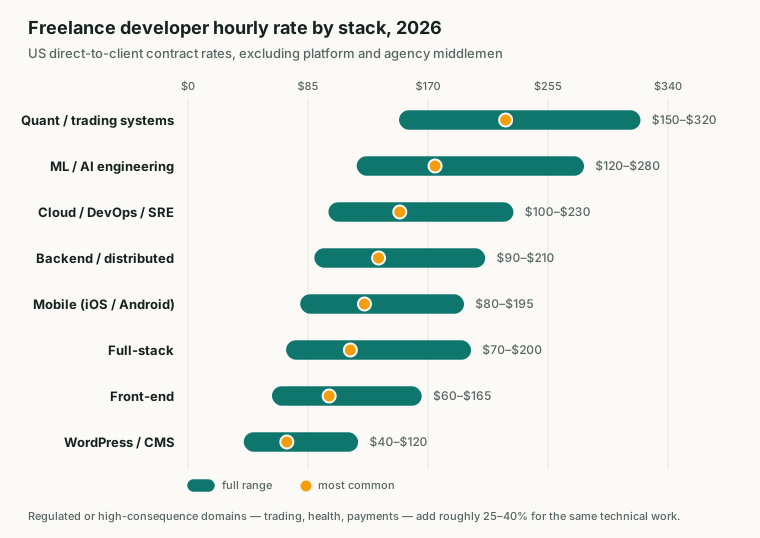
Eight stacks, low to high, with the most common rate marked in gold. The spread inside each band is the interesting part.
| Stack | Low | Typical | High |
|---|---|---|---|
| Quant / trading systems | $150 | $225 | $320 |
| ML / AI engineering | $120 | $175 | $280 |
| Cloud / DevOps / SRE | $100 | $150 | $230 |
| Backend / distributed systems | $90 | $135 | $210 |
| Mobile (iOS / Android) | $80 | $125 | $195 |
| Full-stack | $70 | $115 | $200 |
| Front-end | $60 | $100 | $165 |
| WordPress / CMS | $40 | $70 | $120 |
The domain multiplier
Stack explains less of the spread than people assume. Domain explains more.
The same backend engineer, writing the same quality of Go, is priced differently depending on what breaks when it breaks:
| Domain | Multiplier on base stack rate | Why |
|---|---|---|
| Trading, payments, health records | 1.25 – 1.40× | Regulated; defects have immediate quantified cost; audit and compliance obligations |
| Enterprise internal systems | 1.10 – 1.25× | Procurement, security review, long approval chains — the overhead is priced in |
| Funded startup product | 1.00× (baseline) | Speed valued; risk tolerance high; budget finite but real |
| Agency subcontract | 0.60 – 0.75× | The agency carries the client relationship and takes the margin for it |
| Platform marketplace | 0.35 – 0.55× | Competing on price against a global pool with no relationship context |
A full-stack developer at the $115 typical mark is billing $144 on a payments product and $63 through an agency. That is the same person, the same week, the same code. It is the most consequential pricing decision most developers never consciously make.
Why software should rarely be fixed-bid
There is a strong argument for project pricing in most freelance disciplines — you keep the upside of your own speed. Software is the discipline where that argument is weakest, and it is worth being explicit about why.
Software estimates are unreliable in a structurally asymmetric way. They are almost never wrong in your favour. Integration surprises, an undocumented API, a stakeholder who appears in week three with opinions, a legacy schema nobody warned you about — every one of these adds hours, and none of them subtracts any. When you fixed-bid, you have agreed to absorb an entire category of risk that you cannot inspect before quoting.
Watch what that does to a $12,000 fixed bid estimated at 90 hours:
| Actual hours | Effective hourly | Outcome |
|---|---|---|
| 80 | $150 | You won the estimate |
| 90 | $133 | As planned |
| 120 | $100 | Squeezed but fine |
| 160 | $75 | Below most developers' floor |
| 210 | $57 | You are subsidising the client |
The 210-hour column is not a hypothetical; it is what happens when a "simple integration" turns out to involve an undocumented legacy system. Hourly vs project pricing works through when fixed fees do make sense, and the honest answer for software is: repeatable work you have shipped five or more times, with a written scope and a change-order clause.
The better middle ground for most engagements is weekly or sprint billing. The client gets a predictable number to budget against; you get paid for the weeks the work actually takes. A defined scope per sprint gives both sides the certainty that a fixed bid was supposed to provide, without transferring every unknown onto you.
Building your floor
Before you use any of the tables above, calculate the number below which the work does not pay. It is specific to you, and it is usually higher than developers expect because software carries real overhead.
A worked example for a mid-level backend developer:
- Take-home target: $115,000
- Tax gross-up at a 30% effective load: $115,000 ÷ 0.70 = $164,286
- Annual expenses: $9,400 — a machine on a three-year cycle, cloud and dev tooling, professional liability insurance, accounting, a conference, subscriptions
- Buffer at 12%: +$20,842
- Running total: $194,528
- Realistic billable hours: 1,150 (see how many hours do freelancers work for why this is not 2,080)
- Floor rate: $169 an hour
That developer cannot take agency subcontract work at $85 and call it a business. They can take it as pipeline filler in a slow quarter, knowing it is subsidised by the direct work — but only if they know the number. The freelance rate calculator formula walks the same arithmetic step by step, and the rate calculator will do it with your figures.
Retainers and why most developers should have one
Project work has a structural problem for developers: it ends. A month with two projects and a month with none average out to a fine year and feel like two different lives, and the gap is where developers accept work below their floor out of nervousness rather than arithmetic.
Retained maintenance is the usual fix, and it is priced differently from project work because you are selling availability as well as hours.
| Retainer shape | Typical monthly | What the client is buying |
|---|---|---|
| Maintenance, best-effort | $2,500 – $4,000 | Dependency updates, small fixes, no response guarantee |
| Maintenance + SLA | $4,000 – $6,500 | Same, plus a guaranteed response window |
| Embedded, 1–2 days/week | $6,000 – $10,000 | Reserved capacity, sprint participation, code review |
| On-call, critical systems | $8,000 – $15,000 | Out-of-hours availability and incident response |
Two pricing notes that developers get wrong more than any other discipline.
Price the response window separately. A four-hour guaranteed response has a cost in months where nothing breaks, because it constrains where you can be and what else you can commit to. That constraint is the product. Charging only for hours used means a quiet month pays you nothing for a promise you kept the whole time.
Do not discount below 20 hours a month. Small retainers cost more per hour to service, not less: the context reload on a codebase you last touched five weeks ago is real work. Anything under 20 hours should carry a premium over your standing rate. Freelance retainer rates has the full hour-band logic.
The salary comparison developers get wrong
A very common message: "I make $140,000 as a staff engineer, so $70 an hour freelance is the same, right?"
No, and the gap is large.
| Line item | Employed at $140k | Freelance equivalent |
|---|---|---|
| Base | $140,000 | must be replaced |
| Employer payroll tax share (7.65%) | paid by employer | +$10,710 you now pay |
| Health insurance for a family | mostly employer-funded | +$14,000 to $22,000 |
| 401(k) match at 4% | +$5,600 | you fund it |
| Equipment, tooling, software | employer-provided | +$4,000 to $9,000 |
| Paid time off, sick leave, holidays | ~25 days paid | unpaid |
| True replacement cost | $140,000 | ~$180,000 to $190,000 |
At 1,150 billable hours, $185,000 requires $161 an hour — not $70. The naive salary-÷-2,080 conversion produces $67, which is off by 2.4×. Freelance hourly rate from salary does this conversion in full with a worked example.
This is not an argument that freelancing pays worse. It is an argument that the comparison has to be like for like, and that developers who convert naively spend their first year confused about why a "raise" left them poorer.
Where the top of each band comes from
The developers I know at the top of their band share three things, and none of them is raw technical skill relative to their peers.
They own an outcome, not a ticket. "I will take responsibility for your checkout reliability" prices differently from "I will implement these stories." Ownership is the single largest jump available.
They are legible to non-engineers. Being able to explain a trade-off to a CFO in one sentence is worth more, in rate terms, than most technical depth. It is what turns a contractor into an advisor.
They have a named domain. Not "backend" — "high-volume subscription billing," "HIPAA-compliant data pipelines," "Shopify Plus performance." A named domain is what lets a client believe the premium is justified rather than negotiated.
If you want a second reference point built from a different methodology, the US Bureau of Labor Statistics publishes occupational data for software developers that is useful as a floor sanity-check — bearing in mind it measures employment, so freelance rates should sit meaningfully above the implied hourly figures once benefits and unpaid time are accounted for.
The compressed version: US freelance developer hourly rates in 2026 run from about $40 for CMS work to $320 for quantitative systems, with most competent generalists between $100 and $150. Domain moves your rate more than stack does, weekly billing beats fixed bids for most software, and the number that matters is the floor you calculate from your own costs — not the median of somebody's survey. Run yours here before you quote anything.
Questions people ask
- What is the industry standard hourly rate for a software freelancer?
There is no single standard, but the centre of the US direct-to-client market in 2026 is roughly $115 to $150 an hour for a competent full-stack or backend developer. Front-end sits nearer $100, specialised infrastructure and ML work runs $150 to $225, and CMS work sits at $70. Platform rates are materially lower than all of these.
- Why do quant and trading developers charge so much more?
Consequence, not difficulty. In trading systems a defect has an immediate, quantifiable cost, the hiring pool is small, and engagements often carry compliance and confidentiality obligations. Clients are pricing risk transfer as much as engineering time — which is why the same person writing a marketing site would earn a third of the rate.
- Should a freelance developer bill hourly or per sprint?
Hourly or per-week is usually safer for software than fixed project fees, because software estimates are famously unreliable and the freelancer absorbs every unknown in a fixed bid. Weekly or sprint-based billing gives the client budget predictability without transferring all the estimation risk to you.
- How much should a junior freelance developer charge?
Calculate a floor from your income target, expenses, and realistic billable hours rather than picking a percentage of a senior rate. Most juniors who do this arrive at $55 to $75, which is well above the $25 to $40 platform market — and that gap is exactly why building direct client relationships matters more than portfolio volume early on.
- Do freelance developers get paid more than employed developers?
Per hour, almost always. Per year, often not, until rate and utilisation are both solid. A $130 hourly rate at 1,100 billable hours is $143,000 gross, from which tax, health insurance, retirement, equipment, and unpaid time all come out — costs an employer previously absorbed. Comparing an hourly rate to a salary without that adjustment overstates the gap badly.
- What is a reasonable retainer for ongoing development support?
Maintenance and on-call retainers typically run $2,500 to $8,000 a month depending on response-time commitments and the criticality of the system. Price the availability separately from the hours — a guaranteed four-hour response window has a cost even in months where nothing breaks.
Put these numbers to work
Use the free freelance rate calculator to turn this into your own hourly rate in under a minute.
Open the calculatorKeep reading
More in Rate Benchmarks, or browse all guides.
Freelance designer hourly rate bands for 2026 across eight specialties, and why the spread inside one discipline beats the gap between disciplines.
ReadHow many hours do freelancers work each week? Four real working patterns, the billable share of each, and why billable hours plateau near 26.
ReadFreelance writer hourly rate bands from the real market: the content mill floor, generalist and specialist ranges, and per-word vs hourly math.
ReadHow to measure rate of pay for freelancers if you're the one hiring: a 5-step framework for benchmarking rates, converting to loaded cost, and tracking ROI.
ReadUse a freelance rate calculator automotive pros trust. Real hourly ranges by specialty, hidden expenses, and a worked rate-floor example for auto work.
ReadFreelance completion rate benchmarks by platform and industry. Learn how delivery rate differs from completion rate—and how both affect what you can charge.
Read