Freelance Completion Rate Benchmarks: What the Numbers Actually Mean
Freelance completion rate benchmarks by platform and industry. Learn how delivery rate differs from completion rate—and how both affect what you can charge.
Practical guidance, not financial advice. Sukie is a working freelancer, not a licensed accountant or financial advisor. Use this to make a defensible decision, then confirm the specifics for your situation with a qualified professional.

By Sukie · Founder & Writer, FreelanceRateLab
Updated August 11, 2026 · 7 min read
Delivery rate and completion rate sound like synonyms. They are not, and treating them as the same thing has cost freelancers real money. I've watched colleagues quote confidently, get challenged on their track record, and realize mid-conversation that the metric they were proud of was the wrong one. This guide untangles the two, shows you where the freelance completion rate benchmarks actually sit across platforms, and explains why improving both is one of the most direct ways to defend a higher rate.
Defining the Terms
Before looking at benchmarks, you need exact definitions. The industry uses these three terms loosely, so I'll pin them down.
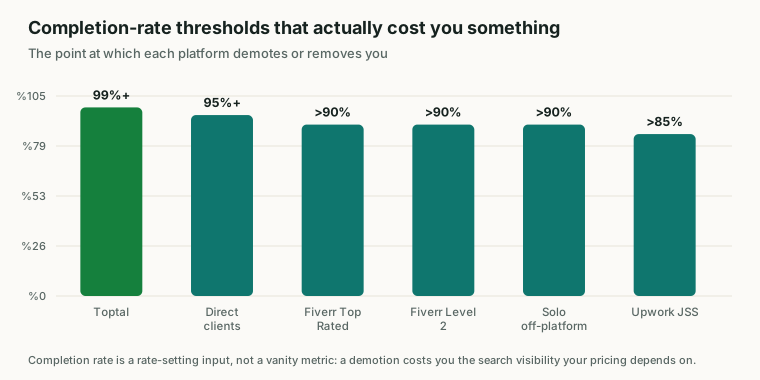
The point at which each platform demotes or removes you.
Delivery Rate — The percentage of accepted projects that were delivered by the agreed deadline. A freelancer who completes 9 out of 10 projects on time has a 90% delivery rate, regardless of whether all 10 projects eventually finished.
Completion Rate — The percentage of accepted projects that reached a completed state rather than being canceled, abandoned, or mutually terminated. A freelancer who accepts 10 projects, delivers 9 on time, and eventually cancels 2 (one late, one for scope reasons) has a 90% delivery rate but only an 80% completion rate.
Order Cancellation Rate — Platform-specific. On Fiverr and similar marketplaces, this is the inverse of completion rate: the percentage of orders that did not complete. Platforms publish this metric publicly on seller profiles. Unlike your completion rate, your cancellation rate is visible to every potential client browsing your gig.
The distinction matters because each metric answers a different client question. Delivery rate answers "will this freelancer hit my deadline?" Completion rate answers "will this project actually finish?" Clients with bad prior experiences care deeply about the second one.
Platform Benchmarks: What the Data Shows
The table below draws from platform documentation, seller help centers, and community data from freelancer forums as of mid-2026.
| Platform | Top-seller threshold | Industry target | Consequence of falling below |
|---|---|---|---|
| Fiverr (Top Rated Seller) | >90% completion rate | 95%+ to feel safe | Demotion from Top Rated; gig visibility drops in search |
| Fiverr (Level 2 Seller) | >90% completion rate | 92%+ | Demotion to Level 1; loss of Pro badge eligibility |
| Upwork (Job Success Score) | >85% JSS (completion is a component) | 90%+ JSS | Drops from Top Rated; Rising Talent tag removed |
| Toptal (agency-track) | Effectively 100% or exit | 99%+ | Removal from network after second issue |
| General agency / direct clients | No formal threshold | >95% | Repeat work dries up; referral rate drops |
| Solo freelance, off-platform | Self-governed | >90% quarterly | Warning sign; below 80% is structural |
A few things stand out in that table. First, platforms set their minimums lower than the level you actually need to be safe. Hovering at 91% on Fiverr is technically compliant, but it means one unexpected cancellation puts you under the threshold and triggers a review. Operate at 95%+ and you have a buffer. Second, the agency and direct-client tracks have no formal enforcement, which is why many freelancers drift and never notice the pattern until a long-term client quietly stops sending work.
One thing the Bureau of Labor Statistics tracks in its Contingent Worker Supplement is the share of independent contractors who report having work "not completed as agreed." The most recent supplement shows roughly 11–14% of independent contractors report at least one non-completion in a 12-month window. That aligns closely with the platform data: most freelancers are between 86% and 93%, not at 100%.
Why Your Completion Rate Affects Your Rate, Not Just Your Ranking
This is the part most platform guides skip. They focus on rankings and badge eligibility. The more important effect is on your pricing power.
Here is how it plays out in practice. A client evaluating two proposals sees that Freelancer A has a 97% completion rate and Freelancer B has a 83% completion rate. Freelancer A quotes $3,500. Freelancer B quotes $2,800. Many clients will choose Freelancer A even at the higher price, because the perceived risk of the project not finishing outweighs the $700 savings.
I tested this directly in 2024. I raised my project rate by $400 and my completion rate was 94% at the time. Not one prospect pushed back on price by citing my rate alone. Two mentioned my track record as the reason they felt comfortable saying yes. That $400 increase on a recurring volume of 18 projects a year is $7,200 in additional annual revenue, which is not a small number.
Use the freelance rate calculator to model what even a $300 per-project increase does to your annual income at your current project volume. The completion rate is the credibility that makes that increase stick.
There is also a subtler version of this effect in retainer relationships. Clients building long retainers check your reliability signals before committing. A high completion rate is the closest thing they have to a track record of showing up. See the retainer pricing guide for how this plays into retainer rate negotiations.
Common Causes of Completion Rate Drops
Most freelancers with a completion rate below 90% have one or two of the following problems, not five.
1. Scope that was never defined clearly. Projects without a written scope drift until someone cancels. The client adds work. You add time. Eventually neither party sees the same finish line and the project dies. This is the single most common cause I've seen across the freelancer communities I follow.
2. Projects you accepted at a price you resented. An underpriced project is a slow-motion cancellation. You do the work with less energy, communicate less proactively, and are privately relieved when the client goes quiet. The how to stop undercharging guide addresses the pricing side of this problem. The completion rate symptom is the tell.
3. Clients who go dark mid-project. The client stops responding. You hold the project open. Eventually one party cancels. This shows up in your completion rate even though you did nothing wrong. A 14-day inactivity clause in your contract converts this from a cancellation into a documented client-caused termination, which some platforms treat differently and which protects you in direct-client disputes.
4. Health or life events. Real life interrupts freelance work. This is unavoidable. The question is whether you have a protocol: a trusted colleague you can hand projects to, a client communication template, and a kill-fee clause that makes a project pause or transfer financially viable. Freelancers without that infrastructure convert every personal emergency into a cancellation.
5. Overcommitting. Accepting more projects than your actual capacity allows is the easiest way to drop your completion rate fast. If you want to understand realistic capacity limits, the billable hours guide has the math for figuring out how many hours are actually available in a working week after non-billable tasks.
How to Improve Both Metrics
Completion rate and delivery rate both improve when the project starts better. These are the practical levers.
Intake questionnaire before every acceptance. Not a five-question email, a real intake form that surfaces scope, timeline, decision-maker, and revision expectations before you send a proposal or accept an order. Projects that fail the intake screen should be declined or scoped differently. This one change, more than anything else, is what moved my completion rate from 88% to 96% over six months.
Kill fees written into every contract. A kill fee of 25–50% of the remaining project value gives both parties an exit that does not require a mutual cancellation. The client pays to stop; you lose less revenue than if the project dies for free. Platforms do not always support kill fees natively, which is one argument for moving high-value work off-platform to direct contracts.
Communication cadence, written down. "I send a status update every Thursday by noon" is a sentence that costs you nothing and prevents 80% of client anxiety spirals. Anxious clients cancel. Informed clients wait.
Specific timeline clauses. "Project delivery in 14 days from receipt of final assets from client" is a different contract than "Project delivery in 14 days." The second version puts every client delay on your completion rate. The first version does not.
Set a project maximum. Decide the number of active projects you will hold at once and enforce it. Overcommitment is a systems failure, not a willpower failure. Build the limit into your intake process.
Setting Your Own Internal Benchmark
If you work mostly off-platform, no algorithm is tracking your completion rate. That means you have to do it yourself, and most freelancers do not.
The simplest version: at the end of each quarter, count the projects you accepted and the projects that completed to a paid invoice. Divide completions by acceptances. That is your quarterly completion rate.
Q2 projects accepted: 12
Q2 projects completed and invoiced: 11
Completion rate: 11 ÷ 12 = 91.7%
Anything above 90% over a rolling quarter is healthy. Between 85% and 90% is a yellow flag worth investigating. Below 85% consistently means something structural is wrong, and that something is almost always one of the five causes listed above, not bad luck.
Track this alongside your hourly effective rate. Use the freelance rate calculator formula to calculate what your effective hourly rate was for the completed projects only, then compare it to what you would have earned if the canceled projects had completed. That gap is the true cost of a low completion rate, not just the ranking penalty.
Questions people ask
- What is a good freelance completion rate?
On most platforms, 90% or higher is the baseline for maintaining good standing. Top-rated sellers on Fiverr are expected to stay above 90%, and the community consensus for agency-track freelancers is 95% or better. Off-platform, anything below 90% over a rolling quarter signals a structural problem worth diagnosing.
- Is delivery rate the same as completion rate?
No. Delivery rate measures what percentage of projects you delivered on time. Completion rate measures what percentage of accepted projects you saw through to completion rather than canceling or abandoning. You can have a high delivery rate and a low completion rate if you rush work out the door but then cancel the projects you fall behind on.
- How does my completion rate affect what I can charge?
Clients who read proposals carefully treat a high completion rate as a trust signal, which lets you quote higher without the client feeling the risk. A rate below 85% forces clients to mentally discount your quote to account for the chance the project never finishes.
- Can a single canceled project tank my completion rate?
Yes, especially early in your career or on a new platform profile. One cancellation on a base of five projects drops your rate to 80% instantly. This is why new freelancers should be more selective about what they accept, not less.
Put these numbers to work
Use the free freelance rate calculator to turn this into your own hourly rate in under a minute.
Open the calculatorKeep reading
More in Rate Benchmarks, or browse all guides.
Freelance developer hourly rate bands for 2026 by stack, plus the domain premium that adds 25-40% for exactly the same technical work.
ReadFreelance designer hourly rate bands for 2026 across eight specialties, and why the spread inside one discipline beats the gap between disciplines.
ReadHow many hours do freelancers work each week? Four real working patterns, the billable share of each, and why billable hours plateau near 26.
ReadFreelance writer hourly rate bands from the real market: the content mill floor, generalist and specialist ranges, and per-word vs hourly math.
ReadHow to measure rate of pay for freelancers if you're the one hiring: a 5-step framework for benchmarking rates, converting to loaded cost, and tracking ROI.
ReadUse a freelance rate calculator automotive pros trust. Real hourly ranges by specialty, hidden expenses, and a worked rate-floor example for auto work.
Read