Freelance Designer Hourly Rate — What Design Actually Pays in 2026
Freelance designer hourly rate bands for 2026 across eight specialties, and why the spread inside one discipline beats the gap between disciplines.
Practical guidance, not financial advice. Sukie is a working freelancer, not a licensed accountant or financial advisor. Use this to make a defensible decision, then confirm the specifics for your situation with a qualified professional.

By Sukie · Founder & Writer, FreelanceRateLab
Published August 31, 2026 · 8 min read
Freelance designer hourly rate questions almost always arrive in the same shape: someone has been quoted a number, or has been asked for one, and wants to know whether it is sane. The honest answer is that "sane" covers a range of about 7× within design, and that the widest part of that range sits inside single specialties rather than between them.
The bands
These are US direct-to-client rates for independent designers in 2026 — not platform rates, not agency salaries divided by 2,080, and not what a studio charges its clients for your time.
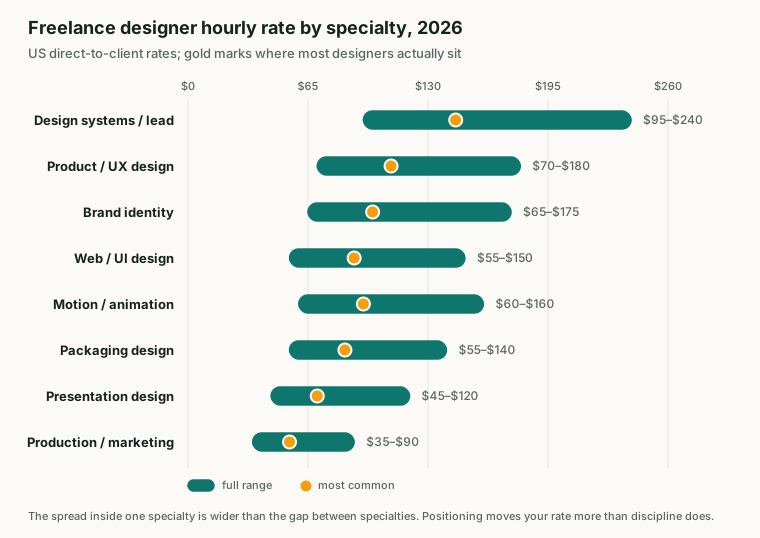
Eight design specialties. The gold marker is where most designers in that band actually sit.
| Specialty | Low | Typical | High |
|---|---|---|---|
| Design systems / design lead | $95 | $145 | $240 |
| Product / UX design | $70 | $110 | $180 |
| Brand identity | $65 | $100 | $175 |
| Motion / animation | $60 | $95 | $160 |
| Web / UI design | $55 | $90 | $150 |
| Packaging design | $55 | $85 | $140 |
| Presentation / deck design | $45 | $70 | $120 |
| Production / marketing design | $35 | $55 | $90 |
The gap between the bottom row and the top row is roughly 2.7× at the typical mark. The gap between the low and high end of product design alone is 2.6×. That is the point of this entire page: two designers doing the same category of work, in the same country, in the same year, differ by as much as an entire discipline shift would give them.
So the useful question is never "what does a designer charge?" It is "what puts a designer at the top of their own band?"
What actually moves you up your band
I have hired freelance designers for my own work three times and been on the other side of the table considerably more often. Four things move the number, in descending order of how much they move it.
Whether the outcome is measurable. A designer who can say "the last three checkout redesigns I did moved conversion by 6%, 11%, and 4%" is not in the same market as one who shows beautiful screens. Measurable outcomes are why conversion-adjacent design (product, UX, CRO-facing web work) sits above equally skilled craft-heavy design like packaging. It is not fairness; it is that the client can do arithmetic on the value.
Whether you carry ambiguity. Being handed a brief and executing it is a different job from being handed a problem and returning a brief. The second one is design leadership, and it is most of the difference between the $90 row and the $145 row. Nothing else in this list compounds as fast.
Who the client is. The same brand identity project is $6,000 from a local business, $18,000 from a funded startup, and $45,000 from an enterprise with a procurement process. The work is not three times harder. The consequence of getting it wrong is.
Specialisation, narrowly defined. "I design for B2B SaaS onboarding" beats "I do UX" by a wide margin, and it beats it fastest in the first three years of a career, when there is nothing else to differentiate on. This is the same effect freelance writer hourly rate documents on the writing side — the jump from generalist to specialist there is about 70%, and design behaves almost identically.
Notice what is not on that list: years of experience, software proficiency, and portfolio beauty. All three matter for getting hired. None of them, on their own, moves the rate much.
Building your own number instead of picking one off the table
Benchmarks tell you whether you are within range. They cannot tell you whether you can survive on a number, because they know nothing about your expenses, your tax situation, or how much of your week is sellable.
Run your own floor first, then check it against the table. The arithmetic is:
- Take-home target — the money you need in your account for the year.
- Gross it up for tax. Divide by (1 − effective tax rate). For a US freelancer, 0.72 is a reasonable working assumption pending a conversation with an accountant.
- Add annual business expenses. Design carries real ones: Adobe or Figma seats, fonts, stock, a colour-accurate display, hardware on a three-year cycle. $4,000–$9,000 is common.
- Add a buffer of 10–15% for slow months.
- Divide by realistic billable hours — 1,000 to 1,300 for a full-timer, not 2,080.
A designer wanting $80,000 take-home, with $6,500 of expenses and 1,150 billable hours, needs: $80,000 ÷ 0.72 = $111,111, plus $6,500 = $117,611, plus 12% = $131,724, ÷ 1,150 = $115 an hour.
That designer is a product designer at the typical mark, a web designer at the top of their band, or a production designer who is, mathematically, in the wrong specialty for the life they want. The number is not negotiable with reality — only the specialty and the hours are. The freelance rate calculator runs this in about a minute if you would rather not do it by hand, and the freelance rate calculator formula walks the same maths with a worked example.
What clients are actually comparing you against
A useful thing to know when you are quoting: the client almost never has another freelance designer's rate in their head. They have one of three other numbers, and which one changes how your figure lands.
An agency quote. If they have spoken to a studio, your number will look cheap. A design agency billing a mid-level designer's time charges $180–$300 an hour, because that rate carries account management, a creative director's oversight, overhead, and margin. Against that anchor, $115 reads as good value — and it is worth naming the comparison out loud rather than assuming they have made it.
A salary divided badly. "We could hire a designer for $85,000, that's $41 an hour." This is the most damaging anchor and the easiest to dismantle, because it is simply wrong: $85,000 of salary is roughly $118,000 of loaded cost, and an employed designer is not billable for all 2,080 hours either. Freelance hourly rate from salary does that conversion properly, and it is worth being able to run it in one breath.
A marketplace listing. If their reference point is a $25 gig, you are not going to win the conversation on price and should not try. That is a different market buying a different thing.
Knowing which anchor you are up against is most of the work. Ask early — "have you worked with a freelance designer before, or is this usually handled in-house?" — and you will hear it in the answer.
The two rates every designer should have
Most designers have one number, which is why they get squeezed. Have two.
Your standing rate is what appears in proposals for well-defined work with a reasonable client. It sits at the typical mark of your band, or above it once you can name outcomes.
Your floor is the number below which the work is a net loss once unbillable time and tax are counted. It is usually 30–40% below the standing rate. You do not publish it, you do not negotiate towards it, and you use it for exactly one purpose: knowing, instantly and without emotion, when to say no.
The most useful thing I did for my own pricing was writing the floor on a sticky note. Not because I ever quoted it — because on the calls where I felt pressure, I had already decided.
For the mechanics of moving from your current number to your standing rate without losing the roster, how to raise freelance rates has the timing and the scripts. If you suspect your current number is below your floor and have not checked, how to stop undercharging as a freelancer is the faster diagnostic.
Where hourly stops being the right unit
Hourly billing punishes designers specifically, and more than most disciplines, because design speed improves dramatically with experience. A brand mark that took you 30 hours in year one takes 9 in year six, and hourly billing hands the entire benefit of that improvement to the client.
Three signals that you have outgrown hourly for a given piece of work:
- You have done this exact category of project more than five times and your estimates are now accurate within 20%.
- The client cares about the outcome, not the process, and has never asked for a timesheet.
- You are noticeably faster than average at this specific thing.
When all three are true, quote a project fee built from your hourly baseline and keep the efficiency. When none are true — new client, fuzzy brief, a stakeholder who has not been named yet — bill hourly and let the client carry the scope risk. Hourly vs project pricing works through the decision case by case, and project-based vs hourly rate covers the contract mechanics.
A note on the low end
The $35 row is real, and it is where a lot of design work is actually transacted, particularly through platforms. I want to be direct about what it means rather than pretend it does not exist.
At $35 an hour with 1,150 billable hours, gross revenue is $40,250. Subtract $5,000 of design-specific expenses and a 28% effective tax load and take-home is around $25,380 — before health insurance, in the US. That is not a viable full-time business; it is a subsidised apprenticeship, and it only makes sense if something else is subsidising it and there is a defined exit.
If you are there, the exit is not "work harder." Billable hours have a ceiling of about 25 a week for structural reasons (how many hours do freelancers work covers why). The exit is specialisation, then outcomes, then a rate conversation. Usually in that order, usually over 12 to 18 months.
The AIGA's long-running design salary and rate research is worth reading alongside these bands if you want a second source with a different methodology — it surveys employed designers as well as independents, which is a useful corrective to freelance-only figures.
The short version: a freelance designer hourly rate in 2026 runs from about $35 to about $240, most independents sit between $70 and $145, and where you land inside that has more to do with measurable outcomes and carried ambiguity than with years or software. Work out your own floor before you look at anyone's benchmark — the calculator on the homepage will give you the number in a minute — then use the table above to check whether the market can support it.
Questions people ask
- What is a basic hourly rate for a freelance designer?
For general production and marketing design in the US market, $35 to $55 an hour is the entry band and $70 to $90 is where competent generalists sit. Below $35 you are almost certainly working below your own cost of business once tax, unbillable time, and software are counted.
- Do designers charge hourly or per project?
Most experienced designers quote projects and calculate them from an hourly baseline they never show the client. Hourly billing is more common for open-ended work, retainer support, and revisions on someone else's design. The baseline matters either way — a flat fee quoted without one is a guess.
- How much should a beginner freelance designer charge?
Start from your own cost floor rather than from a percentage of someone else's rate. Calculate the rate you need from your income target, expenses, and realistic billable hours, then position at the low end of your specialty band rather than below it. Beginners who anchor below the band rarely climb out of it.
Put these numbers to work
Use the free freelance rate calculator to turn this into your own hourly rate in under a minute.
Open the calculatorKeep reading
More in Rate Benchmarks, or browse all guides.
Freelance developer hourly rate bands for 2026 by stack, plus the domain premium that adds 25-40% for exactly the same technical work.
ReadHow many hours do freelancers work each week? Four real working patterns, the billable share of each, and why billable hours plateau near 26.
ReadFreelance writer hourly rate bands from the real market: the content mill floor, generalist and specialist ranges, and per-word vs hourly math.
ReadHow to measure rate of pay for freelancers if you're the one hiring: a 5-step framework for benchmarking rates, converting to loaded cost, and tracking ROI.
ReadUse a freelance rate calculator automotive pros trust. Real hourly ranges by specialty, hidden expenses, and a worked rate-floor example for auto work.
ReadFreelance completion rate benchmarks by platform and industry. Learn how delivery rate differs from completion rate—and how both affect what you can charge.
Read