Freelancer Performance Metrics
Freelancer performance metrics that change decisions: six numbers with formulas, what each means when it moves, and three popular ones worth ignoring.
Practical guidance, not financial advice. Sukie is a working freelancer, not a licensed accountant or financial advisor. Use this to make a defensible decision, then confirm the specifics for your situation with a qualified professional.

By Sukie · Founder & Writer, FreelanceRateLab
Published October 24, 2026 · 9 min read
Which freelancer performance metrics would tell you the most about your business if you could only look at one?
Most people answer with revenue, and revenue is the one that tells you least. It is an outcome, it arrives too late to act on, and it hides every mechanism that produced it. A year where you earned $95,000 by working 60-hour weeks at a poor rate and a year where you earned $95,000 comfortably look identical in that number and are not remotely the same business.
Below are six metrics that actually change decisions, each with its formula, what it means when it moves, and roughly where it should sit. Then three popular ones I have stopped tracking, and why.
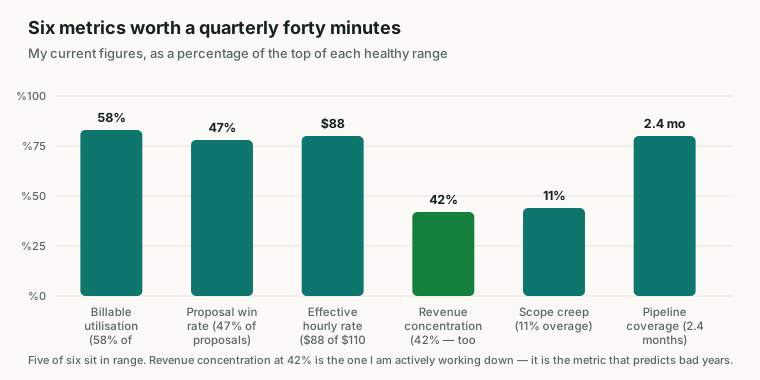
The six metrics below, with my own current figures against the ranges I aim for.
The six that change decisions
1. Effective hourly rate
Formula: total revenue ÷ total hours worked (not billed — worked).
This is the master metric and the most uncomfortable one, because it includes every hour you spent on proposals that went nowhere, admin, chasing invoices and scope you did not charge for.
Your quoted rate might be $120. Your effective hourly rate is what you are actually paid for being at work, and the gap between the two is the real state of your business. Mine sat at $61 against a $110 quoted rate the first time I measured it — a 45 percent gap, almost all of it unbilled revisions and proposals.
Watch the direction rather than the absolute. Rising effective rate with flat revenue means you got more efficient. Falling effective rate with rising revenue means you bought that revenue with unpaid hours, which is the most common way a busy freelance year turns out to be a bad one.
2. Billable utilisation
Formula: billable hours ÷ total working hours.
Healthy sits between 50 and 70 percent for most solo freelancers. Below 45 percent means you are spending too much of the week on things nobody pays for. Above 75 percent sustained is usually not admirable — it typically means business development has stopped, which shows up as a hole in the pipeline three months later.
The reason this metric matters more than raw hours is that it sets your rate. A rate calculated on 2,080 hours when you bill 1,100 is wrong by a factor of nearly two, and that single error is behind more underpricing than any amount of low confidence. Billable hours explained goes through where the non-billable time actually goes, and realistic billable hours per day covers the daily version.
3. Revenue concentration
Formula: largest client's revenue ÷ total revenue.
Above 50 percent from one client, you do not have a freelance business — you have an uncontracted job with none of the protections. Above 35 percent is worth actively working down.
This is the metric that predicts bad years most reliably, and it is invisible in a good one. Everything looks excellent right up until the client restructures, and then two-thirds of your income disappears in a single email. I check this quarterly and treat anything over 40 percent as a prompt to do outreach even when I am busy — especially when I am busy, since that is when the pipeline gets neglected.
4. Proposal win rate
Formula: proposals accepted ÷ proposals sent.
Counterintuitive to read: a high win rate is not good news. Above 80 percent almost always means underpricing — you are winning everything because you are the cheap option. Below 25 percent means either a targeting problem or a proposal problem.
The band I would aim for is 40 to 60 percent. Enough friction to know you are priced at the edge of what the market will bear, enough acceptance that you are not wasting weeks on proposals.
The useful pairing is win rate against effective hourly rate. Win rate falling while effective rate rises is a healthy trade and exactly what a rate increase should look like. Both falling means the increase went too far or landed on the wrong segment. This is worth measuring after any rate change — see when to raise freelance rates for the signals that suggest one is due.
5. Scope creep ratio
Formula: (actual hours − quoted hours) ÷ quoted hours, averaged across projects.
Under 10 percent is fine and normal. Persistently over 25 percent means your estimating or your scoping is broken, and it is worth knowing which.
Track it per client as well as overall, because the average conceals the problem. One client at 60 percent and five at 5 percent averages to a comfortable-looking 14 percent while one relationship quietly destroys your effective hourly rate. When I first split this by client, a single retainer was running at 70 percent overage and dragging my whole effective rate down by about $9 an hour.
The fix is usually not tighter contracts. It is quoting the revision round that always happens, rather than the one you hope for.
6. Pipeline coverage
Formula: value of live opportunities ÷ monthly revenue target.
Two to three months of coverage is comfortable. Below one month is an emergency regardless of how busy this week is, and the trap is that being busy is exactly when coverage drops, because nobody prospects while delivering.
This is the only forward-looking metric on the list. Every other number describes what already happened. Pipeline coverage is what lets you decline bad work, hold a rate in a negotiation and take a holiday — all three are functions of knowing what comes next, which is why it is worth the small discomfort of maintaining honestly.
Three I stopped tracking
Total hours worked
Interesting for wellbeing, useless for decisions. Hours only mean something against revenue and against billability, at which point you are looking at metrics 1 and 2 instead. On its own it mostly produces guilt or false pride depending on the direction, and neither changes what you do on Monday.
Number of clients
A vanity count that says nothing about the business underneath it. Twelve clients at $4,000 and three at $16,000 can be the same revenue with wildly different concentration risk, admin load and effective hourly rate. Revenue concentration answers the question that "number of clients" pretends to.
Social media followers
Unless you can trace enquiries to it — and most freelancers who look honestly cannot — this measures activity rather than outcome. The metric that matters is where enquiries actually come from, which for most people is referrals and past clients. Track the source of every enquiry for six months and the follower count stops feeling important.
Where the numbers actually come from
None of this needs software. It needs three records, all of which most freelancers already half-keep.
A time log covering every working hour, not just billable ones. This is the only genuinely new habit, and it is the one that makes metrics 1, 2 and 5 possible. Log in blocks of fifteen minutes against a project or against a category — admin, sales, learning. Precision matters far less than completeness; an honest rough log beats a meticulous one that quietly omits the two hours you spent on a proposal.
Your invoices. Revenue by client and by month, which gives you metric 3 directly.
A one-line note for every proposal sent. Date, client, value, outcome. That is metric 4, and it takes ten seconds per proposal. Almost nobody keeps this, which is why almost nobody knows their win rate.
One caution about the revenue figures: track them gross, and remember that gross revenue is not income. Self-employment tax alone is 15.3 percent before income tax, which the IRS sets out in its self-employed tax centre, so a rising effective hourly rate still has to clear tax and expenses before it reaches you. Comparing a freelance effective rate to an employed hourly wage without that adjustment overstates the comparison badly — freelance hourly rate from salary works through the conversion properly.
What changed when I fixed mine
The first honest quarter I measured came out badly enough that I nearly stopped measuring.
Effective hourly rate $61 against a $110 quoted rate. Utilisation 71 percent, which I had assumed was excellent and was actually a warning that no business development was happening. Revenue concentration 58 percent on one client. Scope creep averaging 31 percent, with one retainer at 70.
Three changes over the following two quarters. I started quoting the revision round that always happened instead of the one I hoped for, which cut scope creep to 14 percent. I re-scoped the 70 percent retainer at renewal — the client kept their monthly number and dropped a deliverable nobody read. And I deliberately let utilisation fall to about 58 percent by protecting one day a week for pipeline work.
Effective hourly rate went from $61 to $88. Revenue was almost flat. That is the entire point of measuring: the money did not change, and the business underneath it changed completely.
Making this a practice rather than a project
Six numbers, once a quarter, in about forty minutes. That is genuinely the whole commitment, and it needs nothing more sophisticated than a spreadsheet — time tracked per project, invoices, and a note of every proposal sent with its outcome.
The reason it works is not the precision. It is that measurement converts vague unease into a specific question. "This year felt hard" is not actionable. "My effective hourly rate fell $14 while revenue rose 8 percent, and scope creep on one client went from 12 to 48 percent" tells you exactly what to fix and roughly what it is worth.
Two of these feed directly into pricing. Utilisation sets the divisor in your rate calculation, and effective hourly rate tells you whether the rate you think you charge bears any relation to the one you receive. Run both through the rate calculator and you will usually find your floor is higher than your current price — which is the single most common finding across everything on this site. If it is, how to raise your rate covers what to do next, and calculating freelancer ROI extends the same measurement thinking to whether specific investments paid off.
A practical warning about frequency: monthly is too often. Freelance workloads are lumpy enough that a single large project or one quiet fortnight swings every ratio, and reacting to that noise leads to changing things that were working. Quarterly smooths it without letting a problem run for a year. The one exception is revenue concentration, which is worth a glance whenever you sign anything substantial, because that is the moment it moves.
Start with two rather than six if six sounds like a lot. Effective hourly rate and revenue concentration between them catch most of what goes wrong in a freelance business — one tells you whether the work is paid properly, the other tells you how exposed you are if it stops. Add the rest when those two stop surprising you.
The freelancers I know who are paid well are not working harder than the ones who are not. They are the ones who know their numbers, which means they know which conversation to have and when.
Put these numbers to work
Use the free freelance rate calculator to turn this into your own hourly rate in under a minute.
Open the calculatorKeep reading
More in Raising Your Rates, or browse all guides.
When to raise freelance rates, judged by signals instead of nerve: seven concrete triggers, the two that mean you are already late, and one that means wait.
ReadRaising freelance rates email template you can send today, plus variants for long-term, retainer and low-value clients, and the sentences that cost you it.
ReadFreelance rate negotiation without discounting: seven copy-paste scripts for the objections that actually come up, including hourly vs project fee.
ReadFreelance pricing psychology explains why your quoted rate lands below your calculated floor — anchoring, the silence reflex, and four repairs that hold.
ReadHow to raise freelance rates the calm way: a readiness checklist, a step-by-step playbook, and two copy-paste email scripts for new and existing clients.
ReadFreelance writing rates per word converted properly: what each band really pays hourly at honest output speeds, and when to quote a project fee instead.
Read