Freelance Hourly Rate From Salary: What the Conversion Really Looks Like
Freelance hourly rate from salary, converted honestly: gross up for self-employment tax, replace benefits, add expenses, and divide by real billable hours.
Practical guidance, not financial advice. Sukie is a working freelancer, not a licensed accountant or financial advisor. Use this to make a defensible decision, then confirm the specifics for your situation with a qualified professional.

By Sukie · Founder & Writer, FreelanceRateLab
Updated August 11, 2026 · 9 min read
A freelance hourly rate from salary is exactly what it sounds like: the hourly price you should charge as an independent worker to match, or beat, what a full-time salary was actually worth. The problem is the phrase "actually worth." A salary is not just the number on your offer letter. It's that number plus the payroll taxes your employer paid on your behalf, plus health insurance, plus a retirement match, plus paid time off, plus a laptop and software you never bought. Converting salary to an hourly rate means pricing in all of it, then dividing by the hours you can honestly bill, which is far fewer than you worked.
Most people skip all that and do one division: salary ÷ 2,080. It feels rigorous. It's a trap. This guide walks the whole conversion with a $95,000 salary as the worked example, ends with rule-of-thumb multipliers you can sanity-check against, and includes the story of the eight months I spent charging a number I'd reverse-engineered from that exact wrong division.
Why Salary ÷ 2,080 Is a Pay Cut in Disguise
The 2,080 figure is just 40 hours a week times 52 weeks. Divide $95,000 by it and you get $45.67 an hour, which sounds like a perfectly professional rate. Quote it, and you've signed up for a large, invisible pay cut. Three things are wrong with it, and each one compounds the others.
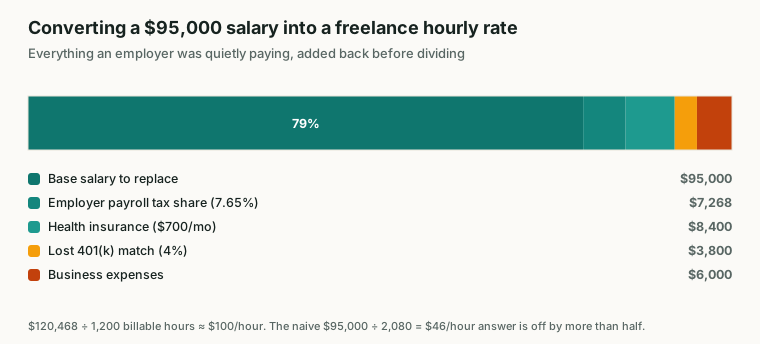
Everything an employer was quietly paying, added back before dividing by billable hours.
First, it assumes your paycheck was your whole compensation. It wasn't. Your employer was also paying its half of Social Security and Medicare, most of your health premium, and probably a retirement match — thousands of dollars that never appeared on your pay stub but were absolutely part of the deal.
Second, it assumes you'll pay the same taxes. You won't. Self-employed people pay both halves of Social Security and Medicare — the 15.3% self-employment tax the IRS explains here — where employees only ever saw half of it withheld.
Third, and biggest: it assumes you'll bill 2,080 hours. You will not bill anywhere close. Between finding clients, writing proposals, invoicing, unpaid revisions, and the weeks that simply don't fill, most full-time freelancers sell 1,100 to 1,300 hours a year. Our breakdown of realistic billable hours per day shows exactly where the other half of the week goes.
I learned this with real money. In March 2022 I left a content strategy job paying $72,000, divided by 2,080 on the back of a grocery receipt, got $34.62, and generously rounded myself up to $35 an hour. I felt scrappy and fair. By November — eight months in — I'd grossed about $27,400, was paying $610 a month for a health plan worse than my old one, and had just gotten my first quarterly tax reality check. When I finally ran the honest conversion, my break-even number was about $66 an hour. I had been working full-time weeks at a 47% discount to my old life and calling it freedom.
What Your Employer Was Quietly Paying For
Before any arithmetic, it helps to see the conversion as a shopping list. Going independent means personally buying back everything on it.
The employer half of payroll tax. Employers pay 7.65% of your salary in Social Security and Medicare taxes on top of what's withheld from you. As a freelancer, both halves are yours via self-employment tax. Adding 7.65% of the old salary is a clean way to gross up for that shift. (The real calculation has wrinkles — SE tax applies to 92.35% of net earnings and half of it is deductible — which is why freelance tax basics gets its own guide. For rate-setting, the approximation is close enough.)
Health insurance. The average employer covers the large majority of premiums. A solo plan bought on your own commonly runs $400 to $900+ a month depending on age, state, and coverage. Whatever your real quote is, it goes in the conversion.
Retirement match. A 4% 401(k) match on $95,000 is $3,800 a year of compensation that vanishes the day you resign. If you intend to keep saving at the same pace — you should — your rate has to fund it.
Paid time off. You don't add PTO as a dollar line, but it's why the billable-hours denominator shrinks: vacation, sick days, and holidays now come out of your own inventory of sellable hours.
Tools and overhead. Laptop, software, accounting, business insurance, a co-working desk. Modest for some fields, brutal for others, never zero.
Add the list up and a pattern emerges: the paycheck was maybe 75-80% of what your job actually cost your employer. That's the real reason a freelance hourly rate from salary comes out so much higher than intuition expects — you're not giving yourself a raise, you're just finally seeing the whole bill. Employers see this math every day; they call it "fully loaded cost" and budget for it without blinking. You're allowed to do the same.
Converting a $95,000 Salary, Line by Line
Here's the whole conversion in one table, using defensible middle-of-the-road figures. Swap in your own numbers — the structure is what matters.
| Step | Line item | Amount | Running total |
|---|---|---|---|
| 1 | Base salary to replace | $95,000 | $95,000 |
| 2 | Employer payroll tax share you now pay (7.65%) | +$7,268 | $102,268 |
| 3 | Health insurance you now buy ($700/mo) | +$8,400 | $110,668 |
| 4 | Lost 401(k) match (4% of salary) | +$3,800 | $114,468 |
| 5 | Business expenses (software, insurance, accounting, hardware) | +$6,000 | $120,468 |
| 6 | Divide by realistic billable hours (1,200/yr) | ÷ 1,200 | ≈ $100/hour |
Read that bottom line next to the naive answer. Salary ÷ 2,080 said $45.67. The honest freelance hourly rate from salary math says roughly $100 — about 2.2 times higher. That gap isn't greed. Every dollar of it maps to something your employer used to pay for or an hour you can't actually bill.
Two notes on the table. The $6,000 expense line is deliberately moderate; a designer with heavy software subscriptions or a consultant who travels will run higher, and if you charge $700 a month for health insurance in a state where your real quote is $950, the table will lie to you politely. Use your quotes, not mine.
Also notice what the table deliberately leaves out: regular income tax. That's on purpose. You paid income tax on your $95,000 as an employee too, so it's not a new cost of freelancing the way the employer payroll share is — it roughly washes out of the comparison. What doesn't wash out is cash-flow discipline: nobody withholds for you anymore, so a chunk of every invoice needs to move into a tax account the day it lands, or April will find you. The mechanics of set-asides and quarterly payments are the whole subject of the tax basics guide linked above.
And this version is intentionally the floor. It replaces your old compensation exactly, with no margin for slow months, late-paying clients, or growth. The fuller build — take-home goal, effective tax rate, buffer percentage — is worked end to end in the freelance rate calculator formula guide, and it's the version I'd run before quoting anyone. Think of today's table as the minimum viable conversion: fast, and already double what most people would have guessed.
The Denominator Decides Everything
Notice that steps 1 through 5 only moved the total about 27%. Step 6 is where the number explodes, because dividing by 1,200 instead of 2,080 is a 73% increase all by itself. Whoever controls the denominator controls the rate, so it deserves more scrutiny than any other input.
Here's the same $120,468 across three honest scenarios:
- 1,300 billable hours (strong pipeline, established client base): about $93/hour
- 1,200 billable hours (a solid full-time year): about $100/hour
- 1,100 billable hours (year one, still building a pipeline): about $110/hour
The uncomfortable implication: your first year, when your confidence is lowest, is precisely when your rate needs to be highest, because you'll bill the fewest hours. Most new freelancers do the opposite — discount because they feel unproven — and that's the mechanism behind my $35-an-hour year. If you're not sure which scenario is yours, track two or three normal weeks and count only the hours a client actually paid for. The number will humble you, and then it will price for you.
One more denominator case worth naming: partial-time freelancing. If you're converting a salary while planning to freelance twenty hours a week, don't halve the salary and then divide — halve the billable hours and keep every replacement cost that still applies to you. Health insurance doesn't get cheaper because you work less, and neither does your accounting software. This is where any freelance hourly rate from salary shortcut breaks down fastest, and why part-timers who skip the full math end up with rates that can't even cover their premiums.
Rule-of-thumb multipliers, with the fine print
If you want a gut-check without a spreadsheet, the folk wisdom is: take salary ÷ 2,080 and multiply by 1.5 to 2. For $95,000, that's a range of about $69 to $91 an hour. It's a genuinely useful ballpark, and here's how to pick within it — plus when to ignore it entirely.
When 1.5x is probably enough
You have low overhead, you're on a spouse's or partner's health plan, you weren't getting a retirement match, and your field lets you bill a high share of your hours (long retainers, few proposals). Under those conditions the cheap end of salary to freelance rate conversion can genuinely work, because you're not replacing much beyond the paycheck and the employer payroll tax.
When you need 2x or more
You're buying your own health insurance, replacing a match, carrying real tool costs, or billing closer to 1,100 hours than 1,300. Notice our fully-worked $95,000 example landed at 2.2x — above the classic range — and it wasn't padded anywhere. That's the honest caveat about multipliers: they were coined when benefits were cheaper, and for anyone replacing a full benefits package today, 2x is the floor of the range, not the ceiling. Use the multiplier to spot a wildly wrong quote, not to set your actual rate.
Sanity-Check the Number, Then Actually Quote It
Once you have your converted rate, test it against reality from two directions.
Against the market: the BLS Occupational Employment and Wage Statistics tables publish median and percentile wages by occupation, which tells you what employed people in your field earn — remembering that your freelance rate should sit well above the employee wage for all the reasons in this guide. If your converted number is 2x the employee median wage, you're not overpriced; you're arithmetically correct.
Against your own inputs: run your figures through our freelance hourly rate calculator — it's the freelance salary calculator version of everything above, with the tax gross-up and billable hours built in, so you can drag the sliders and watch how each assumption moves your rate. The rest of FreelanceRateLab exists to pressure-test the individual inputs, from expenses to buffers.
Then quote it without apologizing. The first time I said "my rate is $70 an hour" out loud — January 2023, on a call I'd rehearsed twice — the client said "okay, send the contract," and I spent the rest of the day annoyed at 2022 me. Nobody argued. Nobody laughed. The only person who'd ever believed the freelance hourly rate from salary conversion should stop at long division was me. Run the table, trust the number, and let your old salary be the floor it was always supposed to be — not the ceiling.
Questions people ask
- What is the formula to convert a salary to a freelance hourly rate?
Start with the salary, add the employer's share of payroll tax (about 7.65 percent), add the yearly value of benefits you now buy yourself, add your business expenses, then divide by realistic billable hours, usually 1,100 to 1,300 per year. For a $95,000 salary that lands near $100 per hour, more than double the $45.67 you get from naively dividing by 2,080.
- Why is dividing my salary by 2,080 hours wrong?
Because 2,080 assumes every working hour is billable and that your paycheck was your whole compensation. Neither is true. Freelancers typically bill 1,100 to 1,300 hours a year after admin, sales, and downtime, and employees receive thousands of dollars in benefits and employer-paid payroll tax on top of salary. Divide by 2,080 and you take an invisible pay cut the day you go independent.
- Is doubling my old hourly wage enough?
Usually it gets you close. The common rule of thumb is 1.5x to 2x the naive salary-divided-by-2,080 number, and 2x is the safer end for anyone replacing employer health insurance and a retirement match. But run the full math at least once: rich benefits, expensive tools, or fewer billable hours can push the honest answer above 2x, as the $95,000 example in this guide shows.
- How many billable hours should I use in the conversion?
Most full-time freelancers realistically sell 1,100 to 1,300 hours a year, roughly half to 60 percent of what a salaried schedule implies. Sales calls, proposals, invoicing, revisions, and gaps between projects absorb the rest. If you have not tracked your own numbers yet, start the conversion with 1,200 hours, then adjust once you have a few months of honest time logs.
Put these numbers to work
Use the free freelance rate calculator to turn this into your own hourly rate in under a minute.
Open the calculatorKeep reading
More in Setting Your Rate, or browse all guides.
What is a day rate, exactly? A plain definition, what a 'day' really means, how day rates are calculated, and what they cost in seven disciplines.
ReadTrue hourly rate is what survives tax, unbillable time and overhead. The full trace from a $75 invoice line to the $21 that reaches your account.
ReadLearn how to stop undercharging as a freelancer with a rate floor formula, 5 warning signs, and a 4-step plan to raise your rate this week.
ReadRealistic billable hours per day for most freelancers sit at 4 to 6, not 7 or 8. See why the daily target matters, the math, and how to raise it sanely.
ReadFollow the freelance rate calculator formula step by step with one real example: a UX designer turning an $85,000 take-home goal into an hourly rate.
ReadBillable hours for freelancers are never the same as hours worked. See the real week, the efficiency math, and what it does to your rate.
Read