Realistic Billable Hours Per Day: Is 7 Even Possible?
Realistic billable hours per day for most freelancers sit at 4 to 6, not 7 or 8. See why the daily target matters, the math, and how to raise it sanely.
Practical guidance, not financial advice. Sukie is a working freelancer, not a licensed accountant or financial advisor. Use this to make a defensible decision, then confirm the specifics for your situation with a qualified professional.

By Sukie · Founder & Writer, FreelanceRateLab
Updated August 11, 2026 · 8 min read
Short answer first, because that is what you came for: a 7-hour billable day is not realistic as a daily average for most freelancers. You can absolutely hit 7 billable hours on a deadline-fueled Tuesday. You cannot do it Monday through Friday, week after week, without either burning out or padding your timesheet. The realistic billable hours per day for a sustained freelance practice land closer to 4 to 6.
That number surprises people, so let me explain where it comes from, what it does to your rate, and how to push it up without adding a single hour to your workday. This guide is about the daily and weekly target specifically. If you want the underlying concept of billable versus non-billable time, that lives in billable hours for freelancers; I will lean on it here but not repeat it.
Why The Daily Number Is Lower Than You Think
A billable hour is not a clock hour. It is a clock hour of focused, sellable, deliverable-producing work. The gap between those two things is the whole reason 7 feels unreachable.
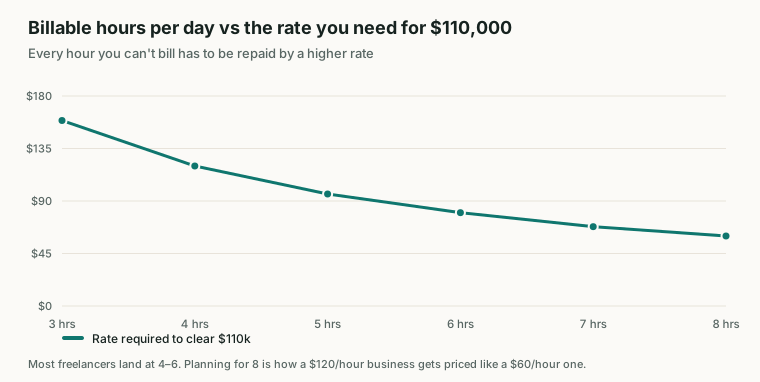
Every hour you cannot bill has to be repaid by a higher rate. Most freelancers sit at 4–6.
Think about an ordinary 8-hour day. Subtract the 45 minutes of email and Slack, the 30-minute call that ran to 50, the proposal you wrote for a lead, the invoice you chased, the context-switch tax every time you bounced between two clients. By the time you total only the hours that actually produced billable deliverables, you are often staring at four and a half.
Then there is the harder ceiling: focus itself. Most knowledge workers have a limited reservoir of high-quality concentration per day. The U.S. Bureau of Labor Statistics' American Time Use Survey shows that even full-time employed people log far fewer hours of pure focused work than their "8-hour day" implies, because meetings, breaks, and task-switching eat the rest. Freelancers carry the same biological limit plus the entire back office of running a business. Seven billable hours means seven hours of your best attention, every day, with no slow afternoons. That is the part nobody can sustain.
What A Sustainable Daily Billable Target Looks Like
Here is the honest range I have seen across years of comparing notes with other freelancers:
- 3 to 4 billable hours/day is common for newer freelancers or anyone in a heavy sales push. Most of the day goes to finding the next client.
- 4 to 6 billable hours/day is the sweet spot for established freelancers with a steady pipeline. This is sustainable indefinitely.
- 6 to 7 billable hours/day is achievable in short bursts, usually on retainer-heavy weeks with almost no prospecting, but it is a sprint, not a pace.
- 8+ billable hours/day is almost always either a timesheet fiction or a fast track to burnout. Add the unpaid work back in and you are looking at a 12-hour day.
Five billable hours a day is a good planning anchor. It assumes a real human who takes lunch, answers clients, and occasionally has an unproductive afternoon, while still getting serious work done. It also leaves two to three hours in a normal workday for the sales, admin, and learning that keep the business alive.
Daily Hours, Annual Hours, And What They Do To Your Rate
This is where the daily number stops being abstract. Your daily billable hours roll up into an annual figure, and that annual figure is the denominator under your income goal. Smaller denominator, higher required rate.
Assume a working year of about 230 days (260 weekdays minus roughly 30 days for vacation, holidays, sick time, and slow stretches). Hold your income target at $110,000 to keep the comparison clean. Watch the rate move:
| Billable hrs/day | Billable hrs/week | Billable hrs/year | Rate to clear $110k |
|---|---|---|---|
| 3 | 15 | ~690 | $159/hr |
| 4 | 20 | ~920 | $120/hr |
| 5 | 25 | ~1,150 | $96/hr |
| 6 | 30 | ~1,380 | $80/hr |
| 7 | 35 | ~1,610 | $68/hr |
| 8 | 40 | ~1,840 | $60/hr |
A few things jump out. First, the $60/hr "8 billable hours" row is exactly the trap: it looks like a healthy rate, but it requires you to bill every full workday with zero unpaid time, which is impossible. Second, the realistic 5-hour row demands $96/hr for the same take-home, not $60. That $36/hr gap is the cost of pretending you can bill 8.
The arithmetic is simple: $110,000 ÷ 1,150 billable hours = $96/hr. Plug your own honest daily number into the freelance rate calculator and it does this division for you, including taxes and expenses, so you are not eyeballing it.
Why Chasing 7 To 8 Hours Backfires
There are only two ways to "hit" a 7-or-8 billable-hour day, and both are bad.
The first is to actually work the hours. To bill 7, you need roughly 10 to 12 hours at your desk once you add proposals, invoicing, email, and the learning that keeps you employable. Do that five days a week and you will be exhausted inside a quarter. Tired work is slower and buggier, so your real output per hour drops even as your hours climb. You end up running harder to stand still.
The second way is to pad. I have done this, and I am not proud of it. Early on I had a client I billed hourly, and on a slow week I "found" billable hours that were really me half-watching a tutorial with the project file open. It felt harmless. It was not. I was lying to a client I liked, the work did not actually improve, and I taught myself that the fix for a thin week was inflation rather than better pricing. The honest move would have been to charge a rate that did not require 7 fake hours to survive.
That is the real lesson. A daily target you can only hit by overworking or padding is not a target, it is a confession that your rate is too low. Raise the rate and the pressure on the daily number disappears.
There is a quieter cost too. When you anchor on 7 or 8 billable hours, every normal day feels like a shortfall. You hit a perfectly healthy 5 and still go to bed feeling behind, because you are measuring against a fiction. Over months that low-grade guilt does as much damage as the long hours do. Setting the target where it actually belongs, around 5, means a good day feels like a win instead of a near miss, and you stop using your evenings to "catch up" on hours that were never realistic in the first place.
Raise Your Effective Billable Hours Without Adding Clock Hours
The good news: you can move from 4 billable hours to 5 or 6 without working a minute longer, by shrinking the non-billable drag instead of extending the day. This is the highest-leverage move available, and none of it requires charging more (though you should also do that).
Batch like tasks. Every context switch costs you 10 to 20 minutes of ramp-up. Doing all your invoicing on Friday afternoon instead of one invoice every day reclaims focus blocks the rest of the week. Same for email: two or three checked windows beat a tab open all day.
Kill standing meetings. A recurring 30-minute weekly sync with three clients is 78 hours a year of non-billable time. Convert what you can to async updates (a short written summary, a Loom). Keep the calls that genuinely need a conversation; drop the status meetings that could have been a message.
Scope tightly so revisions are paid. The single biggest silent killer of billable hours is unscoped revisions. "Just one small tweak" repeated across a project can swallow 20% of your week unpaid. Write scopes that define the number of revision rounds, and bill beyond it. This converts hours that were quietly non-billable into billable ones.
Protect one or two deep-work blocks. Defend a 90-minute to 2-hour window where you do not check messages. Two protected blocks a day reliably produce more billable output than eight fragmented hours of half-attention.
Move toward retainers and project pricing. Hourly work makes every distraction feel like lost income; retainers reward efficiency. When you bill by the project or month, finishing faster is pure profit, which quietly raises your effective hourly. The trade-offs are in hourly vs project pricing.
Do two or three of these and a 4-hour billable day becomes a 5- or 6-hour one inside a month, with the same dinnertime. That is worth more than almost any rate increase, and it stacks on top of one. When you are ready to also lift the number, how to raise your rate covers the conversation.
A Quick Worked Example
Say you currently bill 4 hours a day, work about 220 days, and clear roughly $480/day at $120/hr, for about $105,600 a year. You feel maxed out and assume the only path up is longer days.
Instead you batch admin into Friday afternoons, cut two recurring client calls, and tighten your revision scope. Over a month your billable average rises to 5 hours a day with the same start and stop time. Now you bill 5 × $120 × 220 = $132,000, a $26,400 raise, with zero extra clock hours and zero awkward rate conversation. Then you raise your rate to $135/hr on new clients and the same 5-hour day clears nearly $149,000. The daily-hours lever and the rate lever multiply each other.
Keep Reading
- The concept behind the number: billable hours for freelancers
- Lift the rate, not just the hours: how to raise your rate
- Run your own daily number through it: the rate calculator
- Browse every guide: guides hub
Questions people ask
- Is a 7-hour billable day realistic for a freelancer?
For most solo freelancers, no, not as a daily average over a full year. You can hit 7 billable hours on a heads-down deadline day, but sustaining it five days a week leaves no room for sales, admin, or recovery. A realistic billable hours per day target is 4 to 6 for sustained work.
- What is the ideal number of working hours for a freelancer?
There is no single ideal, but most sustainable freelancers work 6 to 8 total hours a day and bill 4 to 6 of them. The rest goes to sales, admin, and communication. Chasing 8 billable hours usually means a 10 to 12 hour workday once the unpaid work is added back in.
- How many billable hours per year should I plan for?
At 5 billable hours a day across roughly 230 working days a year, you get about 1,150 billable hours. That is a far safer planning number than the 2,080 a naive 40-hour year implies, and it produces a rate that actually covers your costs.
- How do I raise my billable hours without working longer?
Raise your effective billable hours by cutting non-billable drag, not by adding clock hours. Batch similar tasks, reduce standing meetings, scope projects tightly so revisions are paid, and protect one or two deep-work blocks a day. These add billable hours without extending your day.
- How many billable hours per year is realistic?
At a sustainable 5 billable hours a day across roughly 230 working days, you land around 1,150 billable hours a year. That is a far safer planning figure than the 2,080 a naive 40-hour year implies, and it produces a rate that actually covers your costs and taxes.
- Should I set a daily or weekly billable target?
Set both. A daily target (say 5 hours) keeps you honest in the moment, while a weekly target (25 hours) gives you flexibility to shift hours between a slow Monday and a heavy Thursday without feeling like you failed. Review the weekly number against your annual goal each quarter.
Put these numbers to work
Use the free freelance rate calculator to turn this into your own hourly rate in under a minute.
Open the calculatorKeep reading
More in Setting Your Rate, or browse all guides.
True hourly rate is what survives tax, unbillable time and overhead. The full trace from a $75 invoice line to the $21 that reaches your account.
ReadFreelance hourly rate from salary, converted honestly: gross up for self-employment tax, replace benefits, add expenses, and divide by real billable hours.
ReadLearn how to stop undercharging as a freelancer with a rate floor formula, 5 warning signs, and a 4-step plan to raise your rate this week.
ReadFollow the freelance rate calculator formula step by step with one real example: a UX designer turning an $85,000 take-home goal into an hourly rate.
ReadBillable hours for freelancers are never the same as hours worked. See the real week, the efficiency math, and what it does to your rate.
ReadFreelance developer hourly rate bands for 2026 by stack, plus the domain premium that adds 25-40% for exactly the same technical work.
Read