Freelance Editing Retainer: Price It by Word or Hour
A freelance editing retainer guide for editors and writers: price by word count or hours, with worked math, sample tiers, SLAs, and scope-creep protection.
Practical guidance, not financial advice. Sukie is a working freelancer, not a licensed accountant or financial advisor. Use this to make a defensible decision, then confirm the specifics for your situation with a qualified professional.

By Sukie · Founder & Writer, FreelanceRateLab
Updated August 11, 2026 · 8 min read
$0.035 a word, 20,000 words a month, $700 — and a client who assumed that included two revision rounds and a style guide. That was my first freelance editing retainer, and getting it wrong taught me more than any pricing article. If you edit blogs, newsletters, or copy for a content team, you already know the work doesn't arrive as tidy one-off projects. It arrives weekly. Forever. That steady drip is exactly what a freelance editing retainer is built for, and it's why retainers fit editorial work better than almost any other freelance service.
I've edited on retainer for the better part of a decade, mostly for SaaS blogs and a couple of weekly newsletters. The clients who keep me on a monthly arrangement aren't paying for a single polished post. They're paying so they never have to wonder whether their Tuesday article will get a clean read before it ships. A freelance editing retainer turns "can you squeeze this in?" into a predictable monthly rhythm for both of you, and predictability is worth real money on both sides of the table.
The catch is that editing retainers creep more quietly than design or dev retainers, because the unit of work is fuzzy. "Edit this post" can mean a light proofread or a near-rewrite, and if you don't draw that line, you'll bleed hours. So this guide covers the two ways to price the thing, the math behind each, what to put in and leave out, and the scope rules that kept my effective rate from collapsing.
Two Ways to Anchor the Price: Words or Hours
Every editing retainer is priced off one of two anchors. Don't mix them in a single agreement, or you'll spend every month arguing about which one applies.
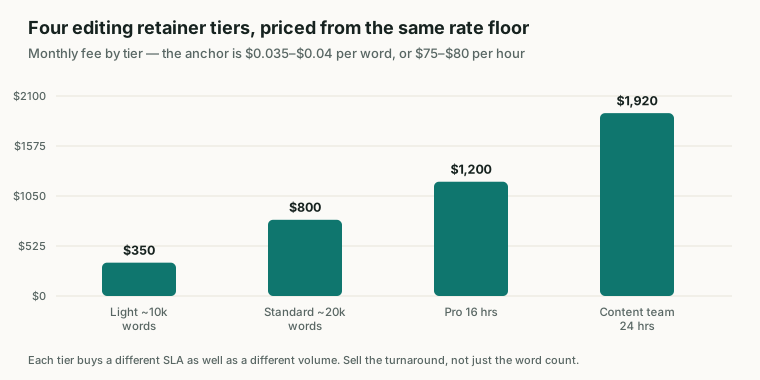
Four tiers built from the same per-word and per-hour anchors.
Anchor 1 — Word count. You agree to edit up to a monthly word volume at a per-word rate. This reads cleanly to clients because they think in word counts already, and it's predictable when their content is uniform.
20,000 words/month at $0.04/word = $800/month
Per-word editing rates run roughly $0.02 for a light proofread up to $0.07+ for a heavy line edit, depending on depth and your experience. Pick the rate that matches the kind of editing you actually do, not the lightest version of it.
Anchor 2 — Hours. You reserve a block of hours per month at your hourly rate. This protects you when the content quality is all over the place, because a sloppy draft eats far more time than a clean one at the same word count.
12 hours/month at $75/hour = $900/month
Notice those two examples land close but not equal. That gap is the whole point. The word-count plan assumes the drafts are reasonably clean. The hours plan assumes they might not be, so it builds in protection. If you don't know which world you're in yet, bill hours for the first two or three months, measure your real speed, then convert to per-word once you trust the pattern.
Either way, get your hourly number nailed down first. Everything below is built on it, and you can derive a defensible one with the freelance rate calculator on the homepage. If your baseline is $75/hour and a per-word plan secretly pays you $48/hour, the per-word plan is wrong, full stop.
How do you know which anchor fits? Ask one question: how consistent are the drafts? If three writers send you three very different levels of polish, the per-word rate that works for the cleanest writer will quietly underpay you on the messiest. Hours absorb that variance automatically. But if the content is uniform, say one editor sending a steady stream of similar newsletters, word count is less to track and easier for the client to budget. I default to hours for content teams and per-word for solo publishers, and that simple rule has been right more often than not.
Sample Editing Retainer Tiers
Here's how I structure tiers when I pitch. The numbers assume a $75/hour baseline and clean-ish drafts; adjust for your own rate and the client's mess level.
| Tier | Monthly volume | Anchor & rate | Monthly fee | Rounds included | SLA |
|---|---|---|---|---|---|
| Light | ~10,000 words | $0.035/word | $350 | 1 pass | 72 hrs |
| Standard | ~20,000 words | $0.04/word | $800 | 1 pass + 1 revision | 48 hrs |
| Pro | 16 hrs (depth varies) | $75/hr | $1,200 | 2 passes + revisions | 48 hrs |
| Content team | 24 hrs | $80/hr | $1,920 | 2 passes + style upkeep | 24–48 hrs |
A few notes on why the table looks like that. The lighter tiers anchor on words because the work is uniform proofreading. The heavier tiers switch to hours because "Pro" and "Content team" editing involves judgment calls, structural suggestions, and style-guide maintenance that don't scale neatly with word count. The Content team tier also carries a small per-hour premium for the coordination overhead of juggling multiple writers' voices.
What's In, What's Out
The fastest way to wreck an editing retainer is to leave "an edit" undefined. Spell it out. Here's my default split.
Included:
- An agreed number of rounds of edits per piece. One thorough pass plus one revision after the writer responds is the standard. Two passes for heavier work.
- A stated turnaround SLA (e.g. 48 hours for anything under 2,500 words).
- Light style-guide upkeep on the higher tiers: keeping a running style sheet current as decisions get made.
- Tracked changes plus a short summary of recurring issues, so the writers actually improve over time.
Excluded (priced separately or declined):
- Developmental editing or restructuring a piece from scratch. That's a different service with a different rate.
- Ghostwriting or writing sections from a brief. Editing is not writing.
- Fact-checking and link verification unless explicitly added.
- Formatting, CMS upload, and SEO meta work. Adjacent, but not editing.
- Rush turnaround. A request for under-24-hour turnaround triggers a rush fee, typically 25–50% on top of the per-piece value. Put the number in the agreement so a panicked Friday email isn't a free emergency.
Writing this list into the agreement does more than protect you. It teaches the client what they're buying, which means fewer awkward "wait, that costs extra?" conversations later.
Scope Creep Is Different for Editors
Most retainer guides warn about scope creep in general terms. Editing creep has its own two specific failure modes, and you have to cap both or one will get you.
Failure mode one: the revision spiral. You return a clean edit. The writer makes changes, you re-edit, they change more, you re-edit again. Without a round cap, a single 1,500-word post can absorb four or five passes. The fix is a hard limit: one pass plus one revision is included; further rounds bill at the overage rate. That single line ends the spiral.
Failure mode two: the expanding word count. The retainer says 20,000 words a month. Then the blog "ramps up" and suddenly there are eight posts instead of five. Nobody renegotiated; the volume just grew. Cap it: up to 20,000 words/month; words beyond that bill at $0.045/word, a touch above the in-plan rate so overage nudges the client to upgrade rather than treating your cap as a suggestion.
Then add the same upgrade and downgrade thresholds any healthy retainer needs. If usage runs over 110% of the plan for two consecutive months, move the client up a tier. If it runs under 70% for two months, drop them down before they feel they're paying for air and cancel outright. The general mechanics of these thresholds, overage rates, and rollover caps live in the retainer pricing decision framework, and they apply here verbatim.
For the contract language itself, the U.S. Small Business Administration's guidance on managing finances and client agreements is genuinely useful plain-English reading before you finalize terms (sba.gov). A retainer without written caps isn't a deal; it's an invitation.
The Retainer That Went Sideways (and the Fix)
Let me tell you about the one that taught me all of this.
A few years back I signed a content-team client at a flat $1,000/month to edit their blog. No word cap, no round cap, just "edit our posts." Anchor: vague. In month one they sent five clean 1,200-word posts. Easy. Roughly 8 hours of work. At $1,000, that's $125/hour, and I felt clever.
Then they hired two junior writers. The drafts got rougher and longer. Month three brought nine posts averaging 1,800 words, each needing a heavy pass plus two or three revision rounds because the writers were still learning. I tracked it one painful week and extrapolated: I'd worked about 26 hours that month.
$1,000 ÷ 26 hours = $38/hour effective
That's roughly half my baseline. I'd accidentally subsidized their hiring spree. Worse, because nothing was written down, raising the issue felt like changing the deal on them rather than enforcing it.
The fix took one honest conversation and a rewritten agreement. I converted them to the Content team tier: 24 hours/month at $80/hour = $1,920, two passes plus style upkeep included, one revision round per piece included and further rounds at overage, words/hours beyond the cap billed at the overage rate, and a 48-hour SLA with a rush fee for anything faster. They stayed. My effective rate snapped back to $80 and held there, because every extra round and every extra post now had a price attached instead of vanishing into a flat fee. The lesson wasn't "charge more." It was "define the unit of work, then cap it."
Keep Going
- Set your hourly baseline first with the freelance rate calculator before you price any tier.
- Get the general thresholds and overage mechanics from the retainer pricing framework.
- Limited capacity on your side? See the part-time freelance retainer approach.
Questions people ask
- How do I price a freelance editing retainer?
Pick one anchor and stay consistent. Word-count works when volume is steady (e.g. 20,000 words/month at $0.04/word = $800). Hours work when the editing depth varies a lot (e.g. 12 hours/month at $75/hour = $900). Whichever you choose, sanity-check it against your hourly baseline so you never accept an effective rate below your normal number.
- Should an editing retainer be priced per word or per hour?
Per word is cleaner for clients and predictable when the manuscripts are similar in shape. Per hour protects you when content quality is uneven, because a messy 2,000-word draft can take three times as long as a clean one. If you serve a content team with wildly variable copy, bill hours. If you edit a steady newsletter, per word is fine.
- What should an editing retainer include and exclude?
Define the rounds of edits (one pass plus one revision is standard), the turnaround SLA, the rush fee, and whether style-guide upkeep is in scope. Exclude developmental rewrites, ghostwriting, fact-checking, and formatting unless you price them in. Vague rounds are the single biggest source of editing scope creep.
- How do I stop scope creep on an editing retainer?
Cap two things: the monthly word count (or hours) and the number of revision rounds per piece. Anything beyond the cap bills at a stated overage rate. Add an upgrade trigger so two months of overage moves the client to the next tier instead of letting extra rounds quietly erode your margin.
- What is a fair turnaround SLA for an editing retainer?
Tie it to your real capacity, not the client's hope. A common SLA is 48 to 72 hours for standard pieces under a set word count, with rush turnaround (under 24 hours) billed as a separate rush fee. Put the SLA and the rush fee in writing so a panicked Friday request doesn't become a free emergency.
- What if a client wants editing but can't predict monthly volume?
Don't lock a fixed word-count plan. Start with an hours-bank arrangement and a clear overage rate, track two or three months, then convert to a per-word tier once a real pattern emerges. This is also the right call for a part-time freelance retainer where capacity is limited on your side too.
- Should style-guide upkeep be free?
Not silently. Light upkeep on a running style sheet is fine to fold into higher tiers because it makes your own work faster. But building a style guide from scratch is a separate paid project. Folding it in for free on a cheap tier is how editors end up doing brand strategy at proofreading rates.
Put these numbers to work
Use the free freelance rate calculator to turn this into your own hourly rate in under a minute.
Open the calculatorKeep reading
More in Pricing Models, or browse all guides.
ROI of hiring a freelancer, calculated the way finance wants it: loaded cost comparison, four attribution models, and the traps that inflate the number.
ReadFreelance retainer rates by discipline and hour band: real 2026 monthly ranges for writers, designers, developers, and VAs, plus the discount ceiling.
ReadThere are 4 freelance retainer structures and each works differently. Learn which fits your client type before you sign anything.
ReadFreelance day rate vs hourly rate, compared side by side. See the math, when each model protects you, and how to set a day rate clients will accept.
ReadProject-based vs hourly rate explained: how each model works, who carries the risk, and which one actually protects your margin. With real dollar examples.
ReadMonthly retainer pricing for part-time freelancers: how to size hours around a day job, price evenings higher, and avoid over-committing time you don't have.
Read