Hourly vs Project Pricing: Which Protects Your Margin
Hourly vs project pricing isn't about which is better. It's about which protects your margin in a given job. Here's the framework, with worked numbers.
Practical guidance, not financial advice. Sukie is a working freelancer, not a licensed accountant or financial advisor. Use this to make a defensible decision, then confirm the specifics for your situation with a qualified professional.

By Sukie · Founder & Writer, FreelanceRateLab
Updated August 11, 2026 · 8 min read
Freelancers argue about hourly vs project pricing like it's a personality test. Team Hourly says fixed prices are a trap. Team Project says hourly punishes you for being fast. Both are half right, and the argument misses the actual question.
The real question isn't which model is "better." It's which model protects your margin on the specific job in front of you right now. Some work is safe to flat-fee. Some work will quietly bankrupt you if you flat-fee it. The skill is knowing the difference before you send the quote, not after you've eaten 40 unpaid hours. This guide is a head-to-head: the trade-offs side by side, the situations where each one wins, and the one number that keeps your project prices honest.
The trade-offs, side by side
Here's the fight card. Same job, two ways to charge for it, and what each one does to your risk.
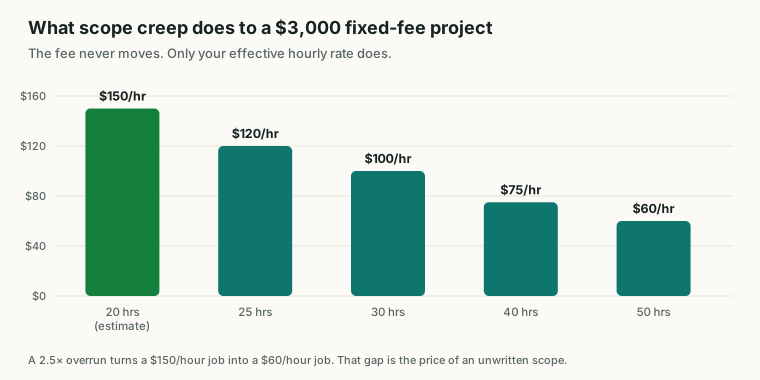
A $3,000 fixed fee, at five different actual hour counts. Only your effective rate moves.
| Factor | Hourly pricing | Project pricing |
|---|---|---|
| Who carries scope risk | The client (more work = more pay) | You (more work = lower effective rate) |
| Upside when you're fast | Capped — you bill fewer hours | Yours to keep — finish early, keep the fee |
| Predictability for the client | Low (open-ended invoice) | High (one fixed number) |
| Cash-flow predictability for you | Steady but variable | Lumpy but plannable |
| Scope-creep exposure | Low — extra work is billable | High — extra work is unpaid unless you act |
| Admin overhead | Time tracking every day | Estimating and change orders up front |
| Rewards your experience | Weakly (faster = less money) | Strongly (faster = same money) |
| Best when | Scope is fuzzy or shifting | Scope is clear and repeatable |
Read that "who carries scope risk" row twice. It's the whole debate compressed into one line. Everything else follows from who eats the cost when the work turns out bigger than expected.
When hourly wins
Hourly is not the beginner option. It's the uncertainty option, and uncertainty isn't a sign you're junior — it's a property of the work.
The scope is genuinely fuzzy. "We want to redesign our onboarding, but we're not sure what's broken yet." You cannot price that as a flat fee without guessing, and your guess will be wrong. Hourly lets you start working while the picture clarifies.
The client is indecisive or changes direction. If a client reverses a decision every other meeting, hourly is your protection. Every reversal is billable. On a flat fee, every reversal is a donation.
The work is open-ended or ongoing. Maintenance, ad-hoc support, "can you also look at this" tasks. There's no deliverable to anchor a project price to, so time is the natural unit. This is also where a retainer often beats raw hourly — same time-based logic, but with guaranteed minimum hours and steadier cash flow.
You don't have data on this kind of job yet. The first time you do a new type of work, you have no idea how long it takes. Bill hourly, log the hours, and now you have the estimate you need to flat-fee it next time. I learned this the expensive way and I'll get to that.
The catch with hourly: your income is capped by hours, and getting faster literally lowers each invoice. That's the price of letting the client carry the risk.
When project pricing wins
Project pricing is the move once you actually know what you're doing — when the uncertainty is gone and your speed becomes an asset instead of a liability.
The scope is clear and you can name the deliverable. "A five-page marketing site from your existing brand kit." You've done it ten times. You know it's roughly 40 hours. A fixed price here is clean for the client and lets you keep the upside of your efficiency.
You're fast at this specific thing. This is the big one. If experience lets you finish a "60-hour" job in 35, hourly punishes you for the skill you spent years building. Project pricing pays you for the result, so those 25 saved hours are profit, not lost revenue.
The client wants budget certainty. Plenty of clients will happily pay a premium for one predictable number over an open-ended hourly meter. Predictability has real value to them, and you can charge for providing it.
The work is repeatable and productizable. Logo packages, audits, standard WordPress builds. When you've systematized the process, the flat fee gets more profitable every time you run it because your process keeps getting tighter while the price holds.
The catch with project pricing: you're now carrying all the scope risk. Which brings us to the number that keeps you honest.
The internal hourly baseline keeps your project prices honest
Here's where the two camps secretly agree, even if they don't realize it. Whether you quote a project price or an hourly rate to the client, you should always know your hourly baseline. That number is your floor, and it's the only way to tell whether a flat fee is actually a good deal or a slow-motion mistake.
If you've never calculated it, start there. Run your real numbers through the homepage freelance rate calculator, or follow the math by hand in the rate formula guide. The short version: take your target annual income plus business costs, divide by realistic billable hours. Say that lands you at $75/hour. That's your baseline. Now every project price gets checked against it.
Here's the worked scope-creep example, the exact failure mode that makes freelancers swear off flat fees.
A client offers you a $6,000 project. Feels great — biggest single number you've quoted all quarter. You estimated 70 hours, which at your $75 baseline pencils out to $5,250, so you padded to $6,000 and felt smart. Then reality:
- The "quick" content revisions became three full rounds.
- They added two pages "since we're already in there."
- Stakeholder feedback arrived in dribs over six weeks, so you context-switched back in five separate times.
You finish at 90 hours. Do the division:
$6,000 ÷ 90 hours = $67/hour
You just worked for $67 against a $75 floor. You're $8/hour underwater on every single hour, roughly $720 of your own money quietly handed to the client. And you might never have noticed, because the invoice said $6,000 and $6,000 felt like a win. That's the trap — not project pricing itself, but project pricing without tracking hours against a baseline.
The fix isn't to abandon flat fees. It's to:
- Estimate hours, multiply by baseline, then add a real buffer. At $75 and a realistic 85-hour view of that job, the floor was already $6,375 — meaning $6,000 was underwater from the moment you sent it.
- Track hours even on flat-fee work. You can't manage the effective rate you refuse to measure.
- Write a change order into the contract. "Up to two revision rounds; additional rounds billed at $75/hour." Now scope creep converts back into income instead of erosion.
Track that effective rate religiously. It's the single habit that separates freelancers who make money on projects from freelancers who just feel like they're making money on projects.
Value-based pricing: the third option
Both camps in the hourly vs project pricing debate are arguing about cost-plus thinking — pricing from your time. There's a third lane: value-based pricing, where the fee is anchored to the outcome's worth to the client, not to your hours at all.
If a sales page you write earns the client an extra $200,000, charging $6,000 is a rounding error to them and a fantastic deal for you, regardless of whether it took you 30 hours or 10. That's the pitch. Value-based pricing has the highest ceiling of any model, because it decouples your income from the clock entirely.
The honest caveat: it requires a client whose outcome is measurable in dollars, real trust, and enough negotiating confidence to talk about their numbers instead of yours. It's not where most people start. But here's the quiet part — even value-based prices get sanity-checked against your hourly baseline. If a "value" price works out to $40/hour of your time, the value story isn't really there yet. The baseline never stops mattering. It just stops being the ceiling.
Does "project based" mean an hourly rate?
People search this exact phrase, so let's answer it straight: does project based mean hourly rate? Not to the client, but yes to you.
To the client, a project-based price is one fixed number for a defined deliverable. They never see an hour count and they don't bill by time. So on the surface, "project based" is the opposite of "hourly."
Underneath, though, every honest project quote is built from an hourly rate. You estimate hours, multiply by your baseline, add a buffer for risk. The hourly math is the skeleton; the flat fee is the skin over it. So project-based pricing doesn't mean an hourly rate to the buyer, but it's calculated from one on your side. Anyone quoting flat fees without doing that hidden hourly math is gambling, not pricing.
The bottom line: hourly vs project pricing isn't a fixed allegiance, it's a per-job decision. Carry the risk yourself when scope is clear and you're fast. Hand the risk to the client when scope is fuzzy. And whichever you pick, always know your hourly baseline — it's the number that tells you the truth no matter what the invoice says. If you haven't nailed yours down, start with the calculator and build every price from there.
Related reading: project-based vs hourly rate for the contract mechanics of each model, freelance day rate vs hourly rate when the unit is a booked day rather than an hour, and true hourly rate for what any of these numbers actually returns once tax and unbillable time are counted.
Questions people ask
- Does project based mean hourly rate?
Not directly. A project price is a single fixed number the client pays for a defined deliverable, while an hourly rate bills for time spent. But every honest project price is built from an hourly baseline internally: you estimate the hours, multiply by your target rate, and add a buffer. So project pricing hides the hourly math from the client, but you still need it yourself to know whether the price is profitable.
- Which is more profitable, hourly or project pricing?
Project pricing has higher upside because you keep the savings when you work faster than estimated. Hourly is safer because the client absorbs scope changes. Project pricing is more profitable only when your estimates are accurate and scope is controlled. If you underestimate, your effective hourly rate collapses below your baseline.
- How do I stop scope creep from killing a fixed-price project?
Put a revision limit and a change-order clause in the contract, get sign-off at defined checkpoints, and track your hours even on flat-fee work. The moment a project crosses your hour estimate, you should know your effective rate is dropping and either invoke the change order or absorb it deliberately, not by accident.
- Can I use both hourly and project pricing with the same client?
Yes, and it is often the smartest setup. A common pattern is a fixed-fee discovery or scoping phase followed by hourly execution, or a fixed project price for the core deliverable plus hourly billing for out-of-scope extras. This caps the client's risk on the part you can estimate and protects you on the part you can't.
- Should beginners use hourly or project pricing?
Lean hourly at first, but not because hourly is "for beginners." It's because beginners lack the data to estimate accurately, and accurate estimates are what make flat fees safe. Bill hourly, log every job, and within a few months you'll have the numbers to start flat-fee pricing the work you do repeatedly.
- How big should my scope-creep buffer be?
For familiar work, 15–20% over your raw hour estimate. For anything with fuzzy requirements or a known-indecisive client, 30–50%, or just bill it hourly. If a buffer that size makes the project price feel uncomfortable, that's the project telling you it isn't ready to be flat-fee priced.
- What if a client refuses to pay hourly?
Some won't, because open-ended invoices scare finance departments. That's fine — give them a project price built carefully on your hourly baseline, with a change-order clause for anything outside the agreed scope. They get certainty; you get protection. Everyone's risk is named in the contract. Get that clause in writing before work starts. The U.S. Small Business Administration's guidance on writing a business plan and contracts makes the same point in blunter language: an unwritten scope is not a scope. A single paragraph naming what a revision is, and what a new project is, has saved me more money than any rate increase.
- Is value-based pricing realistic for ordinary freelance work?
Sometimes. It works best when your deliverable clearly moves revenue (sales copy, conversion design, lead generation) and you have a client willing to discuss outcomes. For internal tools, admin work, or anything without a dollar metric, stick with hourly or project pricing built on your baseline.
Put these numbers to work
Use the free freelance rate calculator to turn this into your own hourly rate in under a minute.
Open the calculatorKeep reading
More in Pricing Models, or browse all guides.
ROI of hiring a freelancer, calculated the way finance wants it: loaded cost comparison, four attribution models, and the traps that inflate the number.
ReadFreelance retainer rates by discipline and hour band: real 2026 monthly ranges for writers, designers, developers, and VAs, plus the discount ceiling.
ReadThere are 4 freelance retainer structures and each works differently. Learn which fits your client type before you sign anything.
ReadFreelance day rate vs hourly rate, compared side by side. See the math, when each model protects you, and how to set a day rate clients will accept.
ReadProject-based vs hourly rate explained: how each model works, who carries the risk, and which one actually protects your margin. With real dollar examples.
ReadMonthly retainer pricing for part-time freelancers: how to size hours around a day job, price evenings higher, and avoid over-committing time you don't have.
Read