Freelance Day Rate vs Hourly Rate: Which Pays You Better?
Freelance day rate vs hourly rate, compared side by side. See the math, when each model protects you, and how to set a day rate clients will accept.
Practical guidance, not financial advice. Sukie is a working freelancer, not a licensed accountant or financial advisor. Use this to make a defensible decision, then confirm the specifics for your situation with a qualified professional.

By Sukie · Founder & Writer, FreelanceRateLab
Updated August 11, 2026 · 8 min read
Freelance day rate vs hourly rate is the choice hiding inside the phrase "paid on a freelance basis," which is a billing arrangement rather than a job description. It means you are working as an independent contractor and invoicing a client for your time or output, rather than drawing a salary. But there is a second layer most new freelancers miss: how that invoice is structured. Do you charge by the hour, by the day, or by the project? That choice changes what you earn, who carries the risk when work runs long, and how clients read your value.
This guide is specifically about freelance day rate vs hourly rate pricing — what each one means, when each one wins, and how to convert between them without leaving money on the table.
Day Rate vs Hourly Rate: A Side-by-Side
The two models look similar on the surface. Both charge for time. Underneath, they work very differently.
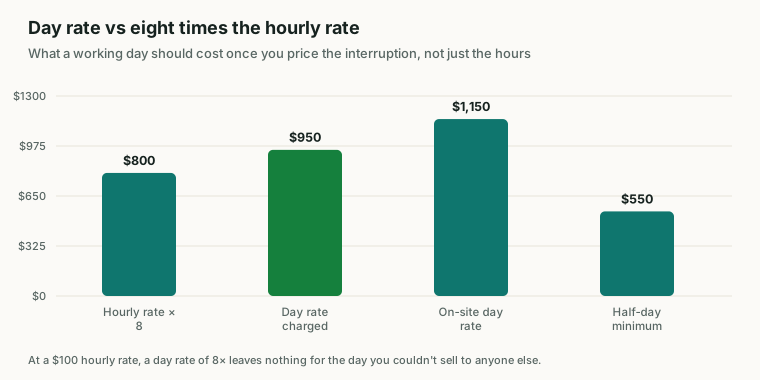
At a $100 hourly rate, 8× leaves nothing for the day you could not sell elsewhere.
| Factor | Hourly rate | Day rate |
|---|---|---|
| What you quote | A price per hour of work | A price per working day |
| Minimum billing unit | One hour (or fractions) | One full day |
| Who absorbs slow days | You — slow days mean fewer billable hours | The client — they bought the day regardless |
| Typical use case | Short projects, unknown scope, new clients | Multi-day engagements, on-site work, retainer-style bookings |
| Client perception | Feels variable and open-ended | Feels clean and predictable |
Read the "who absorbs slow days" row carefully. When a client books you for the day and the morning meeting runs two hours, you still get paid for the full day. On hourly, that same meeting is two hours of billing and the rest of the afternoon disappears from your invoice if there is no follow-up work. Day rates shift that dead-air risk onto the client, which is exactly why clients who know what they want are comfortable with them — and why clients with fuzzy plans often prefer hourly.
The Math Behind a Day Rate
Calculating a day rate is straightforward, but most freelancers get one thing wrong: they multiply their hourly rate by eight.
Eight hours is a full clock day, not a full billable day. Even when a client books you for the day, some of that time goes to communication, their internal meetings where you are just present, or natural transition gaps. A realistic billable day is closer to six or seven hours.
Here is the conversion I use:
$85/hour × 7 billable hours = $595/day
Round that up to $600. Rounding up is not only fine — it is expected. Day rates are round numbers by convention. Clients are not surprised to see $600 instead of $595; they would be mildly suspicious of $595 because it looks like you ran a formula and did not think about the price.
If you want to go slightly above, price at $625 and be ready to justify it. At $625 for a 7-hour day, your implied hourly rate is $89.29. That is not gouging — it builds in a small buffer for the overhead a client-focused day always carries.
For context on where your hourly baseline should come from in the first place, the rate formula guide walks through the full calculation: target income plus expenses divided by realistic billable hours. Do not set a day rate until you know that baseline number. You can also run it directly through the freelance rate calculator on the homepage.
One concrete example from my own work: I took on a UX consulting engagement billed at $95/hour. After three months I noticed the client was consistently booking two- and three-day blocks and then getting surprised by invoices that varied by $300 or more depending on how many hours I logged each day. We switched to a day rate of $625. Same average income for me, zero invoice anxiety for them. The relationship got noticeably smoother.
When Clients Ask for a Day Rate (and What They Really Mean)
Clients who ask for a day rate are not always asking for the same thing. There are two very different requests hiding behind identical words.
Version one: "We want to book you by the day for the foreseeable future." This is a client who needs you on-site or on-call regularly and wants a simple recurring fee. They are thinking of you like an on-demand contractor — Tuesday and Thursday each week, paid per day. This is close to a retainer structure and should be treated like one: put a minimum commitment in writing, define cancellation terms, and confirm whether unused days roll over or disappear.
Version two: "We need a cost ceiling per day so we know what we are spending." This client has a project that may take variable effort. They want a daily maximum so their budget is predictable. They are not necessarily booking you for full days — they just do not want a surprise invoice. In this case, the right structure is a day rate with an hourly floor: you bill by the hour up to a daily maximum, and they pay the cap even if you hit it early. This protects both sides.
You can tell which version you are dealing with by asking two questions: "Are you looking for regular scheduled availability, or is this for a single project?" and "Do you expect me to be available during your business hours on booked days, or do we agree on deliverables and I work independently?" The first scenario points to a recurring day-rate arrangement. The second points toward a project fee with a daily cost ceiling, which is a different animal.
Do not accept a day-rate request without clarifying which version the client means. The contract language is different, and the risk profile is different.
Protecting Yourself on Day-Rate Engagements
A day rate without a clear definition of what a "day" means is an open invitation to scope creep. These are the terms you need to define in writing before you start.
Hours in a day. State the number explicitly: "A day is defined as seven (7) hours of work, available between 9 a.m. and 6 p.m. in the client's time zone." Without this, clients may expect you to be available from their first morning Slack message to their last evening email.
Overtime policy. What happens if a day runs long? The cleanest language: "Hours beyond seven in a single day are billed at my standard hourly rate of $[X], invoiced on the same billing cycle." This is not punitive — it is fair. The client booked seven hours. Eight is extra.
Cancellation terms. If a client cancels a booked day with less than 48 hours' notice, you have likely already blocked out that time and turned down other work. A reasonable cancellation clause charges 50% of the day rate for cancellations under 48 hours and 100% for same-day cancellations. Many clients will push back on this until they realize it mirrors how hotel rooms and hired vehicles work. Hold the line.
Deliverables vs. time. Decide upfront: are you selling a block of time, or a defined output? "Eight hours of design work" and "a completed homepage wireframe" are two different contracts, even if the same day produces both. If the wireframe takes 11 hours, the first framing means you get paid extra; the second means you absorb it. Be explicit about which one governs.
For a broader look at what belongs in a solid freelance contract, the freelance expenses checklist includes the client-facing documents and clauses worth having ready before any engagement starts. The BLS data on independent contractors is also useful context if you are thinking about how common day-rate arrangements are across industries.
When to Stay Hourly
Day rates are not always the right call. There are situations where staying hourly is the smarter, lower-risk move.
Short projects. If a job is likely to finish in one or two days, the overhead of negotiating and defining a day rate is not worth it. Just quote an hourly rate, track your time, and invoice. Simple projects stay simple when you keep the billing model simple.
Unpredictable scope. If neither you nor the client has a clear picture of how much work is involved, locking in a day rate creates pressure to fill the day even when the work does not justify it. Hourly billing aligns the client's cost with the actual work done, which feels fairer to both sides when scope is genuinely uncertain.
New client relationships. The first engagement with any client is a trust-building phase. You do not yet know how they communicate, how decisive they are, or whether their "quick feedback" is actually quick. Starting hourly gives you a natural checkpoint: log the hours, see how the relationship runs, and switch to day rates once you both have a working rhythm. Jumping straight to a day rate with a stranger means you are absorbing all the relationship risk upfront.
When your hourly rate is highly variable. Some work varies in intensity hour to hour in ways a flat day rate cannot capture — consulting that mixes low-stakes calls with intensive strategy sessions, for instance. Hourly billing surfaces that variation on the invoice; a day rate flattens it and you usually end up on the short end. For more on where billable hours actually go in a working day, that guide breaks it down with realistic numbers.
The freelance day rate vs hourly rate decision comes down to one question: how predictable is the work, and who should absorb the uncertainty? When you and your client know what a day looks like, a day rate simplifies everything — cleaner invoicing, clearer expectations, no one counting hours. When the scope is still fuzzy, hourly keeps the billing honest. Know your baseline hourly rate first, build your day rate from there, and put the definition of a "day" in writing before any engagement starts. If you have not run your baseline numbers yet, the freelance rate calculator will get you there in about two minutes.
Questions people ask
- What does 'paid on a freelance basis' mean?
Being paid on a freelance basis means you bill a client for work as an independent contractor, not as an employee. The billing arrangement — hourly, daily, or per project — is separate from that status. You could be paid on a freelance basis at an hourly rate, a day rate, or a flat project fee.
- Is a day rate better than hourly for freelancers?
A day rate is better when a client is booking large blocks of your time and you want a clean, predictable agreement. Hourly is better when scope is unclear or the engagement is short. Neither is universally superior — the right choice depends on how the client plans to use your time.
- How do I calculate my freelance day rate from an hourly rate?
Multiply your hourly rate by the number of billable hours in a working day, typically 6 to 7. At $85/hour and 7 billable hours, that is $595 — round up to $600 or $625. Do not use 8 hours; full-day client work still includes admin and communication overhead that is not directly billable.
- What should a day rate contract include?
Define the number of hours a 'day' covers (typically 7), the start time and availability window, what triggers overtime, the cancellation notice period and any cancellation fee, and whether deliverables or time is the unit of completion. Without these definitions, day-rate disputes are common.
- What does "paid on a freelance basis" actually mean?
Being paid on a freelance basis means you are billing as an independent contractor rather than drawing a paycheck as an employee. The IRS defines independent contractor status based on behavioral control, financial control, and the type of relationship — not on whether you charge hourly or by the day. The billing model you choose (hourly, day rate, project fee) is a separate decision from your contractor status.
- Can I quote both an hourly rate and a day rate to the same client?
Yes, and it is often useful to do so. Presenting both gives the client a choice and signals that you have thought about how they might use your time. A common approach: "My standard rate is $85/hour. For full-day bookings, I offer a day rate of $600, which reflects a slight discount and provides you with predictable costs." This frames the day rate as a value option without undercutting your hourly anchor.
- How do I raise a day rate with an existing client?
Treat it the same as raising any freelance rate — give notice, tie the increase to something real (cost of living, expanded scope, demonstrated value), and frame it as a scheduled adjustment rather than a surprise. Thirty days' notice is standard for ongoing arrangements. For a full playbook, see the how to raise your rate guide, which includes scripts and timing strategies.
- Does a day rate change my tax situation?
No, your tax obligations as a freelancer are the same regardless of how you structure your billing. Self-employment tax applies to your net freelance income, not to the billing model you use. If you are new to freelance taxes, the freelance tax basics guide covers quarterly estimated payments, self-employment tax, and deductions worth tracking. The billing structure you choose is a pricing decision; the IRS sees the net income either way.
Put these numbers to work
Use the free freelance rate calculator to turn this into your own hourly rate in under a minute.
Open the calculatorKeep reading
More in Pricing Models, or browse all guides.
ROI of hiring a freelancer, calculated the way finance wants it: loaded cost comparison, four attribution models, and the traps that inflate the number.
ReadFreelance retainer rates by discipline and hour band: real 2026 monthly ranges for writers, designers, developers, and VAs, plus the discount ceiling.
ReadThere are 4 freelance retainer structures and each works differently. Learn which fits your client type before you sign anything.
ReadProject-based vs hourly rate explained: how each model works, who carries the risk, and which one actually protects your margin. With real dollar examples.
ReadMonthly retainer pricing for part-time freelancers: how to size hours around a day job, price evenings higher, and avoid over-committing time you don't have.
ReadA freelance editing retainer guide for editors and writers: price by word count or hours, with worked math, sample tiers, SLAs, and scope-creep protection.
Read