Typical Freelance Expenses List With Real Cost Ranges
A typical freelance expenses list with realistic annual USD ranges for software, hardware, insurance, fees, and more, so you can benchmark your own overhead.
Practical guidance, not financial advice. Sukie is a working freelancer, not a licensed accountant or financial advisor. Use this to make a defensible decision, then confirm the specifics for your situation with a qualified professional.

By Sukie · Founder & Writer, FreelanceRateLab
Updated August 11, 2026 · 7 min read
When I finally sat down and added up what my freelance business actually costs to run, the number was almost double what I would have guessed off the top of my head. That gap is normal, and it is expensive. This typical freelance expenses list exists to close it. Below is what a real freelance business tends to spend in a year, broken into categories with realistic USD ranges, so you can benchmark your own overhead against something other than a hunch.
A quick framing note before the numbers. This is a cost-reference page: it tells you what things typically cost. It is the sibling of our freelance business expenses checklist, which is about which costs your rate needs to include. Use this page to estimate, use that page to make sure nothing falls off your rate, and use both together. Ranges here are rough and vary by trade, region, and how nice you like your tools. Treat them as a sanity check, not gospel.
How to read these ranges
Each category below shows a typical annual dollar range for a US-based solo freelancer. The low end is a lean operator buying only what they truly need. The high end is someone established, with premium tools, real insurance, and paid help. Most working freelancers sit in the middle.
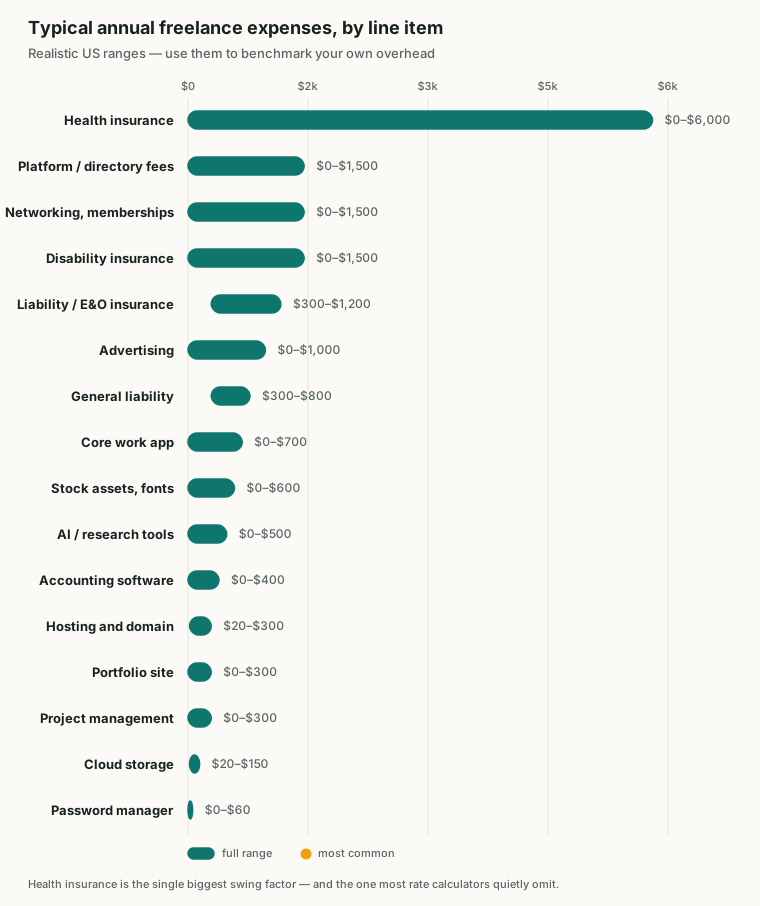
Health insurance is the biggest swing factor, and the one most rate calculators omit.
Two habits make these numbers honest. First, annualize everything: a $30/month app is $360 a year, not "thirty bucks." Second, spread lumpy purchases across their useful life: a $1,500 laptop you keep three years is $500 a year, not a one-time shock. Do that and your overhead stops surprising you.
Software and subscriptions: ~$300–$3,000/year
This is the category that quietly bleeds people, because every line looks trivial and the sum is not.
| Item | Typical annual range |
|---|---|
| Core work app (design / dev / writing suite) | $0–$700 |
| Cloud storage and backup | $20–$150 |
| Project management / time tracking | $0–$300 |
| Accounting or invoicing software | $0–$400 |
| Password manager and security basics | $0–$60 |
| Website hosting and domain renewal | $20–$300 |
| AI or research assistant tools | $0–$500 |
| Stock assets, fonts, templates | $0–$600 |
A minimalist writer might genuinely run $300 here. A designer or developer with a full creative stack, a project tool, accounting software, and a couple of AI subscriptions can easily hit $2,000 to $3,000. The first time I tallied mine, I found $2,300 a year I had never once priced into my rate.
Hardware and equipment: ~$400–$2,500/year (amortized)
Hardware comes in lumps, so the trick is to divide each purchase by how many years it lasts and book that slice every year.
- Primary computer: a $1,500 laptop over 3 years is ~$500/year; a $3,000 workstation over 4 years is ~$750/year
- Monitor, keyboard, mouse, dock: ~$50–$200/year amortized
- Phone (business share): ~$150–$500/year of the plan and device
- Mic, webcam, or camera if your work needs them: ~$30–$300/year
- Desk, chair, ergonomics: a $400 chair over 8 years is ~$50/year
- External drives and backup hardware: ~$20–$150/year
A lean freelancer on one modest laptop and a phone might run $400 a year amortized. Someone with a powerful machine, dual monitors, and real audio/video gear lands closer to $2,000 to $2,500. Booking it annually turns a dead machine from a panic into a planned replacement.
Insurance and protection: ~$0–$8,000/year
This is the widest range on the page, and the most consequential. Skip it and one bad year erases several good ones.
| Item | Typical annual range |
|---|---|
| Professional liability / E&O insurance | $300–$1,200 |
| General liability (if you meet clients or work on-site) | $300–$800 |
| Health insurance (self-funded) | $0–$6,000+ |
| Disability insurance | $0–$1,500 |
Health coverage is the number that swallows the rest. A freelancer buying a marketplace plan can easily pay several thousand dollars a year, and it is the single line freelancers most often forget to fund from their rate. If you are on a spouse's plan, your number here might be near zero; if you are self-funding, it can dwarf every other category combined.
Taxes handling and admin: ~$200–$3,000/year
These are the costs of being a legitimate business. Note: this is the cost of handling taxes, not the tax bill itself, which is a separate layer your rate must clear.
- Accountant or bookkeeper: ~$300–$2,000/year depending on complexity
- Tax prep / quarterly filing help: ~$200–$800/year
- Business formation and annual state fees: ~$50–$800/year (varies wildly by state)
- Business bank and card fees: ~$0–$200/year
- Lawyer to draft or review a contract template: ~$0–$1,000 (often one-time, amortize it)
A freelancer who does their own books and files a simple return might spend $200 here. Add an LLC, an accountant, and quarterly estimates and you are at $1,500 to $3,000. For how the tax bill itself behaves inside your rate, see freelance tax basics.
Marketing, sales, and payment fees: ~$200–$4,000/year
You are not paid for the hours spent finding work, so the cost of finding it has to live in overhead.
| Item | Typical annual range |
|---|---|
| Portfolio site (beyond hosting already counted) | $0–$300 |
| Platform / directory / marketplace fees | $0–$1,500 |
| Networking, memberships, conferences | $0–$1,500 |
| Advertising or sponsored placements | $0–$1,000 |
| Payment processing fees (~3% of invoiced revenue) | $300–$3,000 |
Payment fees are the silent killer here. If you invoice $90,000 a year and lose roughly 3 percent to processing, that is about $2,700 gone before you buy a single tool. Most freelancers never put that on their rate, which means clients effectively get a 3 percent discount funded by your take-home.
Education and growth: ~$100–$2,000/year
The skills that justify your rate need maintenance.
- Online courses and certifications: ~$100–$1,000/year
- Books, paid newsletters, publications: ~$50–$300/year
- Coaching or a mastermind group: ~$0–$3,000/year (the real variable here)
- Conference tickets and travel: ~$0–$2,000/year
Be honest and count what you will actually buy this year, not an aspirational shelf of courses you will never open. A realistic figure for most freelancers is a few hundred dollars.
Coworking, space, and reinvestment: ~$0–$8,000/year
Optional for many, significant for some.
- Coworking membership: ~$0–$3,600/year (a $300/month hot desk is $3,600)
- Home office utilities share (business portion of internet, electricity): ~$200–$800/year
- Subcontractor or virtual assistant: ~$0–$10,000+ (scales with how much you delegate)
- Profit buffer and retirement contributions: as much as you can manage
This category is where a scaling freelancer's overhead really takes off. A hot desk plus a part-time VA can add $8,000 to $12,000 a year on its own, which is exactly why scaling changes your rate math, not just your revenue.
Total annual overhead by persona
Here is the part most freelancers skip: rolling it all up. The table below estimates total annual overhead for three common stages. Your mix will differ, but the magnitudes are realistic.
| Persona | Typical annual overhead | What drives the number |
|---|---|---|
| Lean solo (new, minimal tools) | ~$3,000 | One core app, a few subscriptions, phone share, amortized laptop, on a partner's health plan, DIY taxes |
| Established solo (full-time, self-sufficient) | ~$9,000 | Full software stack, real E&O insurance, accountant, hardware replacement, ~$2,500 in payment fees, modest education |
| Scaling freelancer (delegating, premium) | ~$20,000+ | Everything above plus self-funded health insurance, coworking, a part-time VA or subcontractor, conferences, and reinvestment |
The jump from lean to scaling is not linear, and that surprises people. The biggest step-changes are almost always health insurance and paid help (a VA, a subcontractor, an accountant). Those two categories can each rival your entire software bill.
How this hits your rate
I will keep this short, because the full arithmetic lives elsewhere. Your overhead is a floor your rate must clear before you have paid yourself a cent. Take your total, divide by your realistic billable hours, and you get the per-hour cost of simply existing as a business.
Using the established-solo figure: $9,000 ÷ 1,200 billable hours = $7.50 per hour. That $7.50 funds nothing but overhead. Your salary, self-employment tax, and profit all stack on top. If you assumed 2,080 hours instead of a realistic 1,200, you would have undercounted that floor by nearly half, which is a classic underpricing trap (the billable hours guide explains why the real number is so much lower).
To turn this list into an actual price, do two things. First, work through the freelance business expenses checklist so nothing falls off your rate. Then drop your real overhead total and realistic hours into the freelance rate calculator and watch how fast a "fair-feeling" number turns out to be too low. More benchmarks across guides live in the guides hub.
A note on deductibility
Many items on this list are generally tax-deductible as ordinary and necessary business costs: software, work hardware, business insurance, professional fees, marketing, and education for your current trade. Personal living costs are not, and mixed-use items (a phone that is 60 percent work) are only deductible for the business-use share.
That said, deductibility genuinely depends on your situation and changes over time. Read the official guidance on the IRS deducting business expenses page and confirm specifics with a tax pro. Do not treat these ranges as tax advice. They are a budgeting benchmark, full stop.
Questions people ask
- What are typical freelance expenses in a year?
For a working solo freelancer, typical annual expenses land somewhere between $3,000 and $20,000 depending on stage. A lean beginner might run $3,000 on software, a phone share, and a few subscriptions. An established solo freelancer commonly spends around $9,000 once insurance, an accountant, hardware replacement, and payment fees are included. A scaling freelancer who uses subcontractors and coworking can pass $20,000.
- How much do freelancers spend on software per year?
Software and subscriptions typically run $300 to $3,000 a year. A minimalist might pay $300 for one core tool plus cloud storage. A designer or developer juggling a full stack of creative apps, project management, accounting, and AI tools commonly lands between $1,500 and $3,000. The total creeps up quietly because each line looks small on its own.
- Are these typical freelance expenses tax-deductible?
Many ordinary and necessary business costs on this list are generally deductible, including software, work hardware, business insurance, professional fees, and marketing. Personal living costs are not, and mixed-use items like a phone are only deductible for the business-use share. Deductibility depends on your situation, so confirm specifics with a tax professional and the IRS.
- How do typical expenses change my hourly rate?
Add up your annual expenses, then divide by your realistic billable hours. If your overhead is $9,000 and you bill 1,200 hours, that is $7.50 per hour your rate must cover before any salary, taxes, or profit. Expenses are invisible until you run that division, which is why so many freelancers underprice.
- What is the biggest hidden freelance expense?
Two usually top the list: health insurance and payment processing fees. Health coverage can run several thousand dollars a year and often gets left off the rate entirely. Payment fees of roughly 3 percent quietly skim $2,000 to $3,000 off a $90,000 invoicing year before you spend anything on tools.
- Why are my expenses higher than these ranges?
Region and trade explain most of it. A freelancer in a high-cost city, in a tool-heavy field like video or 3D, or one self-funding family health insurance will sit above these ranges. That is fine, as long as your rate covers it. The danger is being above the ranges and charging like you are below them.
- Should I count taxes in this list?
No. This list covers operating costs and the cost of handling taxes (an accountant, filing help). The tax bill itself is a separate layer that your rate must clear after expenses and salary. Mixing the two together usually leads to undercounting both.
- How often should I update my expense estimate?
Re-tally at least once a quarter and immediately after any new subscription, big purchase, or insurance change. Subscriptions creep up silently, and a stale expense estimate means a stale, too-low rate.
- Can I lower these expenses without hurting my work?
Often, yes. Audit subscriptions for tools you stopped using, negotiate annual instead of monthly billing, and reconsider payment methods that charge high fees for large invoices. Just do not cut insurance or the gear your work depends on to chase a smaller number.
Put these numbers to work
Use the free freelance rate calculator to turn this into your own hourly rate in under a minute.
Open the calculatorKeep reading
More in Money & Taxes, or browse all guides.
Cost to start a freelance business in 2026, itemized: a $0 bootstrap path, a lean $500 budget, a comfortable $2,500 setup, plus the hidden first-90-days gap.
ReadA working writer's honest take on freelance writer expenses: what to spend on tools, the 10-15% overhead rule, a real annual budget, and what pays for itself.
ReadA freelance business expenses checklist, organized by category, so your rate funds every real cost instead of quietly paying for them out of your take-home.
ReadFreelance tax basics for beginners, answered in plain language: self-employment tax, quarterly payments, set-aside math, and deductions that actually help.
ReadFreelance developer hourly rate bands for 2026 by stack, plus the domain premium that adds 25-40% for exactly the same technical work.
ReadFreelance designer hourly rate bands for 2026 across eight specialties, and why the spread inside one discipline beats the gap between disciplines.
Read