Monthly Retainer Pricing for Part-Time Freelancers
Monthly retainer pricing for part-time freelancers: how to size hours around a day job, price evenings higher, and avoid over-committing time you don't have.
Practical guidance, not financial advice. Sukie is a working freelancer, not a licensed accountant or financial advisor. Use this to make a defensible decision, then confirm the specifics for your situation with a qualified professional.

By Sukie · Founder & Writer, FreelanceRateLab
Updated August 11, 2026 · 8 min read
$760 a month for eight hours — my first retainer while holding a full-time job, and a number I picked badly. Monthly retainer pricing for part-time freelancers becomes tempting the moment you start freelancing on the side. After months of chasing one-off gigs around a day job, a fixed monthly fee feels like solid ground: predictable income that lands on the same date every month, no re-selling yourself from scratch every few weeks. I felt that pull hard in my first year of moonlighting, and I signed my first retainer mostly because the steadiness sounded so good.
It is also the single easiest way for a part-timer to dig a hole. A retainer is a standing promise to deliver capacity you may not actually own. When you freelance full time, a heavy month just means a long week. When you freelance around a 9-to-5, a heavy month means evenings disappear, weekends evaporate, and the day job you depend on starts to suffer. That is why monthly retainer pricing for part-time freelancers is a different problem than it is for full-timers, and copying full-time advice is how people burn out.
This guide takes a capacity-first approach. Before we touch a dollar figure, we figure out how many hours you can honestly sell. Then we price those scarce hours (often higher, not lower), build the boundaries that protect them, and look at the real danger of stacking retainers while employed. If you want the general version that isn't specific to part-timers, I've written a full retainer pricing decision framework too.
Start With Capacity, Not Price
Most retainer advice starts with "what should I charge?" For a part-timer, that's the second question. The first is "how much can I actually commit, every single month, without wrecking the rest of my life?"
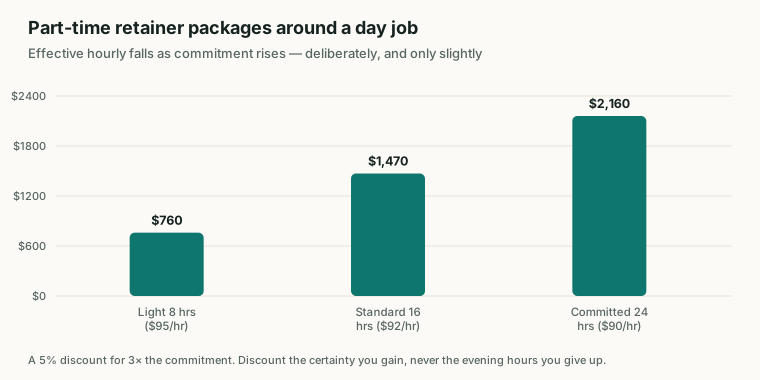
A 5% effective-rate discount for 3× the commitment — and not a penny more.
A retainer is a recurring obligation. You're not selling a project you can grind through once and recover from. You're promising the same availability in your slowest, most exhausted week as in your best one. So the number that matters is not your peak capacity. It's your reliable floor.
Here's the trap I fell into: I counted my best week. I had one glorious Sunday where I knocked out six hours of focused work and thought, "I can clearly do 20 hours a month around my job." I committed to it. Then came a brutal quarter-close at the day job, a head cold, and a friend's wedding, and I was suddenly delivering retainer work at 11pm resenting every minute. The retainer didn't change. My life did, and the promise didn't bend.
The Capacity Math: What Can You Really Sell?
Let's do the actual arithmetic, because this is the part that saves you. The goal is to convert "I have some free time" into a defensible number of committed retainer hours.
Step 1 — Find your raw spare hours. Add up the hours in a normal week that are genuinely free for paid work, after the day job, commute, sleep, meals, and basic life. Be honest. For a lot of employed freelancers this lands around 8 to 12 hours a week. Say you land on 10 hours a week.
Step 2 — Subtract a fatigue and life buffer. You cannot bill 100% of spare time, month after month, without breaking. Evenings get eaten by tiredness, errands, and the occasional day-job emergency. Knock off roughly 30–40%.
10 spare hrs × 0.65 = 6.5 sustainable hours/week
Step 3 — Convert to a monthly retainer number, rounded down. Multiply by about 4.3 weeks, then round down to leave slack.
6.5 hrs/week × 4.3 ≈ 28 hrs/month → commit to about 24 hours/month
So someone with 10 spare hours a week can safely sell roughly 6 to 8 retainer hours a week, not 10. The gap between 10 and 7 isn't wasted; it's the buffer that lets you keep the promise during a bad week and still take the occasional one-off gig without imploding. Notice we're talking about real billable hours here, not seat-time. If that distinction is fuzzy for you, billable hours explained is worth a read before you commit a single hour.
The rule of thumb I give every side-hustler: commit to about two-thirds of your raw spare hours. The other third is what keeps this sustainable past month three.
Why Part-Timers Should Price HIGHER, Not Lower
Now the part that surprises people. New side-hustlers assume they should discount because they're "only part time." That's backwards.
Think about what you're actually selling. A full-time freelancer sells daytime hours from a 40-hour pool. You're selling evenings and weekends carved out of a life that's already full. Your hours come from your rest, your relationships, your one free Saturday. That is your scarcest, most expensive inventory. Scarce inventory commands a premium. It does not get a clearance sticker.
There's also an opportunity-cost angle. When you say yes to a retainer, you're saying no to rest you genuinely need to keep showing up at the job that pays your bills. That trade should be priced richly, or it isn't worth making.
Run the math against your own baseline. If your defensible hourly rate is $80/hour (get this from the rate formula guide if you don't have one), don't quietly drop to $65 because you feel like a part-timer. If anything, add a scarcity premium of 10–25% on top:
$80/hr × 1.15 = $92/hr for evening/weekend retainer work $92 × 7 committed hrs/week × 4.3 ≈ $2,770/month
That number might feel high when you're used to scraping together one-off gigs. It's correct. You're charging for your rarest time, with reserved availability attached.
Sample Part-Time Retainer Packages
Here's how that translates into clean packages you can actually put in front of a client. These assume an $80/hour baseline with a scarcity premium baked in. Adjust to your own number.
| Package | Committed hrs/month | Effective $/hr | Monthly fee | Good fit for |
|---|---|---|---|---|
| Light / starter | 8 hrs | $95 | $760 | A first side-hustle retainer; testing whether you can sustain it |
| Standard | 16 hrs | $92 | $1,470 | The sweet spot for ~10 spare-hrs/week capacity |
| Committed | 24 hrs | $90 | $2,160 | Confident, experienced moonlighters with steady free time |
| Rush-access add-on | n/a | +$300/mo flat | add to any tier | Clients who want guaranteed 24-hr turnaround |
A few things to notice. The per-hour rate barely drops as the package grows, because part-time capacity is scarce at every tier. The rush-access line is a separate flat fee, not a discount, because faster turnaround costs you more, not less. And the light tier exists on purpose: it lets you start small and prove the commitment is survivable before you scale up.
Protecting the Time You Sold
A part-time retainer lives or dies on boundaries. Full-timers can absorb a chaotic client during business hours. You can't, because your hours are already spoken for. The boundaries below go in the written agreement, not in your head, because the ones you try to enforce later always feel personal.
- Response time, not availability. Promise a 48-hour response window, not same-day. You have a day job; you cannot watch email at 2pm. Set this expectation up front and it's a non-issue. Leave it vague and every client assumes you're on call.
- No rush work as default. Standard turnaround is the deal. Anything genuinely urgent triggers a rush surcharge (the flat add-on above, or +50% on the affected hours). This isn't greedy; it's the only honest way to price the cost of dropping your evening plans.
- Defined working windows. Tell the client when you actually work the retainer ("Tuesday and Thursday evenings, Sunday mornings"). It sets expectations and quietly justifies why you're not replying during their Wednesday 10am fire drill.
- A hard cap with a clear overage rate. Included hours are a ceiling, not a suggestion. Beyond the cap, bill overage at your full rate or higher. A part-timer who lets hours creep is borrowing against sleep, and that loan always comes due.
Write these into a simple retainer agreement alongside the included scope, billing date, and notice period. If you're newer to freelancing on the side, the IRS has clear plain-language guidance on reporting side and gig income that's worth reading early so the tax side doesn't ambush you (irs.gov gig economy tax center).
The Real Danger: Stacking Retainers While Employed
Here's the failure mode I see most, and it almost got me. Once one retainer is running smoothly, the logic feels airtight: if one fixed monthly fee is good, two is better, three is freedom. You start dreaming about replacing the day job entirely.
The problem is that retainers don't politely take turns. They all peak at the same time. A client's busy season, a campaign launch, a quarter-end push, these tend to cluster around the same calendar moments, and those moments often overlap with your own day job's crunch.
Let me make it concrete. Suppose you've got 10 spare hours a week and you (over-)commit to two 16-hour retainers, telling yourself the average will balance out. On a calm month, 32 committed hours across ~43 monthly free hours feels survivable. Then March hits: Client A launches a product, Client B's busy season starts, and your employer schedules a major release in the same two weeks. Both retainers spike to "we need you now." Your day job needs overtime. You have promised 32 hours plus your 40-hour job in a month where you genuinely have time for maybe 20 hours of freelance work. Something breaks, and it's usually your health, your reputation, or both.
I came within one stressful month of exactly this. The fix was unglamorous: I capped myself at one retainer plus occasional project work while employed. One standing promise I can always keep, with one-off projects layered on only when I genuinely have room. The day I want a second retainer is the day I'm seriously planning to leave the job, not before. If you want to pressure-test whether the freelance income even justifies the time, the freelance rate calculator on the homepage will show you the real per-hour math behind it.
Keep Going
- Get your defensible baseline first with the freelance rate calculator.
- Understand capacity properly in billable hours explained.
- Read the general retainer pricing framework for structures, overage rules, and the full decision tree.
Questions people ask
- Should part-time freelancers charge a lower retainer rate?
Usually the opposite. Your spare hours come at night and on weekends, which is scarce, high-cost time. A part-time freelance retainer should generally price per hour the same as or higher than full-time work, because you're selling your rarest capacity, not your overflow. Discounting it just means you're working your most precious hours for the least money.
- How many retainer hours can I safely sell around a full-time job?
Sell well below your raw spare hours. If you have about 10 truly free hours a week, commit to only 6 to 8 retainer hours, leaving a buffer for life, fatigue, and the busy weeks at your day job. The honest number is the average bad week, not your best week, because a retainer is a promise you have to keep every month.
- Is it risky to take on multiple retainers while employed?
Yes. Stacking two or three retainers while working full time is the fastest way to over-commit hours you don't have. Each retainer is a standing monthly obligation, and they all peak at once during your day job's crunch weeks. Most employed freelancers should cap themselves at one retainer plus occasional one-off project work.
- How do I protect my time on a part-time retainer?
Write boundaries into the agreement: a 48-hour response window instead of same-day, no rush or weekend-emergency work without a surcharge, and a hard cap on included hours with a clear overage rate. Boundaries you put in the contract are easy to hold; ones you try to enforce later feel personal and rarely stick.
- Can I switch a one-off client to a part-time retainer?
Yes, and it's the best way to start. A client you've already done a few projects for has a known demand pattern, so you can size the retainer to reality instead of guessing. Watch their actual monthly usage for two or three jobs, then propose a retainer at the average, not the peak.
- What if my day job gets busier after I've signed a retainer?
Build for this before it happens by committing to only two-thirds of your spare hours. That buffer absorbs most day-job spikes. If your job's load changes permanently, use the agreement's notice period to downgrade to a smaller tier rather than quietly under-delivering and damaging the relationship.
- Should I tell the client I'm part time?
You don't owe them your schedule, but you do owe them accurate expectations. Frame it as your working windows and response time rather than "I have a day job." Clients care about reliability and clear turnaround, not whether you freelance full time. Set the boundaries clearly and most never think about it again.
- Is a side hustle retainer worth the commitment at all?
Often yes, if it's sized honestly. One well-priced part-time retainer gives you a predictable income floor that makes the rest of your freelancing less stressful and less lumpy. The danger isn't retainers themselves; it's over-committing scarce evening and weekend hours you can't actually spare.
Put these numbers to work
Use the free freelance rate calculator to turn this into your own hourly rate in under a minute.
Open the calculatorKeep reading
More in Pricing Models, or browse all guides.
ROI of hiring a freelancer, calculated the way finance wants it: loaded cost comparison, four attribution models, and the traps that inflate the number.
ReadFreelance retainer rates by discipline and hour band: real 2026 monthly ranges for writers, designers, developers, and VAs, plus the discount ceiling.
ReadThere are 4 freelance retainer structures and each works differently. Learn which fits your client type before you sign anything.
ReadFreelance day rate vs hourly rate, compared side by side. See the math, when each model protects you, and how to set a day rate clients will accept.
ReadProject-based vs hourly rate explained: how each model works, who carries the risk, and which one actually protects your margin. With real dollar examples.
ReadA freelance editing retainer guide for editors and writers: price by word count or hours, with worked math, sample tiers, SLAs, and scope-creep protection.
Read