Your True Hourly Rate, Traced All the Way to the Bank
True hourly rate is what survives tax, unbillable time and overhead. The full trace from a $75 invoice line to the $21 that reaches your account.
Practical guidance, not financial advice. Sukie is a working freelancer, not a licensed accountant or financial advisor. Use this to make a defensible decision, then confirm the specifics for your situation with a qualified professional.

By Sukie · Founder & Writer, FreelanceRateLab
Published August 22, 2026 · 8 min read
True hourly rate is the number almost no freelancer knows, and it is the only one that describes your actual life. It is not what you quote. It is not what the invoice says. It is what is left of a billed hour after the tax on it, the unbillable hour that had to happen for it to exist, and its share of everything you pay for to stay in business.
I found mine by accident. In March 2025 I was arguing with myself about whether to take a $2,400 project I did not want, and to settle it I opened my books instead of my feelings. I had billed $61,200 that year. I had worked, by my own time log, 1,890 hours. That is $32.38 an hour of life, against a rate card that said $75. I had been telling people — and, worse, telling myself — a number that was 2.3× the truth.
This guide is that arithmetic, done properly, in the order it actually happens.
The four subtractions
Every billed hour passes through four gates before any of it is yours. Most rate advice covers one or two and stops. Here they are in the order the money meets them.
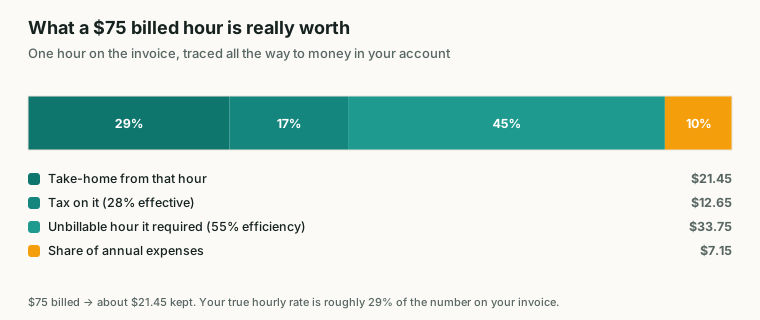
Where a $75 billed hour goes. Take-home is the smallest slice, and the unbillable hour behind it is the largest.
Gate one: the unbillable hour. This is the big one and it is the one people forget, because it does not appear on any statement. If you bill 22 hours in a 40-hour week — the figure I keep landing on, and the one in billable hours for freelancers — then every billable hour drags 0.82 of an unbillable hour behind it. Sales calls, scoping, invoicing, the Slack thread about the thing. That time is real, it is unpaid, and the only place it can be paid from is the billed hour.
At 55% billable efficiency, $75 of billing has to cover 1.82 hours of your working life. Before anything else touches it, your rate per hour-of-life is already $41.
Gate two: tax. Self-employment tax is 15.3% on net earnings, and that is before income tax, which nobody withheld for you. At a 28% effective combined load — a reasonable middle assumption for a US freelancer in a mid-tax state — $12.65 of that $75 was never yours.
Gate three: overhead. Software, insurance, hardware, accounting, the laptop you are amortising whether you think about it or not. On an $11,000 annual expense budget against 1,120 billable hours, that is $9.82 per billed hour, or $7.15 once you allocate it across the full 1.82-hour block.
Gate four: the buffer you should be keeping. Slow months, the client who pays in 74 days, the tooth. Most freelancers skip this one and then experience it as a crisis rather than a line item.
What survives: $21.45. That is 29% of the invoice.
The calculation, step by step
Here is the whole thing as a procedure you can run on your own numbers in about ten minutes. You need three inputs and a year of records.
| Step | What you need | Mine (2025) | Yours |
|---|---|---|---|
| 1 | Total collected revenue for the year | $61,200 | |
| 2 | Total hours worked — all of them, not just billed | 1,890 | |
| 3 | Revenue ÷ hours worked = gross true hourly | $32.38 | |
| 4 | Minus business expenses ÷ hours worked | −$5.82 | |
| 5 | Minus tax paid ÷ hours worked | −$7.31 | |
| 6 | = True hourly rate | $19.25 |
Step 2 is where people cheat, and it is the only step that matters. "Hours worked" means the 40 minutes you spent rewriting a proposal that went nowhere. It means the Sunday evening you spent reconciling receipts. It means the unpaid discovery call. If you do not have a time log, use a fortnight of honest tracking and multiply — you will still be closer than guessing.
Note the gap between step 3 and step 6. Gross true hourly is a useful number for benchmarking; the fully-loaded figure is the one that tells you what your work buys you. Both are worth knowing, and they answer different questions.
Why the rate card is not lying — it is just measuring something else
There is a tempting conclusion here, which is that your rate card is a fantasy and you should be furious about it. That is not quite right, and getting it wrong leads people to raise rates for the wrong reason and then fold under the first bit of pushback.
Your rate card measures the price of an hour of delivery. The fully-loaded figure measures the yield of an hour of life. Those are different units. The ratio between them is your business's efficiency, and it is the thing you can actually improve.
Three levers move it, and they move it by wildly different amounts:
- Raise the rate. A 20% rate increase moves the loaded figure by roughly 20%. Linear, immediate, and by far the highest-leverage of the three — which is the argument how to stop undercharging as a freelancer makes at length.
- Raise billable efficiency. Going from 55% to 65% is an 18% improvement, and it is much harder than it sounds. Most of the unbillable 45% is sales and admin that does not compress just because you would like it to.
- Cut overhead. On an $11,000 budget, cutting 20% moves the figure by about $1.96. Real, but it is the smallest lever, and it is the one freelancers reach for first because it feels like discipline.
The order is: rate, then efficiency, then overhead. Most people run it backwards, cancel a $12 subscription, and wonder why nothing changed.
The number that made me change something
Back to March 2025. $32.38 gross, $19.25 true. The project I was arguing about was $2,400 for what I estimated at 26 hours of delivery. At my real efficiency that is 47 hours of life, so it was a $51/hour job on the rate card and a $14.60/hour job in the only unit that counts.
I said no. Then I did something more useful: I went back through eleven months of invoices and calculated true hourly for each engagement separately. The spread was brutal and clarifying.
| Engagement type | Rate card | True hourly | Why |
|---|---|---|---|
| Retainer, 16 hrs/mo | $92 | $34.10 | Low sales overhead, predictable, no scoping |
| Repeat project client | $85 | $27.80 | Some scoping, no pitching |
| New client, referred | $85 | $19.40 | Full scoping, one free call |
| New client, cold inbound | $75 | $9.15 | Three calls, two proposals, one ghosting |
Cold inbound was costing me money. Not "earning less" — costing. Once I counted the proposals that went nowhere against the ones that landed, the whole channel was net-negative, and it had looked fine for two years because I only ever counted the wins.
That table is the single most useful thing I have ever built about my own business, and it took an afternoon. Retainers won by a factor of nearly four over cold inbound at a rate difference of only 23%. That is not a pricing insight. It is a business-model insight, and true hourly rate is the only lens that shows it.
The three mistakes that make the number look better than it is
Once people start calculating this, three errors reliably show up, and all three flatter the result.
Counting only the hours you remember. Time logged retrospectively is always lower than time logged live, and the difference is not small — when I compared a month of memory-based estimates against a month of live tracking, memory undercounted by 22%. Almost all of the missing time was in five-minute pieces: the Slack reply, the invoice chase, the calendar reshuffle. Those pieces are the unbillable hour.
Treating a good month as the baseline. Your true hourly rate in a month where two retainers ran and nothing broke is not your true hourly rate. Use twelve months. If you only have three, use three and label it provisional.
Excluding the work that did not convert. Every proposal that went nowhere was hours. Every discovery call that ended politely was hours. If you count only the engagements that produced revenue, you have calculated the rate of your wins, which is a different and much less useful number. The whole point of this exercise is that the losses are paid for out of the wins.
What to do with your number once you have it
Set your floor from it, not from your rate card. If you need to clear $55,000 in take-home and your true hourly rate is $19, you need 2,894 hours a year, which does not exist. Work backwards instead: pick the take-home, pick a survivable number of hours, and the required rate falls out. That is exactly what the freelance rate calculator formula does, and the rate calculator will run it for you in under a minute.
Re-run it per channel, not just per year. The aggregate number tells you whether you are fine. The per-channel breakdown tells you what to stop doing.
Re-run it annually, in January, on the previous year. Not monthly — the noise will drive you mad and a single slow month will look like collapse. Once a year, with real figures.
Do not quote it to clients. Ever. It is a management number, not a negotiating one. A client who hears "I only keep $19 of this" has been handed a reason to believe your price is arbitrary. The IRS's own guidance for the self-employed treats these costs as ordinary business expenses precisely because they are — they are the cost of being a business, not a discount you are asking a client to fund.
If you take one thing from this: the number on your invoice is a price, not a wage. The gap between them is not a failure — every business has one. But you cannot manage a gap you have never measured, and until you have run the six steps above on your own books, every pricing decision you make is being made with the wrong number.
Run it once. It takes an afternoon and it will change what you say yes to.
Related reading: realistic billable hours per day for where the unbillable time actually goes, freelance business expenses checklist for the overhead line, and the FreelanceRateLab homepage if you want the short version with a calculator attached.
Put these numbers to work
Use the free freelance rate calculator to turn this into your own hourly rate in under a minute.
Open the calculatorKeep reading
More in Setting Your Rate, or browse all guides.
Freelance hourly rate from salary, converted honestly: gross up for self-employment tax, replace benefits, add expenses, and divide by real billable hours.
ReadLearn how to stop undercharging as a freelancer with a rate floor formula, 5 warning signs, and a 4-step plan to raise your rate this week.
ReadRealistic billable hours per day for most freelancers sit at 4 to 6, not 7 or 8. See why the daily target matters, the math, and how to raise it sanely.
ReadFollow the freelance rate calculator formula step by step with one real example: a UX designer turning an $85,000 take-home goal into an hourly rate.
ReadBillable hours for freelancers are never the same as hours worked. See the real week, the efficiency math, and what it does to your rate.
ReadROI of hiring a freelancer, calculated the way finance wants it: loaded cost comparison, four attribution models, and the traps that inflate the number.
Read