The ROI of Hiring a Freelancer, Measured Properly
ROI of hiring a freelancer, calculated the way finance wants it: loaded cost comparison, four attribution models, and the traps that inflate the number.
Practical guidance, not financial advice. Sukie is a working freelancer, not a licensed accountant or financial advisor. Use this to make a defensible decision, then confirm the specifics for your situation with a qualified professional.

By Sukie · Founder & Writer, FreelanceRateLab
Published September 11, 2026 · 10 min read
The ROI of hiring a freelancer is almost always calculated wrongly, and almost always in the freelancer's favour — which is a strange thing to say on a site written for freelancers, but it is true and it matters. Buyers compare an hourly rate to a salary, get a number that looks alarming, and either reject the freelancer or approve them for the wrong reasons. Neither outcome is good for anybody.
This guide is written for the person on the other side of the invoice: the founder, marketing lead, or operations manager who has to justify a freelance spend to somebody with a spreadsheet. It is the companion to calculating freelancer ROI, which covers the same arithmetic from the freelancer's side of the table.
Start by fixing the comparison
The most common error is comparing a freelancer's hourly rate to an employee's salary divided by 2,080 hours. That comparison is not close to fair, because a salary is roughly two-thirds of what an employee costs.
Here is a like-for-like year, for the same scope of specialist work:
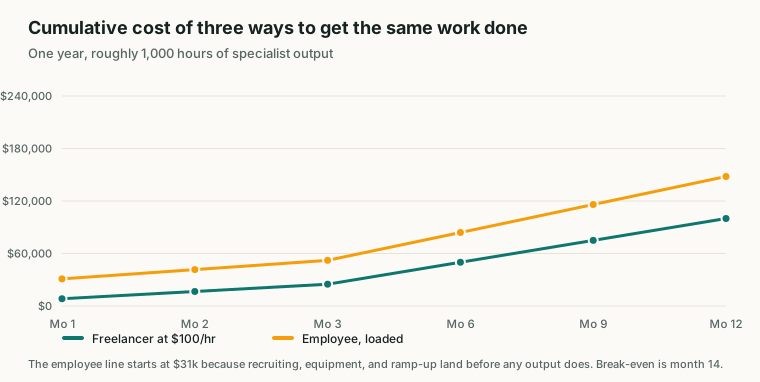
One year of roughly 1,000 hours of specialist output, three ways.
| Cost line | Freelancer, 1,000 hrs @ $100 | Employee, $95k salary | Agency, same scope |
|---|---|---|---|
| Base cost | $100,000 | $95,000 | $235,000 |
| Employer payroll taxes (~7.65%) | — | $7,268 | included |
| Health, dental, vision | — | $14,400 | included |
| Retirement match (4%) | — | $3,800 | included |
| Equipment, software, seat | — | $4,500 | included |
| Recruiting and onboarding (amortised) | — | $9,000 | — |
| Paid time off, sick, holidays | — | (built into salary) | — |
| Total | $100,000 | $133,968 | $235,000 |
Three things fall out of that table immediately.
The freelancer's headline rate is the total cost. There is nothing underneath it. That is the single biggest structural advantage of contract work from a budgeting perspective, and it is invisible if you only compare hourly figures.
The employee is not badly priced — they are differently priced. $134,000 buys availability, institutional memory, and someone who will still be there in March. Those have real value; they are just not on the same line of the spreadsheet.
The agency premium is 2.35×, and much of it buys account management, redundancy, and a throat to choke. Whether that is worth $135,000 depends entirely on how much your organisation values not managing the relationship itself.
Do not stop at cost — cost is not ROI
A cheaper input is not a return. Return requires an output you can name.
The basic formula is unchanged from any other investment:
ROI % = (Value generated − Total cost) ÷ Total cost × 100
The difficulty is never the formula. It is that "value generated" for knowledge work is genuinely hard to attribute, and the temptation is either to invent a number or to give up and approve the spend on vibes. Both are common. Here is a way through.
Four attribution models, ranked by how defensible they are
1. Direct revenue attribution. The freelancer's output maps to tracked revenue. A conversion copywriter rewrites a checkout flow; the flow is A/B tested; the winning variant is worth $340,000 a year. Cost was $9,000. ROI is 3,678%. This is the cleanest model and it applies to a minority of work — mostly sales-facing, marketing, and product surfaces where measurement already exists.
2. Cost avoidance. The freelancer prevented a spend you would otherwise have made. A DevOps contractor spends 60 hours at $150 ($9,000) reworking your infrastructure and the monthly cloud bill falls by $4,100. Payback is 2.2 months; first-year return is $40,200 against $9,000, or 347%. Cost avoidance is nearly as defensible as revenue attribution and is dramatically under-used, because nobody gets promoted for the bill that did not arrive.
3. Capacity release. The freelancer freed expensive internal time for higher-value work. Your $180,000-a-year product lead was spending 8 hours a week on design production. A freelance designer takes it at $85/hour. The direct comparison — $85 versus roughly $115 fully loaded for the product lead — is a $30/hour saving, which is real but small. The actual return is what the product lead does with 8 reclaimed hours a week, and if you cannot name that, the number is soft. Say so in the memo rather than inflating it.
4. Optionality and speed. The freelancer let you test something in six weeks that would have taken six months to staff. This is the hardest to quantify and often the most valuable. The honest framing is not an ROI percentage — it is "we learned that this market does not work for $22,000 instead of learning it for $400,000." Frame it as avoided downside, not as return.
Use the highest-numbered model you can honestly support, and label which one you used. A memo that says "cost avoidance, $40,200 first-year, 347%" survives scrutiny. A memo with an unsourced 340% does not.
Time to value is the number executives actually care about
Almost every buyer I have worked with cares more about when than how much. A 200% return in six weeks beats a 400% return in eleven months for most operating budgets, because the second one has to survive a planning cycle.
Rough time-to-first-value by category, from engagements I have been on both sides of:
| Freelance work type | First measurable value | Why |
|---|---|---|
| Conversion copy, landing pages | 2–4 weeks | Existing traffic, existing test infrastructure |
| Paid ads management | 2–6 weeks | Immediate spend efficiency changes |
| Sales collateral, proposals | 3–6 weeks | Ties to an existing pipeline |
| Infrastructure and cost optimisation | 4–8 weeks | Billing cycle lag |
| Product / UX design | 6–12 weeks | Needs a build cycle before measurement |
| Brand identity | 6–18 months | Diffuse, rarely attributable |
| SEO and content | 4–9 months | Indexing and ranking lag |
This table answers a question I see asked repeatedly in one form or another — which freelance services show ROI in weeks, not months? The top three rows. Everything below the line is a real investment with a real return, but you should not promise a quarterly-reporting executive that brand work will show up in Q3 numbers.
Four traps that inflate the number
Counting gross revenue instead of margin. A freelancer whose work produced $200,000 of revenue at a 22% gross margin produced $44,000 of value, not $200,000. Use margin. Finance will.
Ignoring internal management cost. Every freelance engagement consumes internal hours: briefing, review, approval, coordination. Budget 10–20% of the engagement's hours as internal time and put it in the cost column. An engagement that needs 3 hours of your director's time per week is not costing you what the invoice says.
Attributing everything to the last thing you changed. If you hired a freelancer in the same month you also raised prices and launched a campaign, the freelancer did not cause all of the lift. Say so.
Comparing to zero instead of to the alternative. The counterfactual is rarely "we do nothing." It is usually "an internal person does it worse and later" or "we hire someone in five months." Compare against that, not against a blank page.
What to actually put in the memo
A structure that has survived scrutiny for me, in six lines:
- Scope and duration. "Checkout redesign, 8 weeks, ~120 hours."
- Total cost including internal time. "$14,400 invoiced + ~24 internal hours ≈ $17,300 fully loaded."
- Counterfactual. "Alternative was a Q3 internal hire — 5 months to productive, ~$56,000 for the same period."
- Attribution model. "Direct revenue attribution via A/B test."
- Measured value. "+4.1% checkout conversion, $181,000 annualised gross margin."
- Return and payback. "946% first-year return, payback in 5 weeks."
Six lines. No adjectives. Anyone who wants to argue with it has to argue with a specific number, which is exactly the conversation you want.
Rate is a poor proxy for value, in both directions
The instinct is to treat a higher rate as a worse deal. It is frequently the opposite, and the arithmetic is simple enough to be worth doing every time.
A $75/hour generalist takes 40 hours to produce a landing page: $3,000. A $160/hour specialist takes 12 hours: $1,920. The specialist is 36% cheaper and delivered three weeks earlier — and if the specialist's version converts better, the rate difference disappears entirely inside the first month of traffic.
This is the single most useful reframe available to a buyer: compare cost per outcome, not cost per hour. It is also, incidentally, the strongest argument a good freelancer has for their own rate — which is why how to measure rate of pay for freelancers approaches the same question from the buyer's chair, and why the highest-return four hours in most freelance businesses is a rate increase.
Where freelancers genuinely underperform employees
An honest guide has to include this section, and most do not.
Institutional memory. A freelancer who leaves takes context with them. If the work will need iterating for three years, the total cost of re-briefing every new contractor is real and rarely counted.
Availability during incidents. A freelancer with five other clients is not on call unless you have paid for on-call. If uptime matters, buy an explicit availability retainer rather than assuming.
Cross-functional glue. The unglamorous work of noticing that two teams are about to collide is done by people who sit inside the organisation. Freelancers structurally cannot do it, and paying them to try is expensive.
Anything that needs three years of compounding. Brand, culture, deep platform knowledge. Contract work is excellent at defined outcomes and poor at slow accumulation.
If the work you are buying is on this list, the freelancer-versus-employee comparison should probably resolve towards the employee, and the ROI arithmetic will not save it.
Structuring the engagement so ROI is measurable at all
Most unmeasurable freelance engagements were unmeasurable from the day they were signed. Four things fix that, and all four are decided before work starts.
Name the metric in the contract. Not "improve the site." "Increase checkout completion rate, measured in [tool], baseline 61.4%." If you cannot name a metric, you have bought effort, and you should say so rather than pretending otherwise later.
Record the baseline before day one. The number of engagements that become unmeasurable purely because nobody screenshotted the starting figure is genuinely remarkable.
Define the review point up front. "We assess at week six against the baseline." This protects the freelancer from vibes-based judgement as much as it protects you.
Buy a pilot before you buy a programme. A four-week, tightly scoped pilot with one named metric tells you more about fit than any portfolio. If it works, extend — and consider a retainer, which for ongoing work is usually cheaper per unit of output than repeated project engagements. Retainer pricing for freelancers and freelance retainer rates cover what the market charges for that.
A worked example, end to end
A 40-person B2B software company. Demand generation is stalled. Two options on the table.
Option A — hire a marketing manager. $105,000 salary, fully loaded $148,000. Time to hire: 11 weeks. Time to productive: 8 further weeks. First measurable output: month 5.
Option B — engage a freelance demand-gen specialist. $140/hour, 15 hours a week, 6-month engagement. Invoiced cost: $54,600. Internal management: ~60 hours of the CMO's time, ≈$7,200 loaded. Fully loaded: $61,800.
Result at month six: qualified pipeline up $890,000, gross margin 74%, so $658,600 of margin-weighted pipeline. Applying a 22% historical close rate gives $144,900 of attributable closed margin.
- Return: ($144,900 − $61,800) ÷ $61,800 = 134% in six months
- Payback: month 3
- Counterfactual: the employee would not have produced measurable output until month 5
Note what the memo does not claim. It does not count the full $890,000 of pipeline. It does not ignore the CMO's 60 hours. It applies the historical close rate rather than an optimistic one. The number that survives all three of those honesty adjustments is 134%, and 134% that holds up is worth more than 900% that gets picked apart in the meeting.
The checklist
Before you sign:
- Compared against loaded employee cost, not salary
- Named the counterfactual explicitly
- Chosen one attribution model and labelled it
- Recorded the baseline metric
- Budgeted internal management hours into total cost
- Set a review date and a named metric in writing
- Checked time-to-value against your reporting cycle
- Used margin, not gross revenue, in the value column
- Considered whether this work actually needs institutional memory
If you are on the other side of this — the freelancer being evaluated — every item above is something you can supply before you are asked, and doing so is worth more to your rate than any portfolio piece. Calculating freelancer ROI shows how to build the case, and the FreelanceRateLab calculator will tell you what your hour needs to earn for the arithmetic to work on your side too.
For the accounting treatment of contractor spend versus payroll, the IRS's independent contractor guidance is the authoritative reference on classification — worth reading before structuring a long, high-hour engagement that starts to look like employment.
Put these numbers to work
Use the free freelance rate calculator to turn this into your own hourly rate in under a minute.
Open the calculatorKeep reading
More in Pricing Models, or browse all guides.
Freelance retainer rates by discipline and hour band: real 2026 monthly ranges for writers, designers, developers, and VAs, plus the discount ceiling.
ReadThere are 4 freelance retainer structures and each works differently. Learn which fits your client type before you sign anything.
ReadFreelance day rate vs hourly rate, compared side by side. See the math, when each model protects you, and how to set a day rate clients will accept.
ReadProject-based vs hourly rate explained: how each model works, who carries the risk, and which one actually protects your margin. With real dollar examples.
ReadMonthly retainer pricing for part-time freelancers: how to size hours around a day job, price evenings higher, and avoid over-committing time you don't have.
ReadA freelance editing retainer guide for editors and writers: price by word count or hours, with worked math, sample tiers, SLAs, and scope-creep protection.
Read