Retainer Pricing for Freelancers: A Decision Framework
Retainer pricing for freelancers, made simple: a decision framework for when to offer one, which structure to use, and how to price it off your hourly rate.
Practical guidance, not financial advice. Sukie is a working freelancer, not a licensed accountant or financial advisor. Use this to make a defensible decision, then confirm the specifics for your situation with a qualified professional.

By Sukie · Founder & Writer, FreelanceRateLab
Updated August 11, 2026 · 8 min read
Retainer pricing for freelancers comes down to a trade. You give up some flexibility, the client gives up some of theirs, and in exchange you both get predictability. That is the whole deal in one sentence, and it is the lens I use every time someone asks me to "go on retainer."
When I first started offering them, I treated retainers as free money: guaranteed income, no more chasing invoices. Then I spent a January doing twice the agreed hours for a client who "just had a busy month," and my effective rate quietly dropped from $100 to about $58. That month taught me that retainer pricing for freelancers is not a discount you hand out for loyalty. It is a structured agreement you design on purpose, anchored to the same baseline you'd get from the freelance rate calculator on the homepage.
This guide is the general framework. It walks through whether to offer a retainer at all, which of the three structures fits, how to price it off your hourly number with the actual math, and the upgrade and downgrade rules that keep it profitable. If you want the niche versions afterward, I've written one for editing and writing retainers and one for part-time freelance retainers.
The Real Trade: Stability vs Flexibility
Every retainer sits on a slider between two things you want and can't fully have at once.
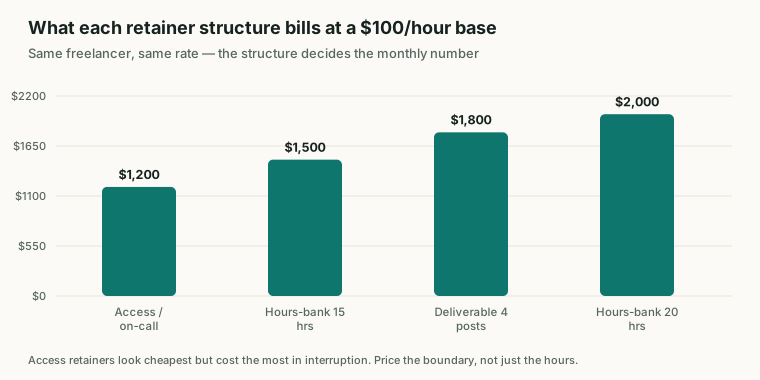
Same freelancer, same rate. The structure decides the monthly number.
On the stability end: reliable monthly income, less time spent selling, smoother cash flow, a client relationship deep enough that the work gets easier over time. On the flexibility end: the freedom to take a better-paying project next week, to scale your hours up or down, to walk away from a client who turns sour without blowing a hole in your revenue.
A retainer pushes you toward stability and away from flexibility. That is fine when the trade is fair. It stops being fair when you've reserved capacity you can't use elsewhere and the client isn't reliably using it either. The skill is reading which side of the slider a given client actually belongs on before you sign anything.
Should You Offer a Retainer? Walk the Tree
I run every potential retainer through the same set of yes/no questions. Follow the branches.
- Is the client's problem ongoing, or is it a one-time job?
- One-time → No retainer. Quote it as a project. See hourly vs project pricing.
- Ongoing → keep going.
- Can the client forecast roughly how much help they'll need each month?
- No, it's wildly unpredictable → Don't lock a fixed retainer yet. Use an hours-bank plan with a clear overage rate, or stay project-based until a pattern shows.
- Yes, it's fairly steady → keep going.
- Does reserving capacity for them cost you real opportunity (turning down other work)?
- Yes → A retainer is fine, but price the priority in. Reserved time is not free.
- No, you have slack → A retainer is low-risk and can fill your calendar. Good fit.
- Is the client organized, or chaotic and reactive?
- Organized and plans ahead → A deliverable-based retainer can work and is efficient.
- Reactive, lots of "quick favors" → Use an hours bank with strict boundaries, or you'll bleed unbilled time.
- Would this retainer genuinely cut your sales and onboarding time?
- Yes → A modest discount versus project rates can be justified.
- No → Charge full rate or a premium. There's no efficiency to pass along.
If you reach the bottom of that tree and still want the deal, you're ready to pick a structure.
The Three Retainer Structures
There are three workhorse models. Most bad retainers come from picking the wrong one for the client in front of you, so match the structure to behavior, not to what sounds cleanest.
| Structure | Best for | What it protects | Main risk |
|---|---|---|---|
| Hours-bank (e.g. 15 hrs/month) | Reactive clients with variable needs; ad-hoc support, maintenance, tweaks | Your time and your effective hourly rate | Tracking overhead; arguments over what counts as billable |
| Deliverable-based (e.g. 4 blog posts/month) | Organized clients with predictable, repeatable output | Your scope and the client's budget clarity | Hidden time risk if a "deliverable" balloons in effort |
| Access / availability (priority + guaranteed response time) | Clients who mainly need you on call, fast, when something breaks | Responsiveness and your priority premium | Interruption cost; needs hard boundaries or it eats your week |
A quick read on each. The hours-bank is the safest default when you don't fully trust the demand pattern, because every hour maps to money. The deliverable model reads cleaner to clients and removes time-tracking friction, but it quietly transfers risk to you the moment a deliverable takes longer than expected. The access model is the most profitable when priced right and the most dangerous when priced wrong, because "be available" with no cap means you're always half on duty.
Pricing the Retainer Off Your Hourly Baseline
Here is the part people skip, then regret. A retainer is not a vibe. It is your hourly baseline times reserved hours, plus a premium for whatever the client is really buying.
Start with your hourly number. If you don't have a defensible one, get it from the rate formula guide first, because everything below is built on it. Say your baseline is $100/hour.
Step 1 — Set the floor. Decide the realistic hours per month. Not the busiest month; the honest average.
$100/hr × 10 hrs = $1,000/month floor
That $1,000 is the absolute minimum. Charging less means a retainer hour is worth less than a normal hour, which is backwards.
Step 2 — Add the priority premium. If the client also gets faster response times or a guaranteed slot, you're carrying interruption cost. Context-switching is real work. I add 15–25% for genuine priority access.
$1,000 × 1.20 = $1,200/month for a priority hours-bank retainer
Step 3 — Adjust for efficiency, honestly. If, and only if, the retainer truly saves you sales time and onboarding, you can trim a little. A retainer that replaces re-pitching every month might justify shaving 10%. Don't discount a retainer that adds interruptions; that one should cost more, not less.
Step 4 — Sanity-check the effective rate. After a couple of months, divide what you billed by the hours you actually worked.
If you charged $1,200 but worked 16 hours: $1,200 ÷ 16 = $75/hr effective
That $75 is well under your $100 baseline, which is the early-warning light that scope has crept. The fix isn't to suffer through it; it's to hit an upgrade threshold. One caution: your "10 hours" should be billable hours, not seat-time. If you're fuzzy on that distinction, billable hours explained clears it up.
Upgrade and Downgrade Rules (Use Real Thresholds)
Retainers drift. The client asks for a little extra, you say yes, and three months later the margin is gone. The cure is to write the thresholds into the agreement before any friction starts, so adjusting the plan feels mechanical instead of personal.
These are the rules I put in writing:
- Overage rate: any hour beyond the plan bills at your standard rate (or higher). For a $100 baseline, overage at $110–$125/hr is normal. The premium nudges the client to upgrade instead of treating overages as a loophole.
- Rollover cap: unused hours roll over once, capped at 25% of the monthly allotment, then expire. This stops clients from hoarding a giant bank to dump on you in one brutal month.
- Upgrade trigger: if usage exceeds 110% of the plan for two consecutive months, move to the next tier. Two months rules out a one-off spike.
- Downgrade trigger: if usage falls below 70% for two consecutive months, drop a tier or convert to project work. Better to right-size than to have the client feel they're paying for nothing and cancel entirely.
- Quarterly review: a standing 15-minute check every three months to confirm the plan still matches reality. Catching drift early is the difference between a calm email and an awkward renegotiation.
Put these in a written freelance retainer agreement alongside the included scope, billing date, and notice period. The U.S. Small Business Administration has solid plain-language guidance on contracts and managing client relationships worth reading before you finalize terms (sba.gov). A retainer without these thresholds isn't a deal; it's a slow leak.
A Worked Example, Start to Finish
Let me run a real-feeling one. A SaaS client wants ongoing help: small site updates, the occasional landing page, fast turnaround when a campaign launches. Reactive, but steady.
That points to a priority hours-bank retainer. I estimate they'll need about 12 hours a month based on a trial month where they used 11. Baseline $100/hr.
Floor: $100 × 12 = $1,200 Priority premium (they want 24-hour response): ×1.20 = $1,440/month Overage rate beyond 12 hrs: $120/hr Rollover: up to 3 hours, expires after one month
Month one they use 12 hours, clean. Month two a campaign hits and they use 16. That's 133% of plan. Month three they use 15, still over 110%. Two consecutive months over threshold, so I email: "We've been consistently over the plan, let's move to the 18-hour tier at $2,160." No drama, because the rule was already written down. My effective rate held near $100 the whole time instead of sliding to $58 like that January years ago.
Keep Going
- Get your baseline number first with the freelance rate calculator.
- Compare the alternative in hourly vs project pricing.
- For specific niches: editing and writing retainers and part-time freelance retainers.
Questions people ask
- How is retainer pricing for freelancers different from hourly billing?
Hourly bills for time already spent. A retainer charges a fixed monthly fee in exchange for reserved capacity, so the client is paying for access and predictability, not just hours. That reserved capacity is why a retainer hour should usually cost the same as or more than a one-off hour, never less.
- Should a freelance retainer be cheaper than project work?
Only if it genuinely lowers your costs by cutting sales time, onboarding, and churn. If the retainer increases interruptions or forces fast turnaround, price it higher than equivalent project work, not lower. A discount only makes sense when the client trades flexibility for that lower price.
- How many hours should a monthly retainer include?
Start with the realistic monthly average the client actually needs, not the busiest month. A common starting point is 10 to 20 hours. Track usage for two or three months, then adjust using clear upgrade and downgrade thresholds so neither side is quietly losing money.
- What goes in a freelance retainer agreement?
Spell out the included hours or deliverables, the overage rate, the rollover policy, response-time expectations, the billing date, the notice period to cancel, and what counts as out of scope. Vague retainer agreements are where margin quietly disappears.
- What if a client wants a retainer but can't define the scope?
Don't lock in a fixed-deliverable retainer yet. Start with a small hours-bank plan or a short paid discovery phase. Once a usage pattern emerges over a month or two, convert it into a properly structured retainer with real numbers behind it.
- Is a retainer better than just billing hourly?
Neither is "better." A retainer trades flexibility for stability and is worth it when the work is ongoing and forecastable. Pure hourly keeps you flexible but leaves income lumpy. Many freelancers run a couple of retainers for a stable base and bill the rest hourly or by project.
- How do I price a retainer when usage is irregular?
Price on the realistic monthly average, not the peak, and attach a clear overage rate. The overage absorbs the spiky months so your effective rate doesn't erode, and the upgrade threshold converts a repeated overage into a higher tier.
- What's a fair length for a retainer commitment?
A 3-month initial term with a 30-day cancellation notice is a common, fair structure. It's long enough to justify your onboarding effort and short enough that neither side feels trapped if the fit is wrong.
- Should I ask for retainer payment upfront?
Yes. Bill at the start of the period, not the end. The whole point of a retainer is reserved capacity, and you're reserving it before the month begins, so you should be paid before it begins too.
Put these numbers to work
Use the free freelance rate calculator to turn this into your own hourly rate in under a minute.
Open the calculatorKeep reading
More in Pricing Models, or browse all guides.
ROI of hiring a freelancer, calculated the way finance wants it: loaded cost comparison, four attribution models, and the traps that inflate the number.
ReadFreelance retainer rates by discipline and hour band: real 2026 monthly ranges for writers, designers, developers, and VAs, plus the discount ceiling.
ReadThere are 4 freelance retainer structures and each works differently. Learn which fits your client type before you sign anything.
ReadFreelance day rate vs hourly rate, compared side by side. See the math, when each model protects you, and how to set a day rate clients will accept.
ReadProject-based vs hourly rate explained: how each model works, who carries the risk, and which one actually protects your margin. With real dollar examples.
ReadMonthly retainer pricing for part-time freelancers: how to size hours around a day job, price evenings higher, and avoid over-committing time you don't have.
Read