How to Measure Rate of Pay for Freelancers (Client Guide)
How to measure rate of pay for freelancers if you're the one hiring: a 5-step framework for benchmarking rates, converting to loaded cost, and tracking ROI.
Practical guidance, not financial advice. Sukie is a working freelancer, not a licensed accountant or financial advisor. Use this to make a defensible decision, then confirm the specifics for your situation with a qualified professional.

By Sukie · Founder & Writer, FreelanceRateLab
Published August 11, 2026 · 10 min read
In March 2026, an operations manager at a forty-person agency stopped me mid-call. We were three months into a content retainer, and she said, almost apologetically: "Can I ask you something off the record? Is your rate... normal? I approve about thirty freelancer invoices a month and I genuinely have no idea if any of them are right." She wasn't accusing me of overcharging. She was admitting that nobody had ever shown her how to measure rate of pay for freelancers, and she'd been signing off on six figures a year of freelance spend using vibes and whatever the last person charged.
She is not unusual. Companies have entire compensation departments for employees — salary bands, market surveys, annual reviews. Freelance spend, which at many organizations now rivals a department's payroll, gets none of that machinery. So rates get judged against the wrong yardsticks, good freelancers get lowballed into leaving, mediocre ones coast on grandfathered rates, and finance asks "what are we even getting for this?" once a year with no way to answer.
I'm going to give you the answer from the other side of the table. I've spent nine years as the freelancer whose invoices land on desks like hers, and I've watched clients measure my pay well and badly. This is the framework I wish every one of them had — five steps, real math, and the loaded-cost conversion that changes how the whole conversation goes.
The Yardsticks That Lie to You
Before the framework, it's worth naming the three comparisons almost every hiring manager reaches for first, because all three mislead.
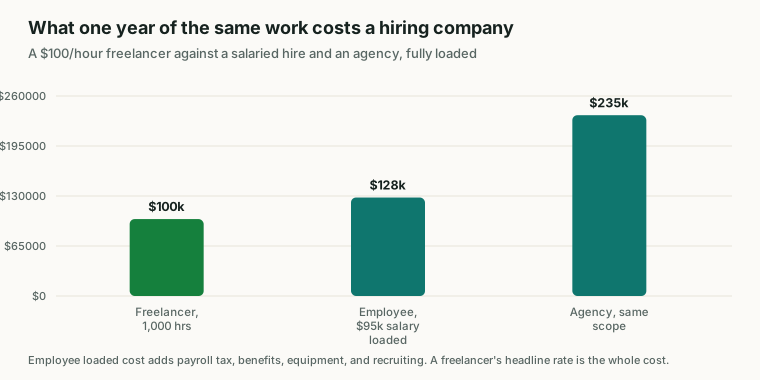
A freelancer's headline rate is the whole cost. A salary is roughly two-thirds of one.
The first is the salary comparison. You see a freelance writer quoting $85 an hour, you know your staff writer earns $70,000 — which feels like $34 an hour — and the freelancer suddenly looks like a luxury. This is the most common mistake and the most wrong, and I'll spend a whole section below on why, because the raw salary is not what an employee costs you. Not even close.
The second is the cheapest-bid comparison. You collect three quotes, treat the lowest as the "real" market price, and read the others as padded. But freelance quotes aren't bids on identical goods. The $40 quote and the $110 quote are usually offering different products entirely — different speed, different revision loads, different amounts of your team's time spent managing the work. Price tells you what an hour costs. It tells you nothing about how many hours you'll need or how much oversight the work will demand.
The third is the anchor of whatever you paid last time. If your last designer charged $60, then $60 becomes "normal" in your head — even if that designer was underpricing, even if the market has moved, even if this new project needs a different level of skill. I've watched a client insist $75 was "way above market" for development work purely because their previous developer, a friend doing them a favor, had charged $50 in 2023.
None of these yardsticks is malicious. They're just what people grab when nobody has ever laid out how to measure rate of pay for freelancers properly. So here is something better.
A 5-Step Framework for Measuring Freelance Rate of Pay
This is the whole method — how to measure rate of pay for freelancers in five steps, each producing a number or a comparison you can actually defend in a budget meeting.
-
Benchmark against market ranges by discipline and seniority. Start with what the market actually pays for this specific work at this specific level — not "a writer" but "a senior technical writer," not "a developer" but "a mid-level front-end developer." The Bureau of Labor Statistics OES tables give you median employee wages by occupation and metro area as a floor; freelance rates properly sit 50–100% above those employee figures for reasons step 2 makes clear. Then layer on freelance-specific ranges — I keep a current set in my industry benchmark guide — and note the spread. If quotes for your project cluster between $70 and $120, a $90 quote needs no interrogation. A $30 quote deserves more suspicion than a $130 one.
-
Convert the freelance rate into a loaded-employee-cost equivalent. This is the apples-to-apples step nearly everyone skips, and it's where freelance rates stop looking expensive. Short version: a freelancer at $85 an hour costs you about the same per productive hour as a $110,000 salaried employee. The full math gets its own section below, because once you've internalized it you will never naively compare a rate to a salary again.
-
Measure output value, not hours. An hourly rate is an input price, and inputs are the wrong thing to optimize. What you're actually buying is a finished landing page, a shipped feature, a resolved backlog. So measure cost per accepted deliverable, revision rounds needed, time-to-done, and how much of your team's attention the work consumed. My fastest client relationship taught me this from the inside: I charged them roughly 40% more per hour than the freelancer I replaced, and their cost per published article went down, because I needed one revision round where he'd needed three and a project manager chasing him. If your engagements are drifting toward paying for time instead of outcomes, it's worth reading hourly versus project pricing — flat project pricing is often the cleanest way to force the conversation onto output.
-
Track ROI per freelance dollar. Once output has a value, divide it by what you paid. Tag every freelance invoice to a project, estimate what that project returned — revenue, cost savings, or capacity your team didn't have to hire for — and compute the ratio. Do this per freelancer and per discipline, and roll it up quarterly. This is the number that answers the question large organizations keep asking about measuring ROI on freelance resources, and it's the number finance actually cares about: not "is $95 an hour a lot" but "did the $38,000 we spent on freelance design this quarter return more than $38,000 of value?" I've written a full walkthrough of the arithmetic, from both sides of the table, in calculating freelancer ROI — that's the deep dive on this step, worked examples included.
-
Re-benchmark annually. Freelance markets reprice faster than salary bands because nothing institutional slows them down. Set a yearly review: refresh the market ranges from step 1, rerun the loaded-cost conversion at current salary levels, and reread your ROI numbers from step 4. Then act on what you find — including raising rates for your best people before they raise them on you, or leave.
Five steps, maybe half a day of setup, an hour a quarter after that. Now let me slow down on the two steps that carry the most weight.
The Loaded-Cost Conversion, Walked Slowly
Here is the math from step 2 in full, because it is the single most persuasive thing you can bring to a budget conversation about freelance rates.
Take a $110,000 salaried employee — a reasonable figure for a mid-to-senior marketing, design, or development hire in most US metros. The salary is not the cost. The Small Business Administration and most HR benchmarks put the true cost of an employee at roughly 1.25 to 1.4 times base salary once you add the employer's share of payroll taxes, health insurance, retirement matching, paid leave, equipment, software seats, and office or stipend costs. Take a middle multiplier of 1.3 and your $110,000 hire actually costs about $143,000 a year.
Now the hours. A standard work year is 2,080 hours, but nobody delivers 2,080 productive hours. Subtract holidays, PTO, and sick time and you're near 1,880. Subtract meetings, internal admin, training, and ordinary organizational friction and honest estimates of truly productive time land around 1,650 to 1,800 hours. Use 1,700.
$143,000 ÷ 1,700 productive hours ≈ $84 per productive hour.
So the freelancer quoting $85 an hour is not "more than double" your $110k employee. Per productive hour, they cost almost exactly the same — and the freelance version comes with no benefits liability, no severance exposure, no equipment budget, and the ability to stop spending the moment the project ends. You buy only the productive hours. The employee's meetings, sick days, and slow Fridays are all baked into that $84 whether you notice or not.
Run this conversion on any quote and the conversation changes shape. $60 an hour is equivalent to hiring at roughly a $78,000 salary. $120 an hour maps to about a $157,000 salary — which is either alarming or perfectly sensible depending entirely on whether the work is $157,000-caliber work. The conversion doesn't tell you a rate is right. It tells you what the rate is actually claiming, so you can judge that claim against the market ranges from step 1 instead of against a raw salary that was never the real cost of anything.
What This Looks Like From My Side of the Table
I want to show you why this matters, with my own numbers.
In November 2025, I quoted a software company $105 an hour for a documentation overhaul, about 120 hours of work. The procurement lead pushed back hard: their in-house technical writers earned $75,000, "which is $36 an hour, so you're asking for triple." I didn't argue. I walked him through the loaded math: $75,000 × 1.3 is $97,500, over 1,700 productive hours is about $57 per productive hour — and then I asked how long the project would sit in their backlog waiting for an in-house writer to have 120 free hours. He checked. The answer was "next fiscal year, probably." My $12,600 quote bought them the deliverable five months sooner, with zero added headcount cost. They signed, and the renewal in April 2026 came without a single question about the rate — because by then they'd measured what the first engagement returned.
Now the other direction, because this framework protects you from cheap as much as from expensive. That same fall, a different client proudly told me they'd found a writer at $35 an hour for their blog. Six months later they quietly moved that budget to me at $105. Their internal accounting told the story: the $35 writer had averaged 19 hours per post after revisions — about $665 each — and the posts needed so much editing that their marketing manager was spending four hours of her own week rewriting them. My posts cost them around $500 flat and shipped final. On the yardstick of rate, I was three times the price. On the yardstick of cost per accepted deliverable — the only yardstick that pays — I was the cheap one.
One more thing worth knowing about the person across the table: most established freelancers didn't pick their rate out of the air. We build it from an income target, real business expenses, and an honest count of billable hours — the exact math behind the freelance rate calculator that anchors this site. When a freelancer quotes you $95, there's usually a spreadsheet under it. Understanding that math doesn't obligate you to pay any particular number, but it does tell you why the quote won't move much below a certain floor, and why the ones that happily drop 40% at the first pushback are often the ones with nothing underneath.
Make It a Habit, Not an Audit
The framework only compounds if it runs on a schedule. Here's the cadence that works without becoming its own job.
Quarterly, spend an hour on step 4: pull the freelance invoices, tag them to projects, and update your ROI-per-dollar numbers. The first pass is the slow one; after that it's maintenance. What you'll typically find is uncomfortable and useful in equal measure — the spread between your best and worst freelance dollars is usually far wider than the spread between their rates. When I've seen clients actually run this, the pattern repeats: the freelancer with the highest rate is almost never the worst ROI on the sheet, and the bargain hire almost never survives the analysis.
Annually, redo steps 1 and 2: refresh the market ranges, rerun the loaded-cost conversion at current salaries, and re-grade every ongoing freelance relationship against both. Then do the thing almost no client does — proactively raise the rates of the freelancers whose ROI numbers are outstanding, before they ask. It sounds like charity. It's the opposite. Replacing a proven freelancer costs you search time, onboarding, and a quality dip measured in months, and their next client will happily pay the market rate you didn't. A $10-an-hour raise that keeps a freelancer returning four dollars per dollar spent is the easiest approval you'll sign all year.
That ops manager from March, the one who asked if my rate was normal? She built a version of this into a one-page quarterly sheet: every freelancer, their effective rate, their loaded-salary equivalent, their cost per deliverable, and a rough ROI ratio. It took her about a day to set up. She told me in June it had already killed two of the agency's worst freelance line items and gotten her CFO to stop asking whether freelancers were "worth it," because now the sheet answers before he asks. Measuring rate of pay for freelancers isn't a dark art. It's five steps and a little arithmetic — and once the arithmetic exists, the arguing mostly stops.
Questions people ask
- What is a fair rate to pay a freelancer?
Fair is a range, not a number. Start with market benchmarks for the discipline and seniority level, then check whether the rate lands at or below the loaded hourly cost of an equivalent employee. A freelance rate that looks high next to a salary often looks normal, or even cheap, once you add the 25-40 percent employer load and count only productive hours.
- How do I convert a freelance hourly rate to a salary equivalent?
Multiply the salary by 1.25 to 1.4 to get the true employer cost, then divide by roughly 1,700 to 1,800 productive hours a year. A $110,000 salary becomes about $140,000 loaded, which works out to roughly $80 to $85 per productive hour. That is the honest number to compare against a freelance quote, not the raw salary divided by 2,080.
- Why do freelancers charge more per hour than employees earn?
Because the freelance rate has to cover everything an employer normally pays: both halves of payroll tax, health insurance, equipment, software, retirement, and the unpaid hours spent finding work and running the business. Freelancers also carry the gap risk between projects. Strip those out and the apparent premium mostly disappears; it was never extra profit, just relocated cost.
- How should large organizations measure ROI on freelance resources?
Track value delivered per freelance dollar at the engagement level, the same way you would evaluate any vendor. Tag each freelance invoice to a project, estimate the revenue, savings, or capacity that project produced, and divide. Roll those numbers up quarterly by discipline. Most organizations that do this find their best freelancers return several times their cost and their cheapest ones return the least.
- Is a cheaper freelancer always the better deal?
Rarely. Rate is the cost of an hour; what you actually buy is a finished outcome. A $40-per-hour freelancer who needs 60 hours and three revision rounds costs more than a $90-per-hour specialist who nails it in 20. Measure cost per accepted deliverable and time-to-done, and the low hourly number frequently turns out to be the expensive option.
- How often should we re-benchmark freelancer rates?
Once a year is the right cadence for most teams, plus a spot check whenever you open a new discipline. Freelance markets move faster than salary bands because there is no HR cycle slowing them down. An annual review keeps you from underpaying your best people into leaving or overpaying out of pure inertia on rates set two years ago.
- Should we pay freelancers hourly or per project?
For defined deliverables, project pricing usually serves both sides better: you get cost certainty and the freelancer is rewarded for efficiency instead of slowness. Hourly makes sense for open-ended, advisory, or ongoing work where scope genuinely cannot be pinned down. Whichever you choose, still translate the total into an effective hourly figure so your benchmarks stay comparable.
- Where can I find reliable freelancer pay benchmarks?
Start with the Bureau of Labor Statistics Occupational Employment and Wage Statistics tables for baseline wages by occupation and metro area, then adjust upward for the self-employment load. Layer on freelance platform rate data and industry-specific guides for your discipline. No single source is definitive; triangulating two or three gets you a defensible range.
Put these numbers to work
Use the free freelance rate calculator to turn this into your own hourly rate in under a minute.
Open the calculatorKeep reading
More in Rate Benchmarks, or browse all guides.
Freelance developer hourly rate bands for 2026 by stack, plus the domain premium that adds 25-40% for exactly the same technical work.
ReadFreelance designer hourly rate bands for 2026 across eight specialties, and why the spread inside one discipline beats the gap between disciplines.
ReadHow many hours do freelancers work each week? Four real working patterns, the billable share of each, and why billable hours plateau near 26.
ReadFreelance writer hourly rate bands from the real market: the content mill floor, generalist and specialist ranges, and per-word vs hourly math.
ReadUse a freelance rate calculator automotive pros trust. Real hourly ranges by specialty, hidden expenses, and a worked rate-floor example for auto work.
ReadFreelance completion rate benchmarks by platform and industry. Learn how delivery rate differs from completion rate—and how both affect what you can charge.
Read