Freelance Rate Calculator Automotive: Specialty Rate Guide
Use a freelance rate calculator automotive pros trust. Real hourly ranges by specialty, hidden expenses, and a worked rate-floor example for auto work.
Practical guidance, not financial advice. Sukie is a working freelancer, not a licensed accountant or financial advisor. Use this to make a defensible decision, then confirm the specifics for your situation with a qualified professional.

By Sukie · Founder & Writer, FreelanceRateLab
Updated August 11, 2026 · 8 min read
If you are hunting for a freelance rate calculator automotive professionals can actually trust, you have probably noticed the generic advice online does not fit your work. It doesn't. A freelance rate calculator built for automotive work has to account for expensive software, vehicle access, and the kind of confidentiality clauses you do not see in other industries. This guide walks through real rate ranges by specialty, the expenses that quietly eat your margin, and a full worked example so you can set a defensible floor.
This is written for automotive freelancers specifically: industrial and automotive designers, technical writers, CAD/CAM contractors, photographers and videographers shooting for auto brands, engineering consultants, and marketing copywriters serving dealerships and OEMs. It is a narrow niche, but a well-paid one. The trick is knowing what your specialty actually commands and what it actually costs you to deliver.
Automotive Freelance Rate Ranges by Specialty
Rates vary widely across automotive specialties because the underlying skills, software, and liability are so different. The table below shows observed, industry-sourced ranges. Treat them as a starting reference, not a ceiling, and always cross-check against the wage data the U.S. Bureau of Labor Statistics publishes for related occupations at bls.gov.
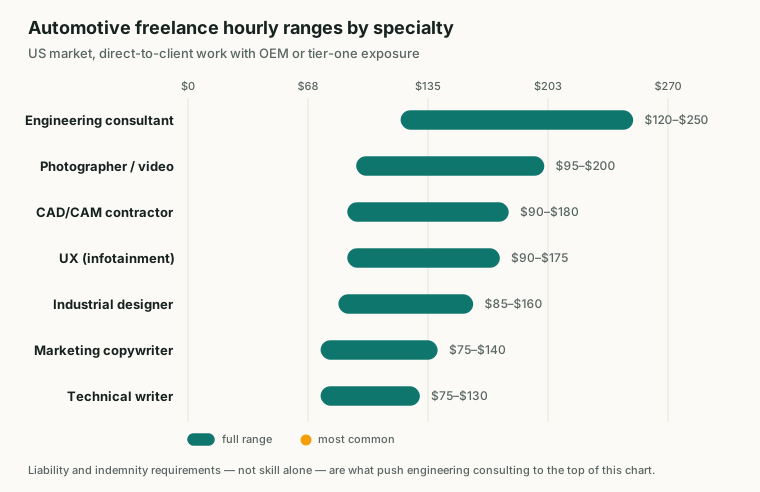
Liability exposure, not skill alone, is what puts engineering consulting at the top.
| Specialty | Typical hourly range | Typical project range | Notes |
|---|---|---|---|
| Industrial / automotive designer | $85 to $160 | $4,000 to $25,000 | Concept sketches to production-ready surfacing; sketching speed and OEM experience drive the high end. |
| Automotive technical writer | $75 to $130 | $3,000 to $20,000 | Service manuals, repair procedures, owner docs; structured authoring tools add value. |
| CAD/CAM contractor | $90 to $180 | $5,000 to $40,000 | CATIA and NX work pays most; tolerancing and Class-A surfacing command premiums. |
| Automotive photographer / videographer | $95 to $200 | $2,500 to $30,000 | Studio and track shoots; gear, licensing, and usage rights heavily affect the quote. |
| Automotive marketing copywriter | $75 to $140 | $1,500 to $15,000 | Dealership campaigns to OEM brand voice; OEM clients pay noticeably more. |
| Engineering consultant | $120 to $250 | $10,000 to $80,000+ | Powertrain, NVH, safety, or simulation work; liability and indemnity push rates up. |
| UX designer (infotainment) | $90 to $175 | $8,000 to $50,000 | In-vehicle HMI and infotainment; safety standards and hardware constraints add complexity. |
A few patterns stand out. Anything touching engineering liability, like consulting or safety work, sits at the top. Anything requiring proprietary software like CATIA or NX commands a premium because the tool itself is a barrier to entry. And OEM clients consistently pay more than dealerships or aftermarket shops for the same skill.
If you want to see how these benchmarks compare across other fields, our freelance rate by industry guide has a broader cross-industry view.
Automotive-Specific Expenses to Factor In
Here is where most automotive freelancers undercharge. The expenses in this niche run higher than almost any other, and if you do not load them into your rate, you are subsidizing your clients. Build these into the expense field of any freelance rate calculator before you set your number.
- Specialized software. CATIA, NX, and SolidWorks licenses can run $4,000 to $12,000 per year. Adobe Creative Cloud for photo and video adds roughly $660 annually. These are not optional in automotive work.
- Vehicle and test-drive access. Borrowing or renting vehicles for shoots, copywriting research, or reference photography is a real line item, especially for current-model-year cars.
- Travel to shoots. Tracks, proving grounds, and dealership locations are rarely around the corner. Mileage, flights, and lodging add up fast on a multi-day shoot.
- Specialized camera gear and lenses. Automotive photography demands fast wide and tilt-shift lenses, lighting rigs, and sometimes motion-control gear. A single pro lens can be $2,000+.
- Professional indemnity insurance. Engineering consultants and anyone signing off on technical work need errors-and-omissions coverage. This can be $1,500 to $5,000 a year depending on scope.
- NDA and IP legal review. Automotive contracts are dense with confidentiality and intellectual-property clauses. Having an attorney review them, even occasionally, is a cost worth budgeting.
- Hardware and rendering power. CAD and rendering work needs serious workstations and GPUs that depreciate quickly.
For a full walkthrough of what belongs in this category, see the freelance expenses checklist. Missing even two of these line items can quietly knock $10 to $20 off your true hourly floor.
Running the Numbers: A Worked Example
Let us build a real rate floor for an automotive technical writer. This is the calculation I run for myself before any new contract, and it is the same logic any solid freelance rate calculator formula follows.
Start with the annual income you actually want to take home. For this example, the target is $95,000.
Next, add self-employment tax. As a sole proprietor in the US, you owe roughly 15.3% in Social Security and Medicare on top of income tax. For a target around this level, budget about $14,000. The Small Business Administration explains the obligations clearly in its self-employment tax guidance.
Now add your automotive-specific expenses. For a technical writer running structured authoring software, a workstation, indemnity coverage, and occasional legal review, $8,500 a year is realistic.
Then account for unpaid time. You will not bill 52 weeks. Between holidays, admin, marketing, and slow stretches, plan for 8 weeks unpaid.
Add the first three numbers together:
$95,000 + $14,000 + $8,500 = $117,500 total revenue you need to generate.
Now divide by realistic billable hours. With 8 weeks off, you have 44 working weeks. If you bill an honest 24 hours a week (the rest goes to admin, pitching, and revisions), that is 1,050 billable hours for the year.
$117,500 ÷ 1,050 billable hours = $112 per hour minimum.
That $112 is your floor, not your target. Quote below it and you are losing money once expenses and taxes clear. To pressure-test your own billable-hour assumption, read billable hours explained, then run your figures through the calculator on the homepage.
Why Automotive Clients Often Pay Above Market
Automotive freelancers consistently earn more than general-market peers for comparable skills, and the reasons are structural. Understanding them helps you quote with confidence instead of apologizing for your rate.
OEM and tier-one budgets are large. A vehicle program is a multi-hundred-million-dollar effort, and the freelance line items inside it are a rounding error to the client but a meaningful contract to you.
Deadlines are immovable. Launch dates, auto-show reveals, and production timelines do not slip easily, so clients pay a premium for someone who can deliver under pressure without hand-holding.
Specialized knowledge is genuinely scarce. The number of writers who understand torque specs and service procedures, or designers fluent in Class-A surfacing, is small. Scarcity is leverage.
NDAs raise the stakes. When you sign a confidentiality agreement on an unreleased model, you are taking on real risk and limiting what you can show in your portfolio. That deserves compensation. In my experience, automotive clients rarely flinch at a premium tied explicitly to confidentiality and tight turnaround. They expect it.
There is also a switching-cost effect that works in your favor once you are in. Onboarding a new contractor onto an OEM program means NDAs, system access, brand guidelines, and a learning curve on the client's internal tooling. That friction is expensive for the client, so once you have proven you can deliver, they would rather pay your rate increase than start that process over with someone cheaper and unproven. The first contract is the hard one to price; the renewals are where the niche rewards you. I have seen a modest first project at a fair rate turn into a standing relationship at twenty to thirty percent more, simply because replacing a known, cleared contractor was more trouble than it was worth.
How to Position Your Rate to Automotive Clients
The way you frame your number matters as much as the number itself. Automotive clients respond to value framing, not cost framing.
Do not justify your rate by listing your costs. Justify it by pointing at outcomes: a service manual that cuts warranty calls, a render that wins an internal design review, a campaign that moves units off a dealership lot. Tie your fee to the result, and the rate stops feeling expensive.
Lead with a portfolio of relevant work, not certifications. In automotive, a folder of real deliverables beats a stack of certificates almost every time. Show OEM-style documentation, production CAD, or brand-accurate copy, and clients relax immediately. If your portfolio is thin because past work sits behind NDAs, build a small set of self-directed samples: redraw a public service procedure, write a spec sheet for a model already on sale, or shoot a car you have access to in the style you want to be hired for. Nobody needs to know it was unpaid.
One more positioning note that has earned me real money: quote a range only when you must, and anchor it high. Automotive buyers are used to procurement and expect a number, so a confident single figure with a short rationale ("$120 an hour, which reflects the CATIA licensing and the NDA scope") reads as more senior than a hedged "$90 to $130, depending." The hedge invites them to pick the bottom. The anchored number invites them to say yes. Pair that with the value framing above and you will rarely be the cheapest quote, which in this niche is exactly where you want to be.
When you switch between hourly and fixed quotes, calculate the hourly floor first and convert from there. The hourly vs project pricing guide covers how to make that conversion cleanly, and calculating freelancer ROI helps you frame the value side of the conversation. You can browse every benchmark and pricing guide in the guides hub when you want to go deeper.
Questions people ask
- What is the best freelance rate calculator for auto work?
The best freelance rate calculator for auto work is one that lets you plug in your specialty's expenses, self-employment tax, and unpaid weeks before dividing by realistic billable hours. Generic calculators miss the elevated software and gear costs that define automotive work, so adjust the expense field upward.
- What are typical automotive freelance rates?
Automotive freelance rates commonly run $75 to $200+ per hour depending on specialty. Technical writers and marketing copywriters sit at the lower end ($75 to $130), while CAD/CAM contractors and engineering consultants reach $120 to $250 because of specialized software and liability.
- Why do automotive clients pay more than other industries?
Automotive clients, especially OEMs and tier-one suppliers, work against tight launch deadlines with large budgets and strict NDAs. The combination of niche knowledge, confidentiality risk, and schedule pressure justifies a premium over general-market freelance rates.
- Should I charge hourly or per project for automotive work?
Both work, but project pricing tends to favor experienced automotive freelancers because clients value predictable budgets for launch timelines. Calculate your hourly floor first, then convert it into a project quote that includes a buffer for revisions and NDA-driven delays.
- Do I need certifications to set higher automotive rates?
Usually no. Automotive clients hire on demonstrated work far more than certificates. A portfolio showing real OEM-style deliverables, CAD models, or published technical documentation will justify a higher rate faster than a credential ever will.
Put these numbers to work
Use the free freelance rate calculator to turn this into your own hourly rate in under a minute.
Open the calculatorKeep reading
More in Rate Benchmarks, or browse all guides.
Freelance developer hourly rate bands for 2026 by stack, plus the domain premium that adds 25-40% for exactly the same technical work.
ReadFreelance designer hourly rate bands for 2026 across eight specialties, and why the spread inside one discipline beats the gap between disciplines.
ReadHow many hours do freelancers work each week? Four real working patterns, the billable share of each, and why billable hours plateau near 26.
ReadFreelance writer hourly rate bands from the real market: the content mill floor, generalist and specialist ranges, and per-word vs hourly math.
ReadHow to measure rate of pay for freelancers if you're the one hiring: a 5-step framework for benchmarking rates, converting to loaded cost, and tracking ROI.
ReadFreelance completion rate benchmarks by platform and industry. Learn how delivery rate differs from completion rate—and how both affect what you can charge.
Read