Freelance Writing Rates, Honestly Explained
Freelance writing rates by format and specialism, with the arithmetic behind each band — and why no authority publishes the 'average' rate everyone quotes.
Practical guidance, not financial advice. Sukie is a working freelancer, not a licensed accountant or financial advisor. Use this to make a defensible decision, then confirm the specifics for your situation with a qualified professional.

By Sukie · Founder & Writer, FreelanceRateLab
Published October 10, 2026 · 9 min read
Every article about freelance writing rates opens with an average. This one cannot, because the average does not exist — not in any published, checkable form. The Bureau of Labor Statistics tracks wages for writers and authors who hold jobs, which is a different measurement of a different population. The Editorial Freelancers Association publishes a rate chart built from member surveys, which is genuinely useful and openly acknowledges that it describes its own members rather than the market. Everything else circulating as "the average freelance writing rate" traces back, eventually, to somebody's client list.
So here is a different approach. Below are the bands I actually see and quote against, labelled honestly as editorial ranges rather than dressed up as data — followed by the arithmetic that lets you work out your own number, which is the only figure that matters when you are on a call.
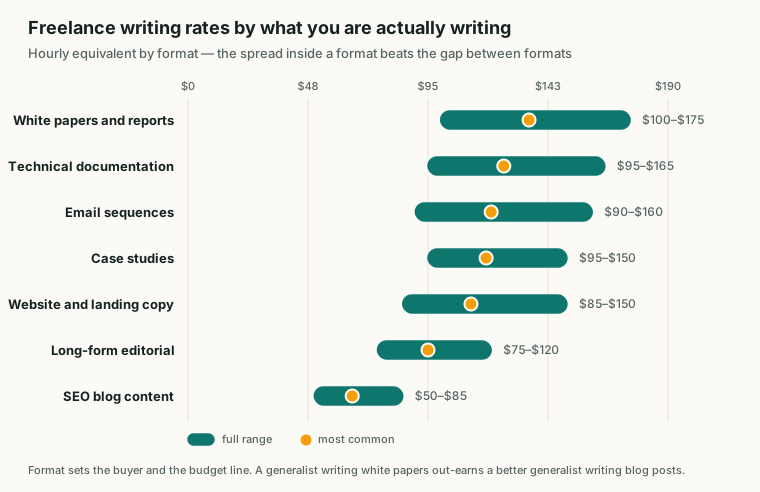
Seven formats, hourly equivalent, low to high, with the most commonly quoted point marked in gold.
The bands, by what you are actually writing
Format matters more than seniority for the first few years. A competent generalist writing white papers out-earns a very good generalist writing blog posts, because the buyer is different and the budget line is different.
| Format | Typical hourly equivalent | Typical project fee | Who buys it |
|---|---|---|---|
| SEO blog content | $50 – $85 | $250 – $600 per post | Marketing managers, agencies |
| Long-form editorial | $75 – $120 | $700 – $2,000 per piece | Publications, brand studios |
| Website and landing copy | $85 – $150 | $1,200 – $5,000 per site | Founders, design studios |
| Email sequences | $90 – $160 | $1,500 – $4,000 per sequence | Ecommerce, SaaS |
| Case studies | $95 – $150 | $1,200 – $2,500 each | B2B marketing teams |
| White papers and reports | $100 – $175 | $3,000 – $9,000 each | B2B, consultancies |
| Technical documentation | $95 – $165 | Usually billed hourly or retained | Engineering orgs |
Two things about this table are worth more than the numbers in it.
First, the project column and the hourly column are the same money viewed from different ends. A $1,600 case study is not generous or stingy until you know it took eleven hours. Second, the ranges overlap heavily, which is the honest shape of this market — the spread inside one format is wider than the gap between most formats.
Where the specialism premium actually comes from
The reliable premiums are not about writing skill:
- Regulated subject matter — health, finance, legal, insurance. Adds roughly 40 to 70 percent, and the client is buying somebody who knows what cannot be claimed.
- Technical depth — developer documentation, infrastructure, data. Adds 30 to 60 percent, because the pool of people who can read a codebase and write a clean sentence is small.
- Direct revenue attachment — sales pages, launch emails, conversion copy. Adds the most and is the least predictable, because the client can see the return.
A generalist who picks up any one of these does not become a better writer. They become a more expensive one.
Building your own number, which beats any benchmark
Here is the arithmetic, using a real target rather than a round one.
Say you want to take home $72,000. That is take-home, after tax, in your account.
Freelance income is taxed at a materially higher effective rate than employment income, because you pay both halves of Social Security and Medicare — the self-employment tax of 15.3 percent sits on top of income tax. For a sole trader at this income level, an effective combined rate around 27 percent is a reasonable planning figure, though your state and deductions will move it.
$72,000 ÷ 0.73 = $98,630 gross.
Then expenses. Software, insurance, a laptop amortised, a co-working desk, an accountant, professional development. For a writer this is usually lighter than for a designer or developer — call it $7,400, and see the expenses checklist if you want to build the number properly rather than guess it.
$98,630 + $7,400 = $106,030 to bill.
Now the part everybody gets wrong: billable hours. Not 2,080. Not even 1,500. Between pitching, invoicing, revisions you did not scope, admin, holidays and the weeks when nothing lands, a full-time freelance writer bills somewhere near 1,050 to 1,250 hours a year. Billable hours explained works through why the gap is that large.
$106,030 ÷ 1,150 = $92 an hour.
That is a floor, not an ambition. It is the number below which you are working for less than you decided you needed, which is a different and much more useful piece of information than knowing what the person next to you charges. The rate calculator on the homepage runs this same build-up if you would rather not do it on paper.
What the floor looks like as a project fee
Nobody wants to be quoted $92 an hour for a blog post. Convert it.
| Deliverable | Realistic hours | Fee at $92/hr | What you quote |
|---|---|---|---|
| 1,500-word researched post | 6.5 | $598 | $600 |
| Case study with two interviews | 12 | $1,104 | $1,150 |
| Five-email welcome sequence | 15 | $1,380 | $1,400 |
| 3,000-word white paper | 34 | $3,128 | $3,200 |
Round up, never down. The rounding is not greed — it is the buffer for the round of revisions that was not in the brief, which arrives roughly two-thirds of the time.
The mistake I made for two years
I quoted from the fee column without ever checking the hours column. A $600 post felt fine because $600 felt like a lot of money in one email. Then I tracked my time properly for a quarter and found the posts I was proudest of — the ones with real interviews and real reporting — were taking fourteen hours and paying $43 an hour, while the fast, forgettable ones were paying $110.
The fix was not to stop doing the good work. It was to stop pricing the good work as though it were the fast work. Those became $1,400 pieces, I lost two clients over it, and the year still ended up ahead.
Per-word rates, and when they stop making sense
Per-word pricing is the default in journalism and content marketing, and it is fine in a narrow band of situations: high volume, stable format, scope genuinely defined by length.
Rough conversions at common drafting speeds:
| Your hourly floor | At 400 words/hr | At 600 words/hr | At 900 words/hr |
|---|---|---|---|
| $60 | $0.15 | $0.10 | $0.07 |
| $92 | $0.23 | $0.15 | $0.10 |
| $130 | $0.33 | $0.22 | $0.14 |
Read those speeds as finished words including research and editing, not drafting speed. Almost everybody overestimates this by about double.
The structural problem with per-word is that it pays you for length while your client wants quality, and those two diverge exactly where the work gets good. Cutting 400 words to make a piece sharper costs you money. So does spending an extra two hours on an interview that makes the piece worth reading. If you want the full treatment of this, the per-word rates guide goes deeper into the conversion math.
Rates by experience, roughly
Experience moves rates less than people expect, and much less than specialism does.
- Year one. $45 – $70/hr, or $0.10 – $0.16/word. The main task is escaping platform pricing, not optimising within it.
- Years two to four. $70 – $110/hr. Enough of a portfolio that you are being chosen rather than compared.
- Years five and up. $110 – $175/hr, and increasingly project-priced or retained, because at this point clients are buying judgement rather than drafting.
The jump between the first two bands is mostly about where you find clients. The jump to the third is mostly about what you say no to.
Retainers, which change the arithmetic
A monthly retainer trades some rate for a great deal of certainty, and for most writers the trade is worth it once one exists. Four posts a month at $600 is $2,400; the same client on a $2,200 retainer for the same four posts is a small discount in exchange for not re-selling every month.
Price the availability separately from the output. A retainer that guarantees turnaround has a cost even in a quiet month, and writers who forget this end up with retainers that are just discounted piecework. The retainer pricing guide and the editing retainer breakdown both work through structures that hold up.
What clients are actually comparing you against
Useful to know, because it explains otherwise baffling reactions to a quote.
A marketing manager weighing a $600 post is usually comparing it to an agency quote near $1,400 and a marketplace listing near $90. You are the middle option, and the middle option wins on the strength of the case you make for it, not on being cheapest. When somebody says "that's more than I expected," they are almost always anchored on the $90 and have not yet been shown why it is $90.
The answer is not a discount. It is specificity: what they get, what it takes, what happens if it is wrong. If you find yourself dropping rates in that conversation regularly, how to stop undercharging is about the reflex rather than the number.
Raising rates once these are set
Set a floor, work at it for a while, then raise it — and raise it on new clients first, where there is no relationship to renegotiate. Existing clients move at renewal with notice, not mid-project. How to raise your rate covers the mechanics, and when to raise freelance rates covers the timing signals that mean you have waited long enough.
The pattern I would push anybody toward: review the floor every twelve months against your actual expenses and actual billable hours, because both drift, and a rate that was correct in 2024 is quietly a pay cut in 2026.
FAQ
What is the average freelance writing rate? There isn't one, and anybody quoting a single figure is either averaging their own client list or repeating someone who did. No government agency or trade body publishes an average freelance writing rate. The BLS reports wages for employed writers and authors, not billing rates for freelancers, and the two are not interchangeable. What you can do is build a defensible number from your own income target, expenses and realistic output speed.
How much should a beginner freelance writer charge? Work out a floor rather than picking a percentage of somebody else's rate. Take the income you need, gross it up for tax and expenses, divide by hours you can realistically bill. Most people who do this land between $45 and $70 an hour, roughly $0.10 to $0.16 a word at a typical drafting speed.
Is it better to charge per word or per project for writing? Per project, almost always, once you can estimate reliably. Per-word pricing penalises cutting and research — both increase effort while reducing or not affecting word count. Per-word is fine for high-volume, well-specified work. Everywhere else, price the deliverable.
Why do technical and financial writers charge more than blog writers? Consequence and scarcity, not keystrokes. A wrong sentence in API documentation generates support tickets; a wrong one in a regulated financial explainer generates legal exposure. The premium is usually 40 to 80 percent.
Should I lower my rate to win a first client? Lower the scope instead. A discounted rate anchors every future conversation with that client. A smaller, cheaper, well-defined first project at full rate gets you the same proof and leaves your pricing intact.
How do freelance writing rates differ outside the US? Rates track the client's market more than the writer's location, so a writer abroad working for US clients bills closer to US rates than local ones. The figures here are US, in USD, for direct-to-client work.
Questions people ask
- What is the average freelance writing rate?
There isn't one, and anybody quoting a single figure is either averaging their own client list or repeating someone who did. No government agency or trade body publishes an average freelance writing rate. The Bureau of Labor Statistics reports wages for employed writers and authors, not billing rates for freelancers, and the two are not interchangeable. What you can do is build a defensible number from your own income target, expenses and realistic output speed — which is what most of this guide is about.
- How much should a beginner freelance writer charge?
Work out a floor rather than picking a percentage of somebody else's rate. Take the income you need, gross it up for tax and expenses, divide by the hours you can realistically bill, and that is your floor. Most people who do this arrive somewhere between $45 and $70 an hour, which converts to roughly $0.10 to $0.16 a word at a typical drafting speed. That is well above content-mill pay, and the gap is the entire argument for skipping content mills.
- Is it better to charge per word or per project for writing?
Per project, almost always, once you can estimate reliably. Per-word pricing quietly penalises the two things that make writing good — cutting and research — because both increase your effort while reducing or not affecting your word count. Per-word is fine for high-volume, well-specified work where the scope genuinely is the word count. Everywhere else, price the deliverable.
- Why do technical and financial writers charge more than blog writers?
Consequence and scarcity, not keystrokes. A wrong sentence in API documentation generates support tickets; a wrong sentence in a regulated financial explainer generates legal exposure. Both fields also require domain knowledge the client cannot quickly hire around. Clients are paying for accuracy risk being absorbed by someone competent, and that premium is usually 40 to 80 percent over general content work.
- Should I lower my rate to win a first client?
Lower the scope instead. A discounted rate sets an anchor that follows you through every future conversation with that client, and 'introductory pricing' is very rarely re-negotiated upward without friction. A smaller, cheaper, well-defined first project at full rate gets you the same proof of competence and leaves your pricing intact.
- How do freelance writing rates differ outside the US?
Substantially, and not always in the direction people assume. Rates track the client's market rather than the writer's location, so a writer in Manila or Lisbon working for US clients bills closer to US rates than to local ones, minus a discount that shrinks as the relationship establishes. The figures in this guide are US, in USD, for direct-to-client work.
Put these numbers to work
Use the free freelance rate calculator to turn this into your own hourly rate in under a minute.
Open the calculatorKeep reading
More in Rate Benchmarks, or browse all guides.
Freelance marketing rates for 2026 across eight channels, why attributable channels pay 40-70% more, plus retainer bands and the performance-pricing question.
ReadFreelance developer hourly rate bands for 2026 by stack, plus the domain premium that adds 25-40% for exactly the same technical work.
ReadFreelance designer hourly rate bands for 2026 across eight specialties, and why the spread inside one discipline beats the gap between disciplines.
ReadHow many hours do freelancers work each week? Four real working patterns, the billable share of each, and why billable hours plateau near 26.
ReadFreelance writer hourly rate bands from the real market: the content mill floor, generalist and specialist ranges, and per-word vs hourly math.
ReadHow to measure rate of pay for freelancers if you're the one hiring: a 5-step framework for benchmarking rates, converting to loaded cost, and tracking ROI.
Read