Freelance Rate After Taxes — Why You Have to Multiply, Not Subtract
Freelance rate after taxes, traced from a $100 invoice to your bank account, with the gross-up multiplier and why subtracting tax gets it backwards.
Practical guidance, not financial advice. Sukie is a working freelancer, not a licensed accountant or financial advisor. Use this to make a defensible decision, then confirm the specifics for your situation with a qualified professional.

By Sukie · Founder & Writer, FreelanceRateLab
Published October 6, 2026 · 7 min read
Freelance rate after taxes is the question behind an enormous number of pricing mistakes, and almost all of them come from doing the arithmetic in the wrong direction. Someone decides they want to keep $80 an hour, takes 28% off a $100 rate, gets $72, and concludes they should charge about $110. The right answer is closer to $180.
The error is that you do not subtract tax from a rate. You gross the rate up from what you want to keep. Those produce different numbers, and the gap is not small.
The trace, one invoice at a time
Here is a $100 invoice line followed all the way to money you can spend.
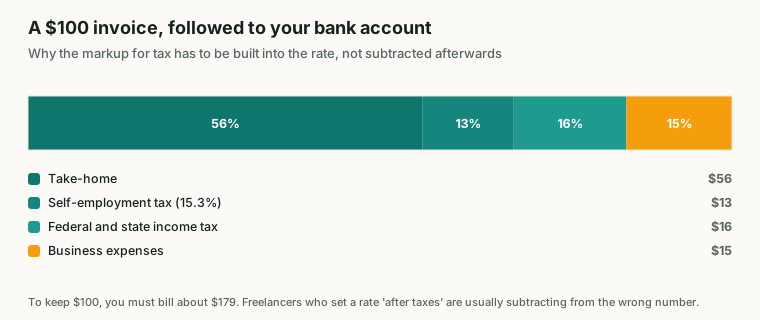
A $100 invoice, followed to the bank. Take-home is a little over half of it.
| Stage | Amount | Running |
|---|---|---|
| Invoice line | $100.00 | $100.00 |
| Less business expenses (15% of revenue) | −$15.00 | $85.00 |
| Less self-employment tax (15.3% of net) | −$13.00 | $72.00 |
| Less federal + state income tax | −$16.00 | $56.00 |
Fifty-six dollars. And to run it the other way — to keep $100 — you need to bill about $179.
That factor of roughly 1.8 is the number worth remembering. Everything else on this page is a refinement of it.
Why subtraction gets it wrong
The arithmetic is worth seeing explicitly because the error is so intuitive.
Suppose you want $72 of every $100 and your effective tax rate is 28%.
The wrong way (subtract): $100 − 28% = $72. Looks right. But you have not answered the question — you started from $100 and found what is left. You never worked out what to charge.
The right way (gross up): to keep $72, you need $72 ÷ 0.72 = $100. Fine, because those numbers happened to match.
Now try it with real figures. You want to keep $80.
- Subtracting: $80 + 28% of $80 = $102.40. This is the mistake.
- Grossing up: $80 ÷ 0.72 = $111.11.
The difference is $8.71 an hour — 8.5% of your rate — and it goes in the same direction every single time. Across 1,150 billable hours that is $10,017 a year, permanently missing, from one misplaced operation.
The rule: divide by (1 − tax rate). Never multiply by (1 + tax rate).
| Effective tax rate | Divide by | Equivalent multiplier |
|---|---|---|
| 22% | 0.78 | 1.282 |
| 25% | 0.75 | 1.333 |
| 28% | 0.72 | 1.389 |
| 30% | 0.70 | 1.429 |
| 35% | 0.65 | 1.538 |
What makes up the tax load
Three separate things, and the middle one is the surprise.
Federal income tax works the same way it did when you were employed — same brackets, same rules — with one difference: nobody withholds it. It arrives as your responsibility, quarterly.
Self-employment tax is 15.3% of net earnings, covering Social Security (12.4%) and Medicare (2.9%). As an employee you paid half and your employer paid half without you seeing it. Now you pay both halves. This is the line that blindsides first-year freelancers, and it is charged in addition to income tax on the same money. The IRS's self-employed tax center is the authoritative reference and worth twenty minutes of your time.
State income tax ranges from nothing at all to meaningfully large depending on where you live.
Add them and 25–35% is the working range for most US freelancers. Use 28% as a planning assumption if you have no better figure, and replace it with a real one from an accountant as soon as you have a year of records. Freelance tax basics for beginners covers the mechanics — quarterly payments, deductions, what actually counts.
Building the rate properly
Tax is one input among four. Here is the whole calculation in order, with a worked example.
A freelancer who wants $78,000 in their pocket:
- Take-home target: $78,000
- Gross up for tax at 28% effective: $78,000 ÷ 0.72 = $108,333
- Add annual business expenses: +$9,500 → $117,833
- Add a buffer for slow months and reinvestment, 12%: +$14,140 → $131,973
- Divide by realistic billable hours — 1,150, not 2,080: $115 an hour
Step 5 is where the second big error lives. Dividing by 2,080 gives $63, which is 45% too low, because 2,080 assumes you bill every hour you work. Nobody does; the realistic figure is 1,000–1,300 for a full-timer. How many hours do freelancers work covers why billable hours plateau around 25 a week, and true hourly rate shows what a billed hour returns once all of this is accounted for.
Two errors, compounding: subtract instead of gross up, then divide by 2,080 instead of 1,150. Together they turn a $115 rate into a $58 one. That is the arithmetic behind most freelance underpricing, and it has nothing to do with confidence.
The freelance rate calculator runs all five steps if you would rather not, and the formula guide walks a second worked example end to end.
The set-aside system that actually works
Knowing the number is half of it. The other half is not spending it.
Move the money on the day the invoice clears, not at quarter end. A fixed percentage — 30% is a sensible default — into a separate account that is inconvenient to reach. Per invoice, automatically, without a decision each time. The freelancers who get into trouble are almost never the ones who miscalculated; they are the ones who intended to move it later.
Pay quarterly estimates. In the US these fall around mid-April, mid-June, mid-September, and mid-January. Missing them can mean penalties even when you pay in full at year end.
Do not touch the account for cash-flow. A slow month is a cash-flow problem. Borrowing from the tax account turns it into a tax problem, which is a considerably worse category of problem.
Reconcile annually and adjust the percentage. After a full year, compare what you set aside to what you owed. If you over-saved, lower it. Most people find their real effective rate differs from their assumption by several points in one direction or the other — and once you know yours, every rate calculation afterwards is more accurate.
Expenses are not a discount on your rate
A tempting piece of reasoning: expenses are deductible, so they cost less than they appear, so maybe the rate does not need to carry them fully.
It does. A deduction reduces the tax on that money, not the money itself. A $1,000 expense at a 28% effective rate still costs you $720 of real cash. Deductions make expenses cheaper; they never make them free, and your rate still has to fund them.
The corollary matters too: expenses you fail to claim are entirely wasted. Track them properly — freelance business expenses checklist covers what qualifies, and typical freelance expenses list gives realistic annual ranges to benchmark against.
If you are behind on this
Some readers arriving at this page have already had the bad conversation with themselves and want to know what to do rather than how to calculate.
Deal with the current year first: work out what is actually owed, and contact a tax professional early rather than at the deadline — payment arrangements exist and are much easier to set up before a filing date than after one. Then fix the system rather than resolving to be more careful: separate account, fixed percentage, moved automatically on the day each invoice clears. Intentions do not survive a slow quarter; a standing transfer does.
And raise the rate. If you have been pricing without a tax markup, you have not merely been paying tax out of profit — you have been running the business below its actual cost, which is not sustainable no matter how the tax is handled. How to stop undercharging as a freelancer has the floor calculation, and how to raise freelance rates has the scripts for the conversation.
Nothing here is tax advice, and it cannot be — your bracket, state, entity structure and deductions are specific to you. It is the arithmetic of rate-setting, which is a different thing. Take the shape of it to a qualified professional and let them fill in your actual numbers.
The two rules worth keeping: divide by (1 − tax rate), never multiply by (1 + tax rate), and divide by billable hours, never by 2,080. Get those two right and you are ahead of most of the freelance market. Run yours here — it takes about a minute, and it is the number every other decision on this site depends on.
Questions people ask
- How do I calculate my freelance rate after taxes?
You do not subtract tax from a rate — you divide the amount you want to keep by (1 minus your effective tax rate), then add expenses and a buffer before dividing by billable hours. Subtracting gets it backwards and always undershoots, because the tax is charged on the higher gross figure, not on the take-home you started with.
- What is the multiplier for taxes on a freelance rate?
For a US freelancer with a 28 percent effective combined load, divide by 0.72 — a multiplier of about 1.39. At 30 percent it is 1.43, at 35 percent it is 1.54. Multiply, do not subtract: taking 28 percent off a number is not the same as grossing it up by 28 percent, and the gap is about 9 percent of your rate.
- How much should I set aside for freelance taxes?
Twenty-five to thirty-five percent of net profit is the standard working range for a US freelancer, covering self-employment tax at 15.3 percent plus federal and state income tax. Set it aside per invoice into a separate account rather than per quarter, and confirm your specific percentage with a tax professional.
- What does 'hourly rate freelance no taxes' actually mean?
It usually means someone has been quoted a rate and wants to know what is left after tax, or is comparing a freelance rate to a post-tax salary. Both are the same question: a freelance rate is a pre-tax business revenue figure, and comparing it to take-home pay without grossing up overstates the freelance rate by roughly 40 percent.
- Do I pay tax on the whole invoice or just the profit?
On the profit. Legitimate business expenses reduce your taxable income, which is why tracking them matters financially and not just administratively. But your rate still has to cover both the expenses and the tax on what is left, so both belong in the rate calculation regardless of the order the tax code applies them.
- Is self-employment tax on top of income tax?
Yes. Self-employment tax of 15.3 percent covers Social Security and Medicare — both the employee and employer halves, which an employer used to pay half of — and it is charged in addition to federal and state income tax on the same earnings. This is the single most common reason first-year freelancers are surprised by their bill.
- How much do I need to bill to keep $100?
About $179, on the assumptions used in this guide: 15 percent business expenses, 15.3 percent self-employment tax, and roughly 16 percent combined federal and state income tax. The exact figure depends on your bracket, state and expense ratio, but the shape — you must bill close to double what you keep — holds broadly.
- Should I raise my rate to cover a tax increase?
Yes, and by the grossed-up amount rather than the headline amount. If your effective tax rate rises by 3 points from 28 to 31 percent, your rate needs to rise by roughly 4.3 percent to leave your take-home unchanged, because the increase applies to the larger gross figure.
- What if I have not been setting money aside?
Deal with the current year first — work out what you owe, contact a tax professional early rather than at the deadline, and set up a payment arrangement if you need one. Then fix the system: a separate account, a fixed percentage moved on the day each invoice clears, and quarterly estimated payments so it never accumulates again.
- Does an LLC or S-corp reduce this?
It can change how earnings are characterised and therefore what self-employment tax applies to, but the savings depend heavily on income level, state, and the cost of the extra compliance. It is a genuine question for a qualified accountant with your actual numbers, not something to decide from a general guide.
Put these numbers to work
Use the free freelance rate calculator to turn this into your own hourly rate in under a minute.
Open the calculatorKeep reading
More in Money & Taxes, or browse all guides.
Cost to start a freelance business in 2026, itemized: a $0 bootstrap path, a lean $500 budget, a comfortable $2,500 setup, plus the hidden first-90-days gap.
ReadA working writer's honest take on freelance writer expenses: what to spend on tools, the 10-15% overhead rule, a real annual budget, and what pays for itself.
ReadA typical freelance expenses list with realistic annual USD ranges for software, hardware, insurance, fees, and more, so you can benchmark your own overhead.
ReadA freelance business expenses checklist, organized by category, so your rate funds every real cost instead of quietly paying for them out of your take-home.
ReadFreelance taxes for beginners, explained simply: what self-employment tax is, when quarterly payments are due, how much to set aside, and which deductions help.
ReadFreelancer performance metrics that change decisions: six numbers with formulas, what each means when it moves, and three popular ones worth ignoring.
Read