How Many Hours Do Freelancers Work — And How Many Get Paid For?
How many hours do freelancers work each week? Four real working patterns, the billable share of each, and why billable hours plateau near 26.
Practical guidance, not financial advice. Sukie is a working freelancer, not a licensed accountant or financial advisor. Use this to make a defensible decision, then confirm the specifics for your situation with a qualified professional.

By Sukie · Founder & Writer, FreelanceRateLab
Published August 27, 2026 · 7 min read
How many hours do freelancers work? More than they say, fewer of them billable than they think, and the two numbers move independently in a way that catches almost everyone out in their first two years.
I have logged every working hour since January 2024. The pattern that emerged is not the one I expected: my worked hours have varied between 31 and 58 a week, and my billable hours have never once exceeded 27. Not in the 58-hour weeks. Not in the panic weeks. The ceiling held regardless of effort, which turned out to be the most useful thing my time log ever told me.
Four working patterns, and what each one actually bills
There is no single answer to the hours question because freelancers are not one population. Here are the four patterns I see most, with the billable share of each.
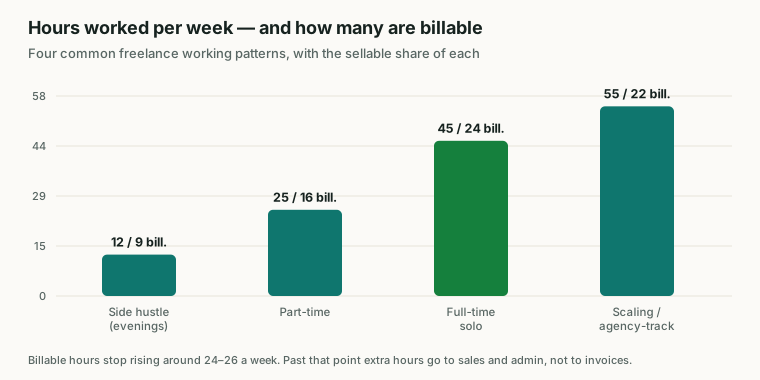
Worked hours rise steadily across the four patterns. Billable hours flatten after the third.
| Pattern | Hours worked | Billable hours | Billable share |
|---|---|---|---|
| Side hustle, evenings only | 12 | 9 | 75% |
| Part-time | 25 | 16 | 64% |
| Full-time solo | 45 | 24 | 53% |
| Scaling / agency-track | 55 | 22 | 40% |
Read that last column downward and the whole thing clicks. Billable share falls as total hours rise. The side-hustler has the highest efficiency in the entire table, because a client already exists, the work is scoped, and nobody is spending Tuesday evening on a discovery call. The agency-track freelancer works 4.6× as many hours and bills fewer than the full-timer, because everything above about 45 hours goes into pipeline, people, and process.
This is the single most counter-intuitive fact about freelance hours, and it explains the queries I see constantly from people trying to work out whether their week is normal. It is normal. The system is designed this way.
Why the ceiling exists
Twenty-four to twenty-six billable hours a week is not a discipline problem. It is structural, and it is made of four things that do not compress:
Sales does not scale down. You need roughly the same number of conversations to land a client whether you are working 30 hours or 55. In my log, prospecting has held steady at 5 to 7 hours a week for three years regardless of how busy I was — and the weeks I cut it were followed, six weeks later, by the weeks I had nothing on.
Admin is a fixed cost of existing. Invoicing, chasing, reconciling, taxes, insurance renewals. Roughly 3 hours a week, and it does not care how much you billed.
Communication scales with client count, not with hours. Four clients at 6 billable hours each generates far more email than one client at 24. This is the hidden argument for retainer pricing for freelancers: the same revenue from fewer relationships costs you less unbillable time.
Deep work has a daily limit. Four to six focused hours is where most people top out, which is the same conclusion realistic billable hours per day reaches from the other direction. Hours seven and eight of a working day are almost never delivery hours; they are the shallow tail.
Add those up and the arithmetic is unforgiving: 40 worked hours minus 6 sales minus 3 admin minus 3 comms minus 3 learning and marketing leaves 25. There is your ceiling, and no amount of waking up earlier moves it much.
What this means for your rate — the part that actually matters
If billable hours are capped near 25 a week, then income is a function of rate, near-exclusively. This is not a motivational point. It is arithmetic.
Twenty-five billable hours a week, 46 working weeks a year, is 1,150 billable hours. To clear $110,000 of gross revenue from 1,150 hours you need $96 an hour. To clear it from the 2,080 hours a salary calculator assumes, you would need $53 — and you would need to bill every single hour you worked, which nobody has ever done.
The difference between those two numbers is not a rounding error. It is the entire reason freelancers underprice, and it is why the freelance rate calculator asks for billable hours rather than working hours as its input.
Here is the same relationship across the range:
| Billable hrs/week | Billable hrs/year | Rate needed for $110k | Rate needed for $75k |
|---|---|---|---|
| 15 | ~690 | $159 | $109 |
| 20 | ~920 | $120 | $82 |
| 25 | ~1,150 | $96 | $65 |
| 30 | ~1,380 | $80 | $54 |
| 35 | ~1,610 | $68 | $47 |
Most people find themselves in the 20–25 band. If your rate is not in the $96–$120 range and you are targeting six figures, the gap has to close from the rate side, because the hours side has a ceiling.
Answering the question a client is actually asking
A large share of the searches that bring people to this page are not curiosity — they are someone staring at a job post that says "how many hours per week are you available for freelance work?" and trying to work out what the honest answer is.
The client is not asking about your life. They are asking about your billable capacity for them, and they are calibrating whether you are a business or a person with spare time. Those get treated very differently.
Three answers, and what each one signals:
"As many as you need." Signals no other clients, no boundaries, and — fairly or not — no leverage. It is the answer that most reliably precedes a lowball rate.
"Around 40." Signals you are looking for a job with extra steps. Some clients want exactly this; most of them are trying to get an employee without paying employment costs.
"I can commit 15 to 20 hours a week, with a hard ceiling of 20." Signals a functioning practice, gives them a real number to plan against, and leaves you room for the other work that makes you safe.
Give the third answer. If they need more than 20, that is a conversation about a second engagement or a higher rate, not a reason to quietly agree to 40.
And put the ceiling in writing. A capped engagement — 15 hours a week, overage billed at the standing rate or work pauses — protects both sides. The client gets a predictable invoice; you get a commitment you can build a schedule around. The US Small Business Administration's contracting guidance makes the general version of this point: what is not written down is not agreed.
The two-week measurement
You do not need a year of data to get useful numbers. You need two honest weeks.
- Track everything, in fifteen-minute blocks, including the parts you would rather not count. The proposal that went nowhere. The Sunday reconciliation. The call that ran forty minutes over.
- At the end, split it into billable and unbillable.
- Divide billable by total. That percentage is your billable efficiency.
- Multiply your realistic weekly hours by that percentage. That is your true weekly billable capacity.
- Divide your annual revenue target by (capacity × 46 weeks). That is the rate you need.
Almost everyone guesses their efficiency at 70–80% and measures it at 50–60%. I guessed 70% and measured 55%, which meant every rate I had set for two years had been calculated against a number that was 27% too generous.
What changes after you know
Three things changed for me, and none of them was working harder.
I stopped taking work that required disproportionate scoping. A $2,000 project that needs three calls and two proposals is not a $2,000 project — it is a $2,000 project with $600 of unbillable time attached, and it competes badly against a $1,600 project from an existing client that needs one email.
I started counting the pipeline as work. Prospecting stopped being the thing I did when I felt guilty and became a scheduled 6 hours, which made the whole week honest.
I raised my rate instead of my hours. Because the ceiling is real, and the only lever above it is price. If that is where you have landed too, how to raise freelance rates has the timing and the scripts, and how to stop undercharging as a freelancer has the floor calculation you should be raising to.
So: how many hours do freelancers work? Roughly 45 if they are full-time, of which about 24 get paid for. The number that decides your income is the second one, it has a ceiling around 26 that effort does not move, and the only reliable way to earn more above that ceiling is to charge more per hour — which starts with knowing what your hour is really worth. The homepage calculator will do that arithmetic with your figures in about a minute.
Questions people ask
- How many hours do freelancers work in a typical week?
Full-time solo freelancers most often land between 40 and 50 hours worked, of which roughly 22 to 26 are billable. Part-timers cluster around 25 worked and 16 billable. Side-hustlers evenings-only average about 12 worked and 9 billable. The worked figure is always higher than people expect and the billable figure is always lower.
- Is freelancing fewer hours than a job?
Usually not in year one or two. Most freelancers work more total hours than they did as employees, because sales, admin, and finance are now their job too. The hours typically fall in years three and beyond, once referrals replace prospecting and rates have risen enough that fewer billable hours are needed.
- What does 'how many hours per week are you available for freelance work' mean on a job post?
The client is asking about your billable capacity for them specifically, not your total working week. Answer with a number you can sustain alongside your other clients — for most full-timers that is 10 to 20 hours per client, not 40. Quoting 40 signals you have no other work, which weakens your position.
- Can a freelance contract be capped at 15 hours a week?
Yes, and capped engagements are common and healthy. A cap protects both sides: the client gets a predictable invoice ceiling and you get a defined commitment you can plan other work around. Put the cap in writing along with what happens when it is reached — either work stops or overage bills at a stated rate.
- Why do freelancers charge for 20 hours a week instead of 40?
Because 40 billable hours a week does not exist. After sales, scoping, admin, invoicing, and client communication, most full-timers can sell 22 to 26 hours. Pricing as if all 40 were sellable is the single most common cause of freelance underpricing.
- Should I work seven hours a day or eight as a freelancer?
Neither figure means much on its own, because what matters is billable hours, not hours at the desk. Four to six billable hours a day is the sustainable range for focused work. Whether the surrounding day is seven or eight hours long is mostly a question of how much sales and admin you have that week.
- Do freelancers work weekends?
Many do, and it is worth being honest about why. Weekend work driven by genuine flexibility — swapping Wednesday for Sunday — is fine. Weekend work driven by having priced the week wrong is a rate problem wearing a schedule costume, and adding hours will not fix it.
- How many hours a week is considered full-time freelance?
There is no legal definition, but 30 or more billable hours a week is the point where most freelancers describe themselves as full-time. In practice that means 45 to 55 hours worked. Many people who call themselves full-time freelancers are billing 22 to 26 hours and earning a full-time income at a higher rate — which is the better outcome.
- How many hours do successful tech freelancers work per day?
Experienced technical freelancers usually report four to six hours of deep, billable work per day, with the rest of the day going to calls, code review, and coordination. The pattern that separates the highest earners is not longer days — it is a higher rate applied to a similar number of deep hours.
- How do I answer 'how many hours are you available for freelance work on a weekly basis'?
Give a range and a boundary: 'I can commit 15 to 20 hours a week for this engagement, with a hard ceiling of 20.' The range shows flexibility, the ceiling shows you have a business rather than spare time, and both are far stronger answers than 'as many as you need'.
- Does working more hours increase freelance income?
Only up to a point, and that point arrives sooner than most people expect. Billable hours plateau around 24 to 26 a week because additional hours get absorbed by the sales and admin needed to keep the pipeline full. Past the plateau, income rises through rate, not through hours.
- How should I track my freelance hours?
Track everything for at least two full weeks, including the unbillable time, then calculate billable hours as a percentage of hours worked. That percentage — not the raw hour count — is the input your rate calculation needs. Most people find they are between 50% and 60%, and almost everyone guesses higher before they measure.
Put these numbers to work
Use the free freelance rate calculator to turn this into your own hourly rate in under a minute.
Open the calculatorKeep reading
More in Rate Benchmarks, or browse all guides.
Freelance developer hourly rate bands for 2026 by stack, plus the domain premium that adds 25-40% for exactly the same technical work.
ReadFreelance designer hourly rate bands for 2026 across eight specialties, and why the spread inside one discipline beats the gap between disciplines.
ReadFreelance writer hourly rate bands from the real market: the content mill floor, generalist and specialist ranges, and per-word vs hourly math.
ReadHow to measure rate of pay for freelancers if you're the one hiring: a 5-step framework for benchmarking rates, converting to loaded cost, and tracking ROI.
ReadUse a freelance rate calculator automotive pros trust. Real hourly ranges by specialty, hidden expenses, and a worked rate-floor example for auto work.
ReadFreelance completion rate benchmarks by platform and industry. Learn how delivery rate differs from completion rate—and how both affect what you can charge.
Read