Freelance Marketing Rates by Channel, 2026
Freelance marketing rates for 2026 across eight channels, why attributable channels pay 40-70% more, plus retainer bands and the performance-pricing question.
Practical guidance, not financial advice. Sukie is a working freelancer, not a licensed accountant or financial advisor. Use this to make a defensible decision, then confirm the specifics for your situation with a qualified professional.

By Sukie · Founder & Writer, FreelanceRateLab
Published September 26, 2026 · 8 min read
Freelance marketing rates spread wider than almost any other discipline, and the reason is not skill — it is measurement. A channel where the client can watch revenue move pays 40–70% more than a channel where they cannot, for work of comparable difficulty. Everything else on this page follows from that.
The 2026 bands
US direct-to-client hourly rates for independent specialists. Agency and platform rates sit meaningfully below these.
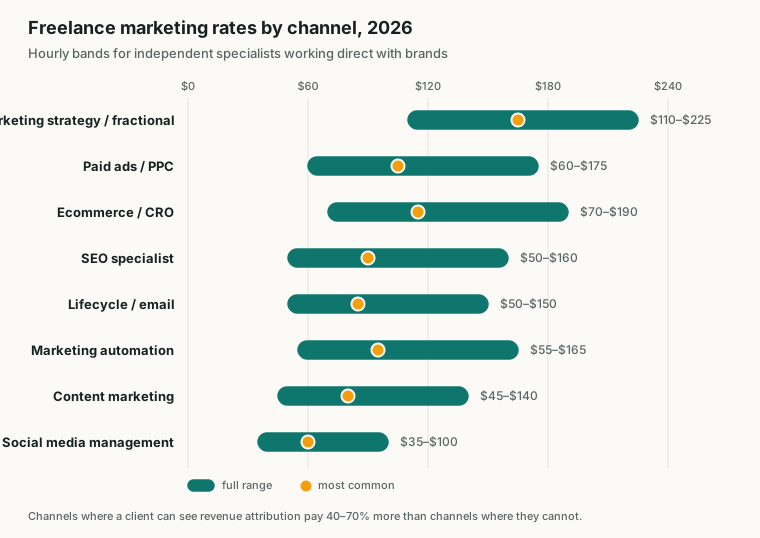
Eight marketing channels, low to high, with the most common rate in gold.
| Channel | Low | Typical | High |
|---|---|---|---|
| Marketing strategy / fractional | $110 | $165 | $225 |
| Ecommerce / CRO | $70 | $115 | $190 |
| Paid ads / PPC | $60 | $105 | $175 |
| Marketing automation | $55 | $95 | $165 |
| SEO specialist | $50 | $90 | $160 |
| Lifecycle / email | $50 | $85 | $150 |
| Content marketing | $45 | $80 | $140 |
| Social media management | $35 | $60 | $100 |
The attribution premium
Sort that table by how directly a client can trace the work to money and you get almost exactly the same order. That is not a coincidence.
CRO and paid ads sit near the top because a competent practitioner can say, with a straight face and a dashboard, "this change moved revenue by $X." Social media sits at the bottom not because it is easy — running a genuinely good brand account is hard — but because when the CFO asks what it returned, the honest answer involves several assumptions.
This has a practical implication that is worth more than the table itself: you can raise your rate by making your work more attributable, without changing what you do.
Three concrete moves, in ascending order of effort:
- Report in revenue units, not activity units. Not "published 12 posts, 40k impressions." Instead: "12 posts drove 2,140 sessions, 61 email signups, and 4 attributed demos at a blended CAC of $186." Same work, different frame.
- Insist on a baseline before you start. The number of marketing engagements that become unmeasurable because nobody recorded the starting figure is remarkable. Screenshot it in week one.
- Own one metric contractually. "I'm responsible for cost per qualified lead" prices differently from "I manage the ad account." It is also riskier, which is the point — carried risk is what the premium pays for.
The same logic runs from the buyer's side in ROI of hiring a freelancer, which is worth reading if you want to know what your client is being asked to justify internally.
Retainers, which is how marketing actually gets bought
Hourly billing is a minority of marketing work. Most ongoing channel management is retained, and the retainer bands look like this:
| Engagement shape | Monthly retainer | Roughly equivalent hours |
|---|---|---|
| Single channel, maintenance | $1,500 – $2,500 | 15 – 25 |
| Single channel, growth mandate | $2,500 – $3,500 | 22 – 32 |
| Multi-channel or strategy-inclusive | $3,500 – $6,000 | 30 – 50 |
| Fractional CMO, 1–2 days/week | $6,000 – $12,000 | 32 – 64 |
Two things about pricing these that catch people out.
Do not discount below 20 hours a month. Small retainers cost more per hour to service, not less — the context-switching and reporting overhead is nearly fixed regardless of size. A 10-hour retainer should carry a premium over your standing rate, not a discount. Freelance retainer rates has the full hour-band pricing logic and retainer pricing for freelancers covers which structure to use.
Price reporting separately in your own head. Marketing retainers are unusually reporting-heavy — monthly decks, dashboard maintenance, the quarterly review. That can be 15–20% of the engagement and it is delivery time you cannot spend on the channel. If your retainer assumes 25 hours of channel work and reality is 20 hours of channel work plus 5 of reporting, your effective rate is 25% lower than you think.
The percentage-of-spend question
Paid media specialists are routinely asked to charge 10–20% of managed ad spend. It is common enough to be a default, and it is worth being clear-eyed about.
What is good about it: it scales automatically with account size, it is simple to explain, and clients understand it because agencies use it.
What is bad about it: it pays you more for spending more of your client's money. That is a genuine misalignment, and sophisticated clients notice. It also punishes you for efficiency — the specialist who halves cost-per-acquisition by cutting wasted spend has just halved their own fee.
A structure that avoids both problems:
Base retainer covering the management work at your standing rate, plus a performance component tied to an outcome the client cares about — incremental revenue, qualified leads, or CAC improvement against an agreed baseline.
The base keeps you solvent in a slow month. The performance component means you get paid for making the account better, not bigger. It is a harder sell than 15% of spend and it is a much better business.
What actually separates the top of a band from the bottom
Within paid ads, the range is $60 to $175 — nearly 3×. Having hired on both ends of it, the difference is consistently three things.
Strategic altitude. A specialist who says "your problem isn't the ad account, it's that your landing page converts at 0.9%" is operating a level above the brief. That is a different job, and it prices like one.
Vertical knowledge. Someone who has run paid acquisition for eleven DTC supplement brands knows things about that market that nobody can acquire from a course. Vertical specificity is the fastest legitimate route up a marketing band, and it is why the 2026 rate queries I see are almost always channel-plus-vertical: ecommerce PPC, LinkedIn profile optimisation, Shopify product page work, Canva template systems. The market is pricing narrowness.
Comfort with the money conversation. Marketers who can sit in a budget meeting and defend a number in the CFO's language earn more than equally skilled marketers who cannot. This is not fair, and it is extremely consistent.
Project fees, and the four that are worth quoting
Not all marketing work suits a retainer. These four are commonly quoted as fixed-fee projects, with the ranges I see most often:
| Project | Typical fee | Usual duration |
|---|---|---|
| Paid account audit and restructure | $2,500 – $7,500 | 2–4 weeks |
| Technical SEO audit | $2,000 – $8,000 | 3–5 weeks |
| Lifecycle / email flow build | $3,500 – $12,000 | 4–8 weeks |
| Positioning and messaging | $6,000 – $20,000 | 4–10 weeks |
Two things make these safe to fix-fee where ongoing channel management is not. The scope has a natural end — an audit is finished when the audit is finished. And you have almost certainly done this exact shape of work before, which is the condition that makes any fixed fee defensible.
Audits in particular are the single best entry product in marketing. They are bounded, they demonstrate competence at low client risk, and they very frequently convert into the retainer that follows. Price them as a real piece of work rather than a loss leader — an audit priced at $500 signals that the findings are worth about that much.
The seasonality problem nobody warns you about
Marketing budgets are unusually seasonal, and freelance marketers are unusually exposed to it. Retail-adjacent clients disappear in January after Q4. B2B goes quiet in late December and again in August. Budget resets in the new fiscal year create a hiring pause that lands on contractors first.
Three defences, in order of how much they help:
Build the buffer into the rate, not into hope. A 12–15% buffer inside your rate calculation is not padding; it is the mechanism by which a nine-month income covers twelve months of life. Freelancers who omit it experience seasonality as a crisis every single year and never connect it to their pricing.
Stagger contract end dates deliberately. Three retainers all ending 31 December is a January with no income. Start them in different months even if it means offering a two-month initial term on one of them.
Diversify the client's seasonality, not just the client count. Four ecommerce clients is one season. Two ecommerce and two B2B SaaS is two seasons pulling in different directions, which is worth more than a fifth ecommerce client.
Setting your own floor before you use any of this
Benchmarks tell you whether a number is plausible. They cannot tell you whether it is survivable, because they know nothing about your costs.
A worked example for a freelance PPC specialist:
- Take-home target: $88,000
- Tax gross-up at 28% effective: $88,000 ÷ 0.72 = $122,222
- Business expenses — tooling, ad-platform certifications, insurance, accounting, hardware: +$7,800
- Buffer for seasonality at 12%: +$15,603
- Total to bill: $145,625
- Realistic billable hours: 1,100
- Floor: $132 an hour
That specialist is above the typical mark for paid ads and comfortably inside the band — but they cannot take a $2,000 monthly retainer that consumes 25 hours, because that is $80 an hour and $52 below their floor. Knowing that in advance is the entire value of doing the arithmetic. The freelance rate calculator formula walks the same steps, and the calculator will run it on your figures.
For a second data point on marketing compensation built from a different method, the US Bureau of Labor Statistics' advertising, promotions and marketing managers data is a reasonable floor check — remembering that it measures employment, so freelance rates should sit well above the implied hourly equivalents once benefits and unbillable time are counted.
Short version: freelance marketing rates in 2026 run from $35 to $225 an hour, retainers from $1,500 to $12,000 a month, and the position of any given channel in that spread is set mostly by how easily a client can attribute revenue to it. Make your work more attributable and the rate follows. Work out your own floor first — start here — because a benchmark you cannot live on is not useful information.
Questions people ask
- What do freelance marketing specialists charge in 2026?
US direct-to-client hourly rates run from about $35 for social media management at the entry end to $225 for fractional marketing leadership. Most competent channel specialists sit between $85 and $115. Retainers, which are more common than hourly in marketing, run $1,500 to $6,000 a month.
- Why do PPC and ecommerce specialists charge more than social media managers?
Attribution. A client can see exactly what a paid ads change did to revenue, which makes the value of the work arguable in dollars. Social media impact is real but harder to trace to a transaction, so it gets priced closer to the labour than to the outcome.
- Should freelance marketers charge a percentage of ad spend?
It is common at 10 to 20 percent of spend but it creates a bad incentive — you earn more by spending more of the client's money. A flat retainer plus a performance component tied to an outcome metric aligns better and is easier to defend when spend fluctuates seasonally.
- What is a normal freelance marketing retainer?
For single-channel management, $1,500 to $3,500 a month is typical. Multi-channel or strategy-inclusive engagements run $3,500 to $6,000. Fractional CMO arrangements sit above that, commonly $6,000 to $12,000 for one to two days a week.
Put these numbers to work
Use the free freelance rate calculator to turn this into your own hourly rate in under a minute.
Open the calculatorKeep reading
More in Rate Benchmarks, or browse all guides.
Freelance developer hourly rate bands for 2026 by stack, plus the domain premium that adds 25-40% for exactly the same technical work.
ReadFreelance designer hourly rate bands for 2026 across eight specialties, and why the spread inside one discipline beats the gap between disciplines.
ReadHow many hours do freelancers work each week? Four real working patterns, the billable share of each, and why billable hours plateau near 26.
ReadFreelance writer hourly rate bands from the real market: the content mill floor, generalist and specialist ranges, and per-word vs hourly math.
ReadHow to measure rate of pay for freelancers if you're the one hiring: a 5-step framework for benchmarking rates, converting to loaded cost, and tracking ROI.
ReadUse a freelance rate calculator automotive pros trust. Real hourly ranges by specialty, hidden expenses, and a worked rate-floor example for auto work.
Read