Freelance Pricing Psychology — The Discount Nobody Asked You For
Freelance pricing psychology explains why your quoted rate lands below your calculated floor — anchoring, the silence reflex, and four repairs that hold.
Practical guidance, not financial advice. Sukie is a working freelancer, not a licensed accountant or financial advisor. Use this to make a defensible decision, then confirm the specifics for your situation with a qualified professional.

By Sukie · Founder & Writer, FreelanceRateLab
Published September 20, 2026 · 7 min read
Freelance pricing psychology is the study of a very specific gap: the one between the rate you calculate in a spreadsheet on Sunday and the rate that comes out of your mouth on Tuesday. Everything in this guide lives in that gap, because that is where freelancers lose money — not in the arithmetic, which most people get roughly right, but in the delivery, which almost nobody does.
I know the size of my own gap because I started writing both numbers down. Over eighteen months, across 44 proposals, my calculated floor averaged $118 an hour and my quoted rate averaged $91. I was giving away 23% of my business to a feeling, on purpose, one conversation at a time.
The shape of the drop
The interesting thing is that the number does not fall all at once. It falls in stages, and each stage has a different mechanism.
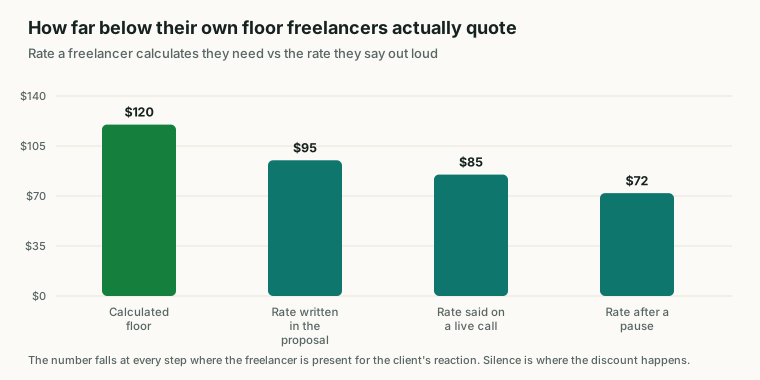
The rate falls at every step where the freelancer is present for the client's reaction.
Look at where the drops happen. From the spreadsheet to the written proposal is a 21% fall — and nobody is in the room. From the written proposal to the spoken number is another 11%, and now someone is listening. And from the spoken number to the number after a pause is a further 15%, and now someone is not speaking.
That last one is the cruellest, because in the overwhelming majority of cases the client has not asked for anything. They are thinking. Perhaps they are checking a budget, or reading the email again, or their dog has done something. The freelancer interprets three seconds of silence as rejection and volunteers a discount to make it stop.
The most expensive sentence in freelancing is "…but I could probably do it for less."
Nobody has ever asked for it. It arrives unrequested, roughly 15% of the time, at a cost of roughly 15%.
Four mechanisms, and what each one actually is
Anchoring. Whoever says a number first sets the frame. If a client opens with "we're thinking around $3,000," your $7,500 does not get evaluated on merit — it gets evaluated as two and a half times too much. The same $7,500, said first, gets evaluated as a price.
The repair is to quote first whenever the situation allows, and to reset explicitly when it does not: "That's helpful to know. Before I respond to that number, can I walk you through what the scope you've described actually involves?" You are not refusing their anchor. You are declining to be measured against it before the scope is agreed.
Loss aversion, pointed the wrong way. Losing a prospective client feels roughly twice as bad as winning one feels good — this is one of the most robust findings in behavioural economics, and freelancers apply it to the wrong asset. You are treating the client as the thing you might lose. The thing you are actually losing, every time, is margin.
Reframe it in units you can feel. A $20/hour discount across a 120-hour project is $2,400. That is not "a bit of flexibility." That is a month of your business's overhead. The reframe works because it makes the loss concrete on the side where it is real.
Ambiguity aversion. Uncertainty about what a project involves makes people quote low, because a low number feels like insurance against having underestimated. It is the opposite of insurance. A low number on an unclear scope is a guarantee of loss, not a hedge against it. If the scope is genuinely unclear, the correct answer is not a lower fixed price — it is hourly billing, or a paid discovery phase. Hourly vs project pricing covers when each applies.
Social proof, absent. Employees learn what work is worth from salary bands, colleagues, and offer letters. Freelancers, working alone, learn it from whatever the last client agreed to — which is a sample size of one, selected for having said yes to a number that may well have been too low. This is why benchmarks matter more for freelancers than for employed people, and why freelance hourly rate by industry exists.
What holding actually costs
Here is the data I most wish I had had five years earlier. Across two years I logged what happened every time I declined to discount — 40 conversations in total.
| Outcome | Count | Share |
|---|---|---|
| Accepted at full rate | 19 | 47.5% |
| Accepted with reduced scope | 11 | 27.5% |
| Walked away | 7 | 17.5% |
| Came back later at full rate | 3 | 7.5% |
Three quarters of the conversations survived the word no. And the seven that did not were, without a single exception, the smallest budgets in the set — their combined value was less than two of the projects in the top row.
That is the empirical answer to "will I lose clients if I hold my price?" You will lose about one in six, and they will be the ones whose loss costs you least. The full argument for that, with the floor arithmetic attached, is in how to stop undercharging as a freelancer.
Notice the second row too. Reduced scope is a win, not a compromise — same effective rate, smaller commitment, faster delivery. It is available almost any time you are willing to say "I can't move the rate, but I can move the scope," and it converted more than a quarter of my price objections.
Four repairs that hold under pressure
Motivation does not survive a live call. Procedure does. These are procedural.
Write the floor down before the call, on paper, where you can see it. Not in your head. The single most effective change I made to my own pricing was a sticky note with one number on it, stuck to the monitor bezel during calls. I have never once quoted below it while looking at it, and I quoted below it regularly before.
Decide in advance that you will not fill the silence. Say the number. Stop. Let the pause be theirs. If you need a mechanical crutch, count to ten. This one repair is worth about 15% on its own, by the chart above.
Separate the quote from the conversation. Say the number in writing, in a proposal, where nobody's face is available to be misread. Then discuss it on a call after it has been read. You lose the drop from written to spoken entirely, because the number was already committed.
Have a scope lever ready before you need one. Know, in advance, the two things you would remove from this project if the price were an issue. Then the answer to "that's more than we hoped" is immediate and confident: "I understand. The rate is the rate, but we could drop the migration and the training session and land at $5,200." You have conceded nothing and offered something.
The part that is not psychological
There is a version of this advice that says the whole problem is confidence, and it is incomplete in a way that harms people.
A freelancer who has never calculated what their business actually costs to run does not have a confidence problem. They have an information problem, and no amount of self-belief fixes it, because deep down they know the number is invented. Aspirational numbers are hard to say out loud precisely because they are aspirational.
Calculated numbers are much easier. When someone questions $118 and you can say "that's what covers self-employment tax, $11,000 of business expenses, and the fact that only about 55% of my working hours are billable" — the conversation stops being about your self-worth and starts being about arithmetic. Arithmetic is a far better place to negotiate from.
So do that first. The freelance rate calculator formula walks through it with a worked example, true hourly rate shows what a billed hour actually returns once everything is counted, and the calculator on the homepage will produce your number in about a minute. Then come back to the four repairs, because a good number said badly still leaks.
Kahneman and Tversky's original work on prospect theory is the source for the loss-aversion asymmetry described above, if you want the underlying research rather than the freelance application of it.
The compressed version: your pricing does not fail in the spreadsheet, it fails in the four seconds after you say the number. Write the floor down where you can see it, deliver it in writing before you deliver it out loud, keep a scope lever in your pocket, and let the silence belong to whoever created it. Three quarters of the conversations survive. The quarter that do not were mostly not worth having.
Questions people ask
- Why do freelancers undercharge even when they know their numbers?
Because the number is calculated in private and delivered in public. The arithmetic happens when you are calm and alone; the quote happens when you are watching someone's face. Almost all of the loss occurs in the gap between those two moments, which is why the repair is procedural rather than motivational.
- What is anchoring in freelance pricing?
Anchoring is the tendency for the first number mentioned to dominate the whole negotiation. If a client says 'our budget is around $2,000' before you have quoted, every subsequent figure is judged against $2,000 rather than against value. The countermeasure is to quote first whenever you can, or to reset the frame explicitly before responding.
- How do I stop discounting when a client goes quiet?
Decide in advance that you will not speak next, and give yourself something concrete to do instead — such as counting to ten or looking at a note that says 'the silence is theirs'. The discount that follows a pause is almost never requested by the client; it is volunteered by the freelancer to end the discomfort.
- Is imposter syndrome really a pricing problem?
Partly, but treating it as purely psychological leads to advice that does not work. A freelancer who has never calculated their cost floor has a genuine information problem, not only a confidence one. Do the arithmetic first — a defensible number is far easier to say out loud than an aspirational one.
- Does raising prices actually lose clients?
Some, and fewer than expected. In my own records, holding rate across 40 proposals lost 7 — and those 7 were consistently the smallest budgets. The clients most likely to leave over price are usually the ones costing you the most in unbillable time, which means the loss is smaller than the headline number suggests.
- Should I put my rates on my website?
It depends on what you want to filter. Published rates screen out low-budget enquiries before they cost you a call, at the price of losing some high-budget clients who would have paid more for a scoped proposal. Publishing a starting-from figure captures most of the filtering benefit without capping your ceiling.
Put these numbers to work
Use the free freelance rate calculator to turn this into your own hourly rate in under a minute.
Open the calculatorKeep reading
More in Raising Your Rates, or browse all guides.
Freelancer performance metrics that change decisions: six numbers with formulas, what each means when it moves, and three popular ones worth ignoring.
ReadWhen to raise freelance rates, judged by signals instead of nerve: seven concrete triggers, the two that mean you are already late, and one that means wait.
ReadRaising freelance rates email template you can send today, plus variants for long-term, retainer and low-value clients, and the sentences that cost you it.
ReadFreelance rate negotiation without discounting: seven copy-paste scripts for the objections that actually come up, including hourly vs project fee.
ReadHow to raise freelance rates the calm way: a readiness checklist, a step-by-step playbook, and two copy-paste email scripts for new and existing clients.
ReadFreelance writing rates per word converted properly: what each band really pays hourly at honest output speeds, and when to quote a project fee instead.
Read