Raising Freelance Rates Email Template (And How to Send It)
Raising freelance rates email template you can send today, plus variants for long-term, retainer and low-value clients, and the sentences that cost you it.
Practical guidance, not financial advice. Sukie is a working freelancer, not a licensed accountant or financial advisor. Use this to make a defensible decision, then confirm the specifics for your situation with a qualified professional.

By Sukie · Founder & Writer, FreelanceRateLab
Published October 14, 2026 · 9 min read
Every raising freelance rates email template you find online is too long, and mine was the worst offender of all.
It sat in my drafts for eleven days. I rewrote it four times, each version longer and more apologetic than the last, and the final draft before I gave up ran to five paragraphs explaining my increased software costs to a client who had never once asked what my software costs were.
I deleted all of it and sent three sentences instead. He replied in under an hour: "No problem — send the new agreement when you get a chance." The whole thing had lived in my head for a week and a half and in his for about forty seconds.
That gap is the real subject here. Below are the templates, but the templates are the easy part.
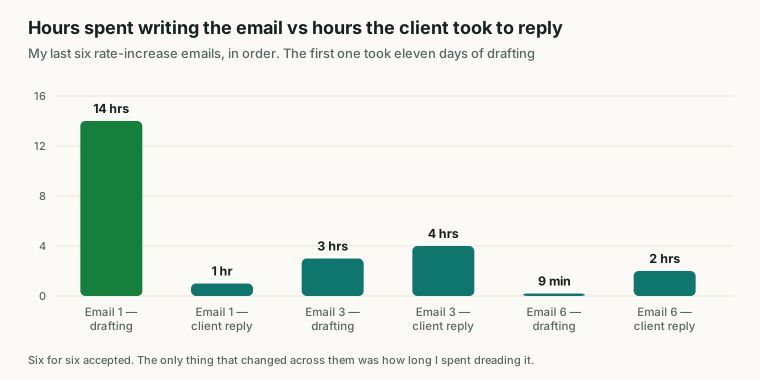
My last six rate-increase emails: hours I spent writing each one, against the hours the client took to reply. The gap is the whole problem.
The template, in its shortest useful form
This is the one to send to a stable client you like, at renewal or year-end. It is deliberately short.
Subject: Rates for 2027
Hi [Name],
A quick heads-up that my rate is moving to $[new rate] from 1 January. Everything already scheduled stays at the current rate, so this only affects new work from then.
Happy to talk it through if useful. Otherwise nothing changes on your end and I'll invoice at the new rate from January.
Thanks for a good year — looking forward to the next one.
[You]
Four things are doing the work in there, and all four are easy to accidentally remove.
The date is specific. "Sometime early next year" invites a conversation about when. "1 January" is a fact you are reporting.
Existing work is protected. This is the single line that removes most objections, because the client's immediate anxiety is about the project currently on their desk and their current budget. Answer it before they ask it.
There is no reason given. Not one word about costs, inflation, demand or how long it has been. See below.
The action required is nothing. The default outcome is acceptance. A client who has to reply to agree is a client who has to find time to think about it, and thinking about it is how a simple thing becomes a negotiation.
Why leaving out the reason works better
Every instinct says to justify. Resist it, because a justification does two unhelpful things at once.
It reframes your rate as a problem you are having, rather than a price you are setting — which invites sympathy, and sympathy is not the register you want. And it hands over a list of things to argue with. If you say your costs rose 8 percent, you have implicitly agreed that 8 percent is the right size of increase, and a client who wanted to push back now has an obvious opening.
Your landlord does not explain their reasoning. Your accountant does not. The clients you have are, right now, absorbing price increases from a dozen suppliers who sent them a single line.
The one exception
If you are raising rates a long way — more than about 30 percent — a short forward-looking sentence helps, because a large jump without context reads as arbitrary and slightly alarming. Frame it around what they are getting rather than what you are spending:
The new rate reflects where the work has moved over the last two years — more strategy and less production — which I think has been the more useful half for you.
Still one sentence. Still no mention of your costs.
The long-standing client you undercharged for years
The hardest one, and the one people avoid longest. The trap is that the size of the gap makes you want to apologise, and apologising makes the increase sound negotiable.
Subject: Rate change from March
Hi [Name],
I've kept my rate flat since we started working together in 2023, and I'm bringing it in line with the rest of my client work from 1 March: $[new rate].
I know that's a bigger step than a normal annual adjustment — it's the catch-up for not having done this sooner, and it won't move again for at least a year. Work booked before March runs at the current rate.
You've been one of my favourite clients to work with and I'd like to keep going. Let me know if you want to talk it through.
[You]
The phrase "it's the catch-up for not having done this sooner" is doing real work. It names the thing they are already thinking, takes responsibility for it without grovelling, and closes the door on this being an annual shock.
The retainer client
Retainers need more notice, because retainers sit in somebody's budget line and that budget was probably set months ago.
Subject: Retainer renewal — new terms from Q2
Hi [Name],
Our retainer comes up for renewal at the end of March. From 1 April it moves to $[new amount]/month for the same scope — [briefly restate the scope in one clause].
I wanted to flag it now so it lands before your Q2 planning rather than after. If the scope should change too, this is a good moment for that conversation.
[You]
Offering to revisit scope is not a concession. It is frequently how a rate increase gets accepted — the client keeps their number and drops the deliverable they never really used, and you get a better hourly outcome than the increase alone would have produced. The retainer structures guide covers what to trade and what to hold.
The client you would be fine losing
Send exactly the same email as the first template. Do not soften it, do not offer a middle option, and do not include the sentence about being happy to talk it through.
If the answer is no, you have your answer, and it is a good one. The clients most likely to refuse a reasonable increase are, in my experience without exception, the ones who were already consuming the most unbilled time.
Five sentences that quietly cost you the increase
Each of these appears in almost every draft I have ever been shown, and each one hands something back.
"I hope this is okay." Converts a notice into a request. If it is a request, it can be declined.
"I know this is a big jump, sorry." Apologising signals that you think the number is unreasonable, which invites the client to agree with you.
"Let me know if this doesn't work for you and we can figure something out." Offers a discount before anybody has asked for one. Delete it every time.
"With inflation and rising costs..." Makes your rate a symptom of external conditions rather than a decision, and invites a debate about whether those conditions are really worth 12 percent.
"I've been meaning to do this for ages." True, probably, and it tells the client you were comfortable at the old rate for a long time — which is the last thing you want them holding when they decide whether to accept.
The pattern across all five: each one moves the email from informing to asking. Read your draft once looking only for that shift, and cut whatever produced it.
What to do about the number itself
Send the email only after the number is settled, because a rate you are unsure of leaks into the wording and clients can hear it.
Work it out from your own floor rather than as a percentage of the old rate — percentages compound old mistakes. Run the build-up on the rate calculator, or work through the formula if you want to see each step. Two figures move more than people expect between reviews: your real expenses, and your real billable hours. Both usually make the correct number higher than the percentage bump you had in mind.
Worth remembering while you set it: you are not only covering your own costs. Self-employment tax alone is 15.3 percent before any income tax, as the IRS sets out, and it is charged on the rate you actually agreed rather than the one you meant to.
Then set the walk-away figure — the rate below which you would rather transition the client out. Write it down before sending. The entire purpose of deciding in advance is that you will not decide well at 9pm in a reply thread.
Sending it, and the twenty minutes afterwards
Send on a Tuesday or Wednesday morning. Not Friday, when it sits unanswered all weekend and you spend the weekend in it. Not Monday, when everyone's inbox is a wall.
Send to every client in the same week. Staggering means a month of low-grade dread and, eventually, an awkward moment when two clients compare notes.
Then close the tab. The most common outcome by a wide margin is a two-line reply agreeing, often faster than you expect, sometimes with a note that they had assumed you would have done this sooner. The second most common is silence followed by a paid invoice at the new rate.
If the reply is a negotiation
Some clients negotiate reflexively — it is their job, and it is not personal. Two responses cover almost everything:
If they ask for a smaller increase, hold the rate and offer a later start date. Time is cheaper for you to give than money, and it usually satisfies the impulse.
If they ask what they get for the extra, answer it concretely — faster turnaround, a standing slot, first refusal on capacity — and then stop talking. The pause after a number is where rates are won and lost, and the person who fills it first is generally the one who concedes.
After it lands
Update your standing quote, your contract template and your proposal boilerplate the same day. The most common failure I see is not the email at all — it is quoting the old rate to a new prospect three weeks later out of habit, which resets the anchor you just spent a week of nerves moving.
Then diarise the next review for twelve months out. Rate increases are unbearable when they are events and unremarkable when they are a routine. The whole reason my first one took eleven days of drafting was that it was the first; the fourth took nine minutes.
If you are unsure whether now is even the right moment, when to raise freelance rates lists the signals worth acting on, and how to raise your rate covers the wider strategy this email sits inside.
FAQ
How much notice should I give before a rate increase? Thirty days minimum, sixty for retainer clients who budget quarterly. Notice matters more than size — clients rarely object to paying more, they object to being surprised. Mid-project work stays at the old rate, and saying so removes most of the objection before it forms.
Should I explain why I am raising my rates? One sentence at most, forward-looking, never a justification. "My rates for 2027 are $X" is a business fact. Explaining your costs invites a negotiation about whether your costs are the client's problem.
What do I do if a client says no? Decide your walk-away rate before you send, not after they reply. If their answer is below it, transition them out over an agreed period rather than reversing. A client who declines is giving you accurate information about what the relationship is worth to them.
Questions people ask
- How much notice should I give before a rate increase?
Thirty days is the working minimum and sixty is better for retainer clients who budget quarterly. The notice period matters more than the size of the increase — clients rarely object to paying more, they object to being surprised. If you are mid-project, the new rate starts on the next project rather than the current one, and saying so explicitly removes most of the objection before it forms.
- Should I explain why I am raising my rates?
One sentence, forward-looking, and never a justification. 'My rates for 2027 are $X' is a business fact. 'Because my costs have gone up and I've been undercharging' invites a negotiation about whether your costs are really their problem. Clients accept price changes from suppliers constantly without receiving an explanation; you are a supplier.
- What do I do if a client says no?
Decide before you send the email, not after they reply. Work out the rate at which you would genuinely rather lose the client, and if their answer is below it, transition them out over an agreed period rather than reversing. A client who declines is giving you accurate information about what the relationship is worth to them, which is useful even when it stings.
Put these numbers to work
Use the free freelance rate calculator to turn this into your own hourly rate in under a minute.
Open the calculatorKeep reading
More in Raising Your Rates, or browse all guides.
Freelance rate negotiation without discounting: seven copy-paste scripts for the objections that actually come up, including hourly vs project fee.
ReadFreelance pricing psychology explains why your quoted rate lands below your calculated floor — anchoring, the silence reflex, and four repairs that hold.
ReadHow to raise freelance rates the calm way: a readiness checklist, a step-by-step playbook, and two copy-paste email scripts for new and existing clients.
ReadFreelance writing rates by format and specialism, with the arithmetic behind each band — and why no authority publishes the 'average' rate everyone quotes.
ReadFreelance rate after taxes, traced from a $100 invoice to your bank account, with the gross-up multiplier and why subtracting tax gets it backwards.
ReadFreelance marketing rates for 2026 across eight channels, why attributable channels pay 40-70% more, plus retainer bands and the performance-pricing question.
Read