Freelance Rate Negotiation, With the Actual Words
Freelance rate negotiation without discounting: seven copy-paste scripts for the objections that actually come up, including hourly vs project fee.
Practical guidance, not financial advice. Sukie is a working freelancer, not a licensed accountant or financial advisor. Use this to make a defensible decision, then confirm the specifics for your situation with a qualified professional.

By Sukie · Founder & Writer, FreelanceRateLab
Published October 1, 2026 · 7 min read
Freelance rate negotiation goes wrong in a very small number of predictable places, and it goes wrong with the same four or five sentences every time. This guide is mostly scripts, because the thing that fails on a live call is never your understanding of the economics — it is your access to a sentence.
I have logged rate conversations for two years. Here is the outcome distribution when I simply did not discount:
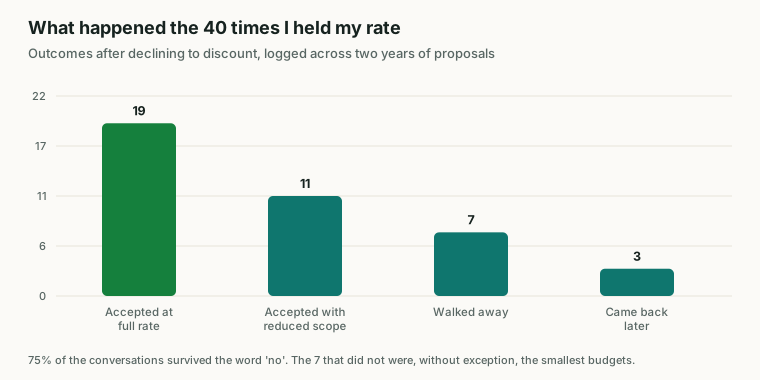
Forty conversations where I declined to move the rate. Seven ended the relationship — and those seven were the smallest budgets in the set.
Seventy-five percent survived. That is the number to hold in your head for everything below.
Before any of it: know your two numbers
Scripts do not work if you do not believe the number you are defending. Have two figures written down before the call.
Your standing rate — what you quote for well-scoped work with a reasonable client.
Your floor — the number below which the engagement loses money once tax, expenses, and unbillable time are counted. Usually 30–40% below the standing rate. You never quote it and you never negotiate towards it. It exists so that "no" is a calculation rather than a mood.
If you do not have these, get them first: the freelance rate calculator formula builds them from your income target and real billable hours, and the calculator does it in a minute. Everything below assumes you have them written on something you can see.
Script 1 — "The client wants hourly, I want a project fee"
This is the most common structural disagreement in freelancing, and it is almost always a misunderstanding rather than a conflict.
The client is not attached to hourly billing. They are attached to not being overcharged, and hourly feels like a receipt. Answer the fear, not the request:
"Happy to talk through the structure. The reason I've quoted a fixed fee is that it caps your exposure — you know the number today, and it doesn't move if this takes me longer than I expect. With hourly, that risk sits with you.
If the concern is transparency about what's in it, I'm glad to share the hour estimate the fee is built from, and we can put a change-order clause in for anything outside the agreed scope."
You have kept the fixed fee, reframed it as protection for them, and offered transparency instead of a discount. In my experience this converts more often than any other script here.
If they still insist — some finance departments genuinely cannot process a fixed-fee invoice — take hourly, but adjust for what you have given up. Fixed fees reward speed; hourly punishes it. If you are faster than average at this work, hourly costs you real money, and pricing 10–15% above your standing rate to compensate is reasonable. Project-based vs hourly rate works through who carries which risk in each model.
Script 2 — "That's more than we budgeted"
Never move the rate. Move the scope.
"I understand. I can't move the rate, but I can move what's in it. Two options: we could drop the content migration and the training session, which brings it to $5,200. Or we phase it — the core build now at $6,400, and the rest next quarter if it's working."
Three things are happening. Your effective hourly rate is untouched. The client gets a genuine choice rather than a refusal. And you have quietly established that your price is a function of scope, not of negotiation — which makes every subsequent quote easier.
Have the scope lever chosen before the call. Know which two things you would remove. The script only works if the answer is immediate; hesitating while you invent one reads exactly like preparing to discount.
Script 3 — "What's your rate?" before scope exists
Answering with a bare number here is a trap: it becomes the anchor and the scope grows around it.
"Projects like this usually land between $6,000 and $11,000 depending on scope. Can I ask three quick questions to tell you where in that range this one sits?"
The range anchors high, stays honest, and moves the conversation to scope — which is where you want it. Note that the bottom of your range should be a number you are genuinely happy with, because it is the only number they will remember.
Script 4 — "Can you do better on price?"
The reflex answer is a small discount. The correct answer is a question.
"Possibly — what would it be worth to you? If we're talking about a longer commitment, or paying the full amount upfront, or being able to use this as a public case study with your results in it, there's room to move. On the project as scoped, this is the number."
Discounts are fine. Free discounts are not. Every reduction should buy something with cash value: duration, volume, cash-flow, or proof. This one sentence converts "can you do better" from a giveaway into a trade roughly half the time.
Script 5 — Raising rates with an existing client
Short, dated, unapologetic. The most common failure here is over-explaining, which reads as uncertainty and invites a counter-offer.
"Hi [Name] — a quick note that my rate is moving to $135/hour from 1 November. Everything currently booked stays at the existing rate through the end of the year. I've really enjoyed working on [project] and I'm looking forward to what's next."
That is the whole message. No apology, no paragraph about rising costs, no request for approval. Four to eight weeks of notice. How to raise freelance rates covers timing and readiness in full — the short version is that the best moment is immediately after you have delivered something that visibly worked.
Script 6 — The lowball first message
"Thanks for reaching out. That budget is quite a way below where I work, so I don't think I'm the right fit for this one — but I'd genuinely rather say so now than waste your time. If the budget changes, I'd be glad to talk."
Warm, fast, final. Do not negotiate from a lowball anchor; every subsequent number gets measured against it. And note from the chart above: the conversations that ended when I held my rate were consistently the smallest budgets. A first-message lowball is information about the entire relationship.
Script 7 — The silence
There is no script. That is the script.
Say the number. Stop. Do not add "…but there's some flexibility." Do not add "…does that work?" Do not fill it.
The pause is the single most expensive moment in freelance pricing — worth roughly 15% by my own records, volunteered rather than requested. If you need a mechanical crutch, count to ten. If you need a reason, remember that the client is almost certainly checking a budget or reading the email again, not recoiling. Freelance pricing psychology covers why this specific moment does more damage than all the others combined.
Three things that make every script work better
Quote in writing first, discuss after. A number delivered in a proposal cannot be softened by your own facial expression. Send it, let them read it, then talk. You skip the entire spoken-number drop.
Never justify a rate with your costs. "I need $120 because of my expenses" invites the client to audit your business. "$120 is my rate for this work" does not. Costs are how you calculate the number in private; they are not how you defend it in public.
Be willing to lose the deal, visibly and pleasantly. Not as a tactic — as an actual position. The freelancer who cannot walk away has no rate, only an opening bid. This is why the floor matters: it converts walking away from an act of nerve into an act of arithmetic.
For the contractual side of everything agreed here — scope, change orders, what counts as a revision — the Small Business Administration's contracting guidance is the plain-language reference. Every script above is worth less if the agreement it produces is verbal.
Three quarters of rate conversations survive being held. The scope lever converts a good share of the rest. And the seven-in-forty that end were, in my records, uniformly the clients who would have cost the most to keep. Write your floor down, put the number in writing before you say it out loud, and let the silence belong to whoever created it. If you have not calculated the floor yet, do that first — every script here depends on it.
Questions people ask
- What do I say when a client wants to pay hourly and I want a project fee?
Name what each model gives them, then offer the one that solves their real concern. Clients ask for hourly because they fear paying for padding, so answer that fear directly: 'A fixed fee means you know the number today and it does not move if this takes me longer than expected. If the worry is transparency, I'm happy to share the hour estimate the fee is built from.' You have kept the fixed fee and removed the objection.
- How do I respond to 'that's more than we budgeted'?
Do not move the rate — move the scope. 'I understand. I can't change the rate, but I can change what's in it. If we drop the migration and the training session, we land at $5,200.' This keeps your effective hourly rate intact, gives the client a real choice, and converts a surprising share of price objections.
- Should I ever discount my freelance rate?
Only in exchange for something with cash value: a longer commitment, guaranteed volume, upfront payment, or a case study with named results. A discount given for nothing teaches the client that your first number was inflated, which makes every future quote harder.
- What if a client asks for my rate before I know the scope?
Give a range with a condition attached: 'Projects like this usually land between $6,000 and $11,000 depending on scope. Can I ask three questions to tell you where in that range this sits?' You have anchored high, stayed honest, and moved the conversation to scope.
- How do I raise rates with an existing client without losing them?
Give notice, tie it to a date rather than a negotiation, and keep it short. Four to eight weeks of warning, a single paragraph, no apology and no lengthy justification. Long explanations read as uncertainty and invite counter-offers that a two-sentence notice does not.
- Is it worth negotiating with a client who lowballs immediately?
Usually not, and the data backs this up: in my own records, every conversation that failed after I held my rate was among the smallest budgets in the set. A first-message lowball is information about the whole relationship, not just about this project.
- What should I do when the client goes silent after I give a number?
Nothing. Say the number and stop talking. The discount that follows a pause is almost never requested — it is volunteered by the freelancer to end the discomfort, and it costs roughly 15%.
Put these numbers to work
Use the free freelance rate calculator to turn this into your own hourly rate in under a minute.
Open the calculatorKeep reading
More in Raising Your Rates, or browse all guides.
Freelancer performance metrics that change decisions: six numbers with formulas, what each means when it moves, and three popular ones worth ignoring.
ReadWhen to raise freelance rates, judged by signals instead of nerve: seven concrete triggers, the two that mean you are already late, and one that means wait.
ReadRaising freelance rates email template you can send today, plus variants for long-term, retainer and low-value clients, and the sentences that cost you it.
ReadFreelance pricing psychology explains why your quoted rate lands below your calculated floor — anchoring, the silence reflex, and four repairs that hold.
ReadHow to raise freelance rates the calm way: a readiness checklist, a step-by-step playbook, and two copy-paste email scripts for new and existing clients.
ReadFreelance writing rates per word converted properly: what each band really pays hourly at honest output speeds, and when to quote a project fee instead.
Read