Project-Based vs Hourly Rate: Is Freelance Pay Fixed or Variable?
Project-based vs hourly rate explained: how each model works, who carries the risk, and which one actually protects your margin. With real dollar examples.
Practical guidance, not financial advice. Sukie is a working freelancer, not a licensed accountant or financial advisor. Use this to make a defensible decision, then confirm the specifics for your situation with a qualified professional.

By Sukie · Founder & Writer, FreelanceRateLab
Updated August 11, 2026 · 7 min read
Project-based vs hourly rate was the question a client emailed me last year, mid-project, in a single line: "Just to confirm — is this project-based or hourly?" I stared at it for longer than I'd like to admit. I had sent a flat fee. I had a scope doc. But I had never once given her a clean, one-sentence definition of what either of those terms actually meant for our working relationship. I made one up on the spot, it was vague, and she followed up with three more questions.
That moment is why I wrote this guide. The phrase "project-based vs hourly rate" sounds simple until a real client asks you to explain it under pressure. Here is the clean answer I wish I'd had.
What Project-Based Actually Means
Project-based pricing means you charge a single fixed price for a defined deliverable. The client pays that number when the work is complete (or in milestones), regardless of how many hours the work actually takes you.
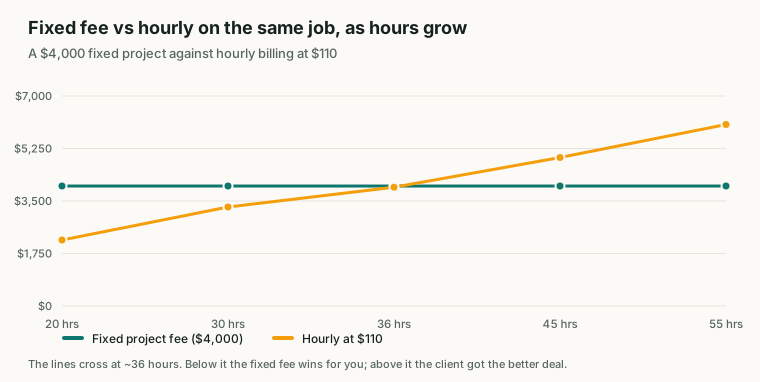
The lines cross near 36 hours. Below it the fixed fee favours you; above it, the client.
The key word is defined. A project price is only as stable as the scope document behind it. "Write a 10-page white paper on supply chain risk, two rounds of revisions included, delivered in three weeks" — that is a project. "Help us with content stuff" is not. The second one will eat you alive on a flat fee.
Project-based does NOT mean hourly in disguise. When clients ask "does project based mean hourly rate," the short answer is no. You are not billing time. You are billing for an outcome. Whether you finish in 15 hours or 45 hours, the client's invoice is the same. That is the whole trade-off in one sentence, and it cuts both ways.
Internally, you still need your hourly rate to build a sane project price. If your freelance rate calculator says your baseline is $95/hr and you estimate 30 hours of work, your floor is $2,850. Most experienced freelancers add 20-30% buffer on top, bringing that quote to $3,500 or so. The client sees one number. The hours math is yours to keep.
Fixed vs Variable: The Real Question
"Are freelance project payments fixed or variable?" is really asking who holds the risk when scope shifts. Here is the breakdown:
| Pricing model | Payment trigger | Who holds scope risk | Best for |
|---|---|---|---|
| Fixed project | Deliverable or milestone accepted | You (time overruns come out of your margin) | Well-defined, repeatable work with clear end state |
| Hourly | Hours logged and approved | Client (more scope = bigger invoice) | Shifting requirements, research-heavy, ongoing unclear work |
| Hybrid | Base project fee + hourly overage rate | Shared | Long relationships, complex projects, retainers with caps |
Fixed project payments are truly fixed only when scope is locked. If your contract allows unlimited revisions, client-requested additions, or vague success criteria, the payment is fixed in name only. You end up doing variable work for a fixed check, which is the worst of both worlds.
Hourly payments are always variable by nature. The billable hours you log determine the invoice. That variability is a feature, not a bug, for certain types of work — it means the client absorbs every scope addition automatically.
Hybrid models acknowledge that most real client relationships don't fit neatly into either box. More on those in a later section.
When Project Pricing Protects Your Margin
Fixed project pricing rewards speed and expertise. If you are genuinely faster than average at a type of work, project pricing is where your skill turns into higher effective earnings.
Scenario 1: The fast logo design. You quote $2,400 for a brand identity package. It is work you have done 60 times. You finish the whole thing in 14 hours. That is $171/hr effective rate. Your hourly rate would have billed the client $95 x 14 = $1,330 — a $1,070 gap in your pocket. Project pricing captured the value of your experience.
Scenario 2: The website audit. A client needs a technical SEO audit. You scope it at $4,000, estimating 40 hours. You have a templated workflow at this point and finish in 22 hours. Effective rate: $182/hr. If you had billed hourly, you would have invoiced $2,090 and probably felt vaguely resentful. The project price lets your process pay off.
Scenario 3: The mistake I made (and the lesson). A few years ago I scoped a content strategy project at $3,600, estimating 30 hours. I was on track until the client changed their target audience halfway through, which I had not defined as out of scope. I ended up at 52 hours. Effective rate: $69/hr — well below my $95 baseline at the time.
The fix was not to abandon project pricing. It was to write better contracts. I added a revision limit, a scope-change clause, and a line that said audience or format changes beyond the original brief triggered a new quote. That one clause has saved me an estimated $8,000+ in absorbed hours across subsequent projects.
Project pricing protects your margin when: scope is specific and written, revisions are capped, you have done similar work before, and your contract gives you a clean way to say "that's out of scope."
When Hourly Actually Wins
There are categories of work where fixed pricing is genuinely dangerous. Pushing into project pricing on these will cost you.
Scenario 1: Shifting requirements. The client thinks they know what they want. They do not. This is common in early-stage startups, rebrand projects, and any work where the client is discovering their own needs through the process. If you flat-fee this, every "we changed our minds" conversation is an unpaid meeting and unpaid rework. Hourly billing turns those changes into billable items automatically. The SBA recommends that service contracts clearly define payment terms — which for variable-scope work means hourly with a defined cap, not a fixed price.
Scenario 2: Research-heavy or open-ended consulting. A client wants you to help them figure out their content marketing strategy. They are not sure what they need. This is exploration work. The output is ambiguous. Billing a fixed fee for an ambiguous deliverable means one of you will be disappointed with the result, and it is usually you, because you overdelivered trying to justify the price.
Hourly billing makes the economics transparent. If you work 20 hours at $110/hr and find that what the client really needs is a different service entirely, you invoice $2,200, both of you move on, and no one is stuck arguing about whether the "project" was completed.
For ongoing unclear work, check the realistic billable hours per day benchmarks before you agree to any open-ended engagement — knowing your actual daily capacity keeps you from committing to more than you can deliver at an hourly rate you can sustain.
The Hybrid Reality Most Freelancers Land On
After a few years, most freelancers stop arguing project-based vs hourly rate and start mixing both into arrangements that match real client relationships.
The retainer with a project cap. You agree to a monthly retainer for ongoing availability — say, $2,500/month for up to 20 hours. Anything over 20 hours bills at your standard hourly rate. The client gets budget predictability on routine work. You get protection when things get heavy. This is probably the most common setup for long-term client relationships. See the freelance retainer structures guide for a deeper breakdown of how to negotiate these.
Value pricing with an hourly floor. You quote a project based on the value delivered, not hours spent. A landing page that converts well might be worth $5,000 to a client even if you build it in eight hours. You quote $5,000. But you also include a clause: if the project expands beyond the defined scope, additional work bills at $125/hr. Value pricing with an hourly fallback lets you capture upside on well-defined work while protecting yourself when reality diverges from the plan.
The discovery phase. Charge hourly for the first engagement with any new client whose needs are unclear. Use that phase to understand the work, build trust, and develop the data you need to quote a fair project price later. Many freelancers charge $500-$1,500 for a paid discovery call or brief that produces a proposal. Clients who balk at paying for discovery are often the same clients who turn fixed-price projects into nightmares.
For ongoing client work, revisit the freelance retainer pricing guide for the decision framework on when to propose a retainer versus continuing project-by-project.
The Number Behind Every Project Price
Whatever pricing model you use, one number anchors all of it: your baseline hourly rate. Not what you charge — what you need to earn to cover your actual costs, taxes, and income target.
The math is not complicated. Say your goal is $88,000 take-home, you work 48 weeks per year, and you realistically bill 22 hours per week. That is 1,056 billable hours. Add 30% for self-employment taxes and benefits: $88,000 ÷ 0.70 = $125,700 gross needed. Divide by billable hours: $125,700 ÷ 1,056 = $119/hr baseline. Every project price you quote should clear that floor once you divide the fee by your estimated hours.
The BLS Occupational Outlook data can help you sanity-check whether your target rate is in range for your field and region — useful when you are setting a baseline for the first time or wondering if you have priced yourself out of the market.
If you want to run this calculation on your own numbers, the freelance rate calculator on the homepage does it in about 60 seconds.
Questions people ask
- Does project based mean hourly rate?
No. A project-based price is a single fixed number for a defined deliverable — the client pays that amount regardless of how many hours it takes. Hourly billing charges per unit of time spent. Internally you may use your hourly rate to build a project price, but the client never sees an hour count on the invoice.
- Are freelance project payments fixed or variable?
Project payments are fixed when the scope is defined upfront and agreed in writing. They become variable when scope is loosely defined, revisions are unlimited, or the contract allows add-ons. Hourly billing is always variable because the total depends on time spent. Hybrid models mix both.
- Can I switch from hourly to project-based mid-relationship?
Yes, and many freelancers do after they understand a client's work patterns. Give the client notice, explain what scope the project price covers, and include a change-order clause. The transition tends to go smoothly with established clients because both sides already trust each other's estimates.
- How do I price a project if I've never done it before?
Estimate conservatively, then add 25-30% for unknowns. Use your target hourly rate as the floor: if you think it will take 30 hours and your rate is $100/hr, your minimum project price is $3,000, ideally $3,750 or more to absorb surprises.
- What happens if a project takes much longer than estimated?
On a fixed-price contract, you absorb the extra time unless the contract has a change-order clause. This is why scope definition and revision limits matter so much. If a project regularly runs 50% over estimate, your effective rate is collapsing. Track hours on every project even when billing flat-fee.
Put these numbers to work
Use the free freelance rate calculator to turn this into your own hourly rate in under a minute.
Open the calculatorKeep reading
More in Pricing Models, or browse all guides.
ROI of hiring a freelancer, calculated the way finance wants it: loaded cost comparison, four attribution models, and the traps that inflate the number.
ReadFreelance retainer rates by discipline and hour band: real 2026 monthly ranges for writers, designers, developers, and VAs, plus the discount ceiling.
ReadThere are 4 freelance retainer structures and each works differently. Learn which fits your client type before you sign anything.
ReadFreelance day rate vs hourly rate, compared side by side. See the math, when each model protects you, and how to set a day rate clients will accept.
ReadMonthly retainer pricing for part-time freelancers: how to size hours around a day job, price evenings higher, and avoid over-committing time you don't have.
ReadA freelance editing retainer guide for editors and writers: price by word count or hours, with worked math, sample tiers, SLAs, and scope-creep protection.
Read