Freelance Retainer Structures: Know Which Type You're Signing
There are 4 freelance retainer structures and each works differently. Learn which fits your client type before you sign anything.
Practical guidance, not financial advice. Sukie is a working freelancer, not a licensed accountant or financial advisor. Use this to make a defensible decision, then confirm the specifics for your situation with a qualified professional.

By Sukie · Founder & Writer, FreelanceRateLab
Updated August 11, 2026 · 8 min read
Retainers sound like the holy grail of freelancing: predictable income, no constant hustle for new clients, a stable base you can plan around. And they can be all of that. But most freelancers sign retainer agreements without realizing there are four fundamentally different freelance retainer structures underneath that single word, and each one has different risk, different math, and different implications for how you spend your time.
I have signed retainers that looked identical on the surface and played out completely differently in practice. One drained me dry at a fixed fee. Another barely asked anything of me and paid every month like clockwork. The difference was not luck. It was structure. Before you agree to anything called a "retainer," you need to know which type is on the table.
The 4 Freelance Retainer Structures
1. Hours-Banked Retainer
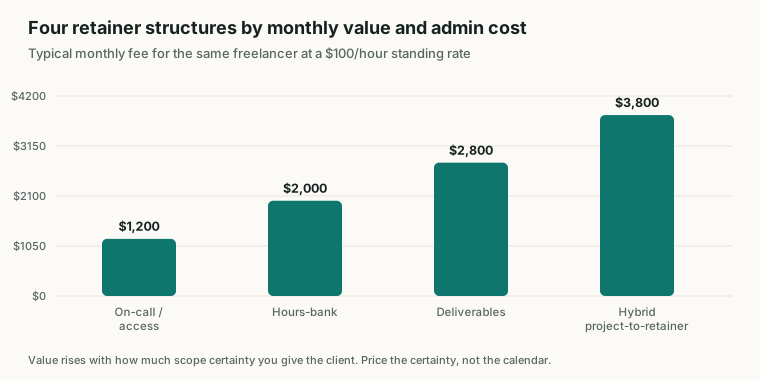
Value rises with the scope certainty you hand the client.
The client pays you upfront each month for a fixed block of hours. You work those hours, report on them, and the month resets. The key variable is what happens to unused hours: do they roll over, or does the client lose them?
This is the most recognizable of the freelance retainer structures because it mirrors how clients think about employee time. A client who has managed a 20-hour-per-week contractor before will immediately understand "I'm buying 40 hours a month from you." That familiarity makes it easier to sell. It also means clients sometimes expect the same flexibility they had with an employee, which is a boundary you will need to set clearly in your agreement.
The math is simple. If your hourly rate is $95 and the client wants 20 hours a month, your retainer is $1,900/month. Paid upfront on the first of each month, use-it-or-lose-it after 30 days. I add a clause that any hours requested beyond 20 in a single month are billed at my standard rate of $95/hr with a 48-hour notice requirement. Without that clause, I have watched a "20-hour retainer" quietly become a 30-hour month because the client assumed overflow was included.
Quick math: 20 hours x $95/hr = $1,900/month retainer. Overage hours: $95/hr invoiced separately at end of month.
2. Deliverables Retainer
Instead of selling time, you sell output. The client pays a flat monthly fee for a defined set of deliverables: 4 blog posts, 2 landing pages, one monthly analytics report, whatever the scope is. Your hours are your business, not theirs.
This is the most freelancer-friendly structure once you get efficient. If you can produce 4 blog posts in 14 hours instead of 20, you just earned $540 extra for the same month without renegotiating anything. Your incentive is to get faster and better, not to fill hours. The risk runs the other direction too: if a deliverable takes twice as long because the client gave you unusable briefs or endless revision rounds, you absorb that cost. Scope definitions and revision limits matter enormously here.
When I shifted my editing retainer from hourly to deliverables, I added one line to my contract: "Each deliverable includes two rounds of revisions. Additional rounds are billed at $75/hr." That single clause cut my revision time in half because clients started giving better feedback the first time.
Quick math: 4 blog posts x $350/post = $1,400/month flat. If you write each post in 3 hours, that is 12 hours of work for $1,400, or $116/hr effective rate. If revision rounds balloon to 20 hours total, your effective rate drops to $70/hr. Scope control is the entire game.
3. On-Call / Availability Retainer
You are not selling hours or deliverables. You are selling availability. The client pays a monthly retainer fee to know that when they need you, you are accessible and not booked out for three weeks with someone else. They may use you heavily one month and barely at all the next.
This structure is rare and often underpriced because freelancers feel guilty charging for "doing nothing." But that framing is wrong. You are not doing nothing. You are keeping that time ring-fenced. You are turning down other clients who might want to book those slots. The SBA's guide on service contracts explicitly frames availability-based arrangements as a legitimate service: you are selling the option on your time, not the time itself.
Pricing an on-call retainer requires you to estimate the opportunity cost of staying available. If you could reliably fill that capacity with project work at $100/hr for 15 hours a month, your availability fee floor is $1,500/month, before any premium for urgency response or priority access. I charge a 20-30% premium on top of that floor for true on-call arrangements because urgent requests carry a real cost to my schedule and focus.
Quick math: Opportunity cost: 15 hrs x $100/hr = $1,500. On-call premium (25%): +$375. Monthly retainer fee: $1,875. If the client uses 5 hours in a given month, your effective rate is $375/hr. If they use 18 hours, your rate drops to $104/hr, which is still above your floor. Set a maximum hours ceiling in the contract to protect against overuse.
4. Hybrid: Project + Retainer
A project scope kicks things off. You build the website, run the content audit, design the brand system, or write the strategy document. Once that initial engagement wraps, the relationship converts to a monthly maintenance retainer. The client gets continuity. You get a long-term income stream without starting from scratch every quarter.
This is one of the most underused structures in freelancing, and it is genuinely one of the best. The project phase earns you the client's trust and gives you deep context on their business. The retainer phase is lower-friction work because you already know the systems, the tone, the stakeholders. I have converted three project clients into retainer clients this way, and in each case the retainer phase was more profitable per hour than the project phase because my ramp-up cost was zero.
The structure requires you to price the two phases separately and transition them cleanly. The project has a defined end date and deliverables. The retainer starts the month after the project closes. Do not let the project scope creep into the retainer without a formal scope document for the ongoing work.
Quick math: Website project: $6,000 flat (one-time). Monthly maintenance retainer starting month 2: $800/month (content updates, plugin management, monthly report). After 12 months, total relationship value: $6,000 + ($800 x 12) = $15,600. That is more than double the project fee alone.
Which Structure Should You Choose?
Not every retainer type fits every client. Here is how I think about the match:
| Client Type | Best Retainer Structure | Why |
|---|---|---|
| High-volume, predictable workload (e.g., in-house marketing team that always needs content) | Deliverables retainer | You can get efficient; client gets cost certainty |
| Unpredictable but urgent needs (e.g., startup that fires off requests whenever a campaign launches) | On-call retainer with hours ceiling | Protects your schedule; client gets access when they need it |
| Relationship-stage client (just finished a project, wants ongoing support) | Hybrid: project to retainer | Lowest friction conversion; built-in trust from project phase |
The hours-banked structure fits when a client is new to retainers and needs something familiar, or when your work genuinely cannot be scoped by deliverable (consulting, strategy, ongoing advisory). It is not bad, it is just the least leverage for the freelancer. You are still selling time.
Red Flags in Retainer Agreements
1. No definition of what "unused hours" means
If your contract says "20 hours per month" but does not explicitly define what happens to unused hours, the client may assume they roll over indefinitely. Watch for language like "hours accumulate toward future work" or simply no rollover clause at all. Add explicit language: "Unused hours expire at the end of each calendar month and do not roll over."
2. Scope described in outcomes, not deliverables
"Ongoing marketing support" is not a scope. It is an invitation for scope creep. Watch for retainer agreements that describe your role in outcome language ("help us grow our social presence") without specifying exactly what you will produce each month. Before signing, convert every outcome phrase into a specific deliverable or a specific hours cap.
3. No termination notice period
A retainer without a termination clause can disappear overnight. I had a client cancel a $2,200/month retainer with three days' notice during a month I had already turned down other work to stay available. The contract had no notice requirement. Now every retainer I sign requires 30 days' written notice of termination. Watch for contracts that say "either party may terminate at any time" with no notice window, or that link termination to "project completion" without defining what that means.
Retainer Pricing: Setting the Right Monthly Number
Whatever structure you choose, the monthly number has to be grounded in your actual rate, not in what feels like a reasonable ask. Use your freelance rate calculator to establish your hourly floor first. Once you know your floor, you build the retainer fee above it, not around it.
A simple formula: (estimated monthly hours x hourly floor rate) x 1.15 = minimum retainer fee. The 1.15 buffer covers administrative overhead, client communication time, and the minor scheduling friction that retainers always create. For deliverables retainers, replace "estimated monthly hours" with the realistic hours each deliverable takes, including revisions.
For more on setting the number itself, see the retainer pricing guide and the part-time freelance retainer guide if you are structuring a retainer around a partial-week commitment.
Example: Target income $90,000/year. Divide by 900 realistic billable hours (billable hours explained here) = $100/hr floor. A 15-hour/month retainer: 15 x $100 x 1.15 = $1,725/month minimum. Round to $1,800 and hold the line.
If you do not yet have a defensible floor to multiply, get that first — the rate calculator on the homepage builds it from your income target, tax load, expenses and realistic billable hours, and every retainer number on this page is a multiplier on top of it.
Questions people ask
- What is the most common freelance retainer structure?
The hours-banked retainer is the most common, where clients pay upfront for a set number of hours each month. It is familiar to clients because it mirrors how they think about employee time, but it requires careful tracking and a clear rollover policy.
- Should unused retainer hours roll over to the next month?
It depends on your agreement. Use-it-or-lose-it protects your schedule and income predictability. Rollover gives the client more perceived value but can create an unpredictable workload spike. Most experienced freelancers cap any rollover at 25-50% of the monthly block.
- How do I price a deliverables retainer?
Estimate the realistic hours each deliverable takes, multiply by your effective hourly rate, add a 15-20% buffer for revisions and client communication, then set that as your flat monthly fee. Do not price based on what you think the client will accept.
- What is an on-call retainer and when does it make sense?
An on-call retainer pays you a monthly fee simply to stay available to a client, even if they never send work that month. It makes sense when a client's needs are unpredictable but urgent, and when the fee is high enough to justify blocking that time from other clients.
- Can I combine a project with a retainer?
Yes. A hybrid retainer starts with a defined project (website build, brand audit, content strategy) and converts to an ongoing maintenance fee once the project is complete. This is one of the smoothest ways to turn a one-time client into a long-term relationship.
- What dollar amount should I charge for a retainer?
Start with your target annual income divided by realistic billable hours to get your hourly floor, then build up from there based on the retainer type. A $90,000 income goal divided by 900 billable hours gives you a $100/hr floor. Your retainer fee should sit above that floor, not below it.
Put these numbers to work
Use the free freelance rate calculator to turn this into your own hourly rate in under a minute.
Open the calculatorKeep reading
More in Pricing Models, or browse all guides.
ROI of hiring a freelancer, calculated the way finance wants it: loaded cost comparison, four attribution models, and the traps that inflate the number.
ReadFreelance retainer rates by discipline and hour band: real 2026 monthly ranges for writers, designers, developers, and VAs, plus the discount ceiling.
ReadFreelance day rate vs hourly rate, compared side by side. See the math, when each model protects you, and how to set a day rate clients will accept.
ReadProject-based vs hourly rate explained: how each model works, who carries the risk, and which one actually protects your margin. With real dollar examples.
ReadMonthly retainer pricing for part-time freelancers: how to size hours around a day job, price evenings higher, and avoid over-committing time you don't have.
ReadA freelance editing retainer guide for editors and writers: price by word count or hours, with worked math, sample tiers, SLAs, and scope-creep protection.
Read