Freelance Retainer Rates: What Freelancers Charge in 2026
Freelance retainer rates by discipline and hour band: real 2026 monthly ranges for writers, designers, developers, and VAs, plus the discount ceiling.
Practical guidance, not financial advice. Sukie is a working freelancer, not a licensed accountant or financial advisor. Use this to make a defensible decision, then confirm the specifics for your situation with a qualified professional.

By Sukie · Founder & Writer, FreelanceRateLab
Updated August 11, 2026 · 12 min read
Most of the freelance retainer rates I see in the wild land between $1,000 and $5,000 a month for a solo freelancer, with the bulk of writing and design retainers clustering in the $1,500 to $3,500 band and development retainers running roughly double that. Below $800 a month, what's being called a retainer is usually just an underpriced standing discount. Above $8,000, you're almost always looking at agency work or a fractional-executive arrangement, not a typical solo freelancer.
Those are my observations from years of freelancing, comparing notes with other freelancers, and reviewing the retainer quotes people send me when they ask "is this number sane?" They are not survey statistics, and I'd be suspicious of anyone selling you precise ones, because retainer pricing is private, negotiated, and wildly dependent on scope. But the ranges are consistent enough that you can benchmark against them.
This page is the numbers page. If you want the decision framework for whether a retainer makes sense at all, that's the retainer pricing guide. If you want to know which of the four retainer types you're signing, read retainer structures first. Here, we're just going to talk about dollars: freelance retainer rates by discipline, how hour bands change the math, how much discount is too much, and what an underpriced retainer looks like before it hurts you.
What Freelancers Actually Charge, by Discipline
Here's the honest picture of freelance retainer rates as I see them in 2026, for US-based freelancers selling to US clients. Read the ranges as "where most competent, experienced freelancers land," not as floors or ceilings. Beginners quote below these. Specialists with a reputation quote above them, sometimes far above.
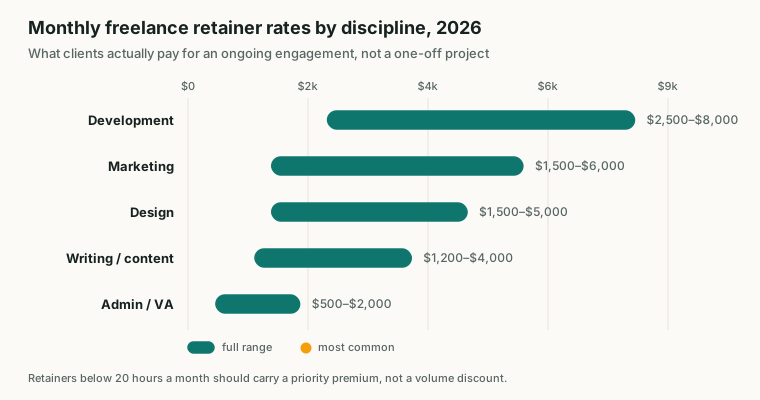
What clients actually pay for an ongoing engagement, by discipline.
| Discipline | Typical monthly retainer | Effective hourly | What that usually buys |
|---|---|---|---|
| Writing / content | $1,200 – $4,000 | $60 – $150/hr | 4–10 articles or a content program with strategy |
| Design (brand, graphic, product) | $1,500 – $5,000 | $75 – $160/hr | Ongoing design support, 10–30 hrs or a deliverable bundle |
| Development / technical | $2,500 – $8,000 | $90 – $200/hr | Maintenance, feature work, on-call fixes, code review |
| Marketing (SEO, email, social, ads) | $1,500 – $6,000 | $75 – $175/hr | Channel management plus reporting and strategy calls |
| Admin / virtual assistant | $500 – $2,000 | $25 – $60/hr | 15–40 hrs of inbox, scheduling, ops support |
Two things jump out of that table every time I update it in my head. First, the effective hourly on retainers runs above typical project hourly rates in the same discipline, not below — good freelancers charge a premium for commitment, and clients pay it because reserved capacity is worth more than maybe-available capacity. Second, the spread within each discipline is enormous, which brings us to the next section.
Why the Ranges Are That Wide
Why do freelance retainer rates spread this wide within a single discipline? Because a $1,200 writing retainer and a $4,000 writing retainer are not the same job with different price tags. The spread comes from a handful of variables that matter more than the discipline label:
- Strategy vs. execution. A retainer that includes "tell us what to write and why" prices two to three times higher per hour than "write what we brief you on." The moment your retainer includes judgment calls the client can't make themselves, you've left the commodity band.
- Specialization. A generalist blog writer and a technical writer covering API documentation can both fill the "writing" row, but the second one quotes from the top of the range and gets it.
- Client size. The same 20 hours sells for more to a funded startup than to a solo founder, partly ability to pay, mostly what's at stake for them.
- Your baseline rate. Retainers inherit your standing hourly. If your hourly is underpriced, your retainer will be too, just more predictably.
For calibration on that last point, it helps to know what employees earn doing similar work. The Bureau of Labor Statistics' Occupational Employment and Wage Statistics puts median wages for writers and authors at roughly $36 an hour and for web developers around $45 an hour as employees. A freelancer's effective rate has to run meaningfully above the employee median for the same skill, because you're covering self-employment tax, health insurance, unbilled admin time, and zero paid leave out of that number. When I see a freelance retainer priced below the BLS employee median for the discipline, I know the freelancer never did that math. If you haven't done it either, the rate calculator on the homepage will walk you through it before you quote anything.
Hour Bands: Smaller Blocks Should Cost More Per Hour
This is the single most common pricing mistake I see in retainer quotes, so it gets its own section and its own table. Freelancers instinctively price retainers like bulk warehouse goods: bigger block, cheaper unit price, and — here's the error — smaller block, same unit price as their standing rate.
Backwards. A small retainer is not a small commitment. A client buying 10 hours a month is still buying priority access to your calendar. You still have to hold space for them, still context-switch into their business, still answer their emails within your promised window. All of the overhead of a retainer relationship, amortized over fewer hours. That overhead is why the effective hourly should rise as the hour band shrinks.
A 10-hour retainer is not one quarter of a 40-hour retainer. It's a full-priority client at one quarter of the volume, and the priority is what you charge for.
Here's how that plays out against a $100/hr standing rate:
| Hour band | Pricing vs. standing rate | Monthly fee at $100/hr base | Effective hourly |
|---|---|---|---|
| 10 hrs/month | +15–20% priority premium | $1,150 – $1,200 | $115 – $120/hr |
| 20 hrs/month | Standing rate to +10% | $2,000 – $2,200 | $100 – $110/hr |
| 40 hrs/month | Up to 10% off standing rate | $3,600 – $4,000 | $90 – $100/hr |
The 40-hour band is the only place a discount belongs, and even there it's modest — more on the ceiling in a moment. The 10-hour band carries a premium because small retainers are, hour for hour, your most expensive inventory to service. This is doubly true if you're freelancing around a day job, where every retainer hour comes out of evenings and weekends; I've written a whole guide on monthly retainer pricing for part-time freelancers because that situation justifies an even steeper premium.
If a client balks at the small-band premium, the honest answer is: "The retainer buys you a reserved slot and priority response, not just hours. If you only need occasional hours without the priority, I'm happy to do project work at my standard rate as availability allows." About half the time they take the project option, and the other half they realize the priority is exactly what they were trying to buy.
The Discount Ceiling: 10 to 15 Percent, Never More
Somewhere along the line, freelancers absorbed the idea that a retainer client deserves a big discount because the income is "guaranteed." So they lop 25 or 30 percent off their standing rate and call it a loyalty price.
Run the numbers on what that guarantee is actually worth. A retainer saves you some sales and onboarding time — no re-pitching, no ramp-up, one invoice a month. Across a year, that's real but modest, maybe the equivalent of 5 to 10 percent of the engagement's value. Meanwhile the retainer costs you flexibility: those hours are spoken for, so you turn down better-paying work that shows up mid-month, and most retainer agreements can be cancelled with 30 days' notice anyway. Guaranteed income that can vanish in a month is not a guarantee worth 30 points of margin.
My ceiling, and the one I recommend to everyone who asks me to review their freelance retainer rates: never more than 10 to 15 percent off your standing rate, and only at 30-plus committed hours a month. Below that volume, no discount at all — standing rate or a premium, per the hour-band table above. If the savings a client gets from your discount exceed what the commitment saves you in sales overhead, you're not pricing a retainer, you're subsidizing one.
There's a psychological reason to hold the ceiling too. A deep retainer discount tells the client your standing rate was soft. Every future negotiation starts from the discounted anchor. A shallow, principled discount — "10 percent at 40 hours, because you're saving me sales time" — signals that your rate is real and the discount has a reason attached. Clients respect numbers that come with reasons.
Four Signs Your Retainer Is Underpriced
Underpriced retainers rarely announce themselves. The fee arrives on the first of the month, which feels like winning, while the engagement quietly eats your margin. Here are the tells I look for, in myself and in the quotes people send me.
Your effective hourly is below your project rate
Divide last month's retainer fee by the hours you actually spent, including calls, email, and revisions. If that number is lower than what you charge one-off project clients, your most committed client is paying your worst rate. It should be the reverse.
You dread the client's name in your inbox
Emotional data is still data. When a fairly-priced retainer client emails, it's neutral. When an underpriced one emails, you feel the resentment before you've read the message, because some part of you knows each request costs you money. I've learned to treat that flinch as an audit trigger.
Scope has grown but the fee hasn't
Retainers ratchet. The client adds "one quick extra thing" in March, it becomes normal by May, and by autumn the retainer covers 30 percent more work at January's price. If you can't remember the last time the fee changed but you can list three things you now do that weren't in the original scope, you've been repriced downward without a negotiation.
You'd panic if they doubled the volume
A healthy retainer scales: if the client wanted twice as much, you'd be pleased, because the unit economics work. If the thought of them actually using everything they're entitled to makes your stomach drop, the price only works because the client under-uses it. That's not a retainer, that's a bet, and the client controls the outcome.
Any one of these is a signal to reprice at the next renewal. Two or more means don't wait for the renewal.
The $2,600 Quote That Taught Me to Stop Apologizing
In November 2024, I quoted a marketing consultancy $2,600 a month for a 20-hour editing and content retainer — about $130 an hour effective, a touch above my project rate at the time, exactly as the hour-band logic says it should be. The contact went quiet for six days, and I spent every one of them drafting the "happy to find a number that works for you" email in my head. I had it half-written when her reply landed: they'd approved it without discussion, and could I start the following Monday.
Eight months in, I learned from an offhand comment that the agency they'd been using before me had charged $4,000 a month for roughly the same volume. My scary number was 35 percent below the incumbent's, and the client considered me the bargain. Nobody on their side ever thought $2,600 was aggressive. The only person in that negotiation who thought my price was high was me.
That retainer ran two and a half years and is the anchor for how I quote now: pick the number the math supports, say it plainly, and then — this is the hard part — stop talking. The niche version of that engagement, including how I scoped and structured it, is written up in the freelance editing retainer guide if editing is your lane.
Quoting the Number: Deliverables Fee or Hour Block?
The same monthly dollar figure can be framed two ways, and the framing changes how the retainer ages.
Quote a monthly-deliverable fee when output is countable
If the work resolves into discrete units — four articles, two design concepts, a monthly SEO report — quote a flat fee for the bundle and keep your hours out of the conversation. Your efficiency gains stay yours: get faster, and your effective hourly climbs without a renegotiation. The dollar figure should still be built from the hour-band table (realistic hours times your rate, plus a revision buffer), but the client buys outcomes, not time.
Quote an hour block when the work is reactive
If the client's needs are unpredictable — advisory, maintenance, "we'll need you for whatever comes up" — deliverables can't be defined in advance, so sell a capped block of hours with a written overage rate. You give up the efficiency upside, but you're protected against the scope ratchet, because every request visibly draws down the same pool.
My rough rule: predictable work gets a deliverables fee, reactive work gets an hour block, and anything with both gets a small hour block bolted onto a deliverables core. The full breakdown of these arrangements, including on-call and hybrid types, is in the retainer structures guide — worth reading before you put either framing in a contract, because the fine print (rollover, overage, notice period) matters as much as the number.
What About Freelance Agency Retainer Pricing?
Clients comparing your quote to an agency's will see numbers two to four times higher, and it's worth understanding why so you can position against it. Freelance agency retainer pricing typically starts around $3,000 to $5,000 a month for a single channel and runs to $10,000–$25,000+ for multi-channel engagements. The premium covers account managers, project managers, multiple specialists, and the agency's own margin stacked on top of every hour.
For you, this is context, not a target. Don't price at agency levels — you don't carry their overhead and clients know it. But don't ignore the comparison either, because it's your strongest anchor. When a client is choosing between a $12,000/month agency and your $3,500/month retainer, you are not expensive; you are the sane middle option with a senior person doing the actual work. My November 2024 story above is exactly this dynamic: the client wasn't comparing me to zero, they were comparing me to a $4,000 incumbent. When you know the agency numbers in your discipline, quote from the confident middle of the solo ranges instead of the apologetic bottom. The gap below the agency price is your credibility cushion, and it is usually thousands of dollars wide.
Turning These Benchmarks Into Your Number
Benchmarks tell you where the market is; they don't tell you what to charge. That comes from your own math. The sequence I'd actually follow:
- Establish your hourly floor from your income target and realistic billable hours — the calculator on the homepage does this in a few minutes.
- Pick the hour band the client's demand actually supports, then apply the band pricing: premium under 15 hours, standing rate around 20, no more than 10–15 percent off at 40+.
- Sanity-check against the freelance retainer rates in the discipline table. If your quote falls below the bottom of your discipline's range, the problem is almost always your floor rate, not the retainer math.
- Choose the framing — deliverables fee or hour block — and put the overage rate, rollover policy, and 30-day notice period in writing.
- Say the number and stop talking.
Freelance retainer rates reward the prepared. The freelancers earning $150 effective on retainers aren't better negotiators than the ones earning $60 — they walked in knowing the market ranges, knowing their floor, and knowing that small blocks carry premiums instead of discounts. Now you know all three. The retainer pricing framework covers the decision tree from here: when to propose a retainer, how to transition an existing client onto one, and what to do when they counter.
Put these numbers to work
Use the free freelance rate calculator to turn this into your own hourly rate in under a minute.
Open the calculatorKeep reading
More in Pricing Models, or browse all guides.
ROI of hiring a freelancer, calculated the way finance wants it: loaded cost comparison, four attribution models, and the traps that inflate the number.
ReadThere are 4 freelance retainer structures and each works differently. Learn which fits your client type before you sign anything.
ReadFreelance day rate vs hourly rate, compared side by side. See the math, when each model protects you, and how to set a day rate clients will accept.
ReadProject-based vs hourly rate explained: how each model works, who carries the risk, and which one actually protects your margin. With real dollar examples.
ReadMonthly retainer pricing for part-time freelancers: how to size hours around a day job, price evenings higher, and avoid over-committing time you don't have.
ReadA freelance editing retainer guide for editors and writers: price by word count or hours, with worked math, sample tiers, SLAs, and scope-creep protection.
Read