Cost to Hire a Freelancer: How to Budget It Before You Sign
Cost to hire a freelancer, from the buyer's side: hourly bands by type of work, a budget worksheet, a three-freelancer project and the employee comparison.
Practical guidance, not financial advice. Sukie is a working freelancer, not a licensed accountant or financial advisor. Use this to make a defensible decision, then confirm the specifics for your situation with a qualified professional.

By Sukie · Founder & Writer, FreelanceRateLab
Published October 20, 2026 · 10 min read
The cost to hire a freelancer is the hourly rate multiplied by the hours the work genuinely takes, plus a contingency for revisions, plus any platform or payment fees, and it is almost always higher than people expect on the first quote and lower than they fear once they compare it with hiring someone. That is the whole answer in one sentence. The rest of this page is how to put real numbers into each part so the budget holds.
I write this from the other side of the table most of the time. I am a freelancer, and I have watched plenty of good projects stall because a client's budget was built on a number they found in a forum thread. But I also hire freelancers myself, for design and development on client work I cannot do alone, so I have had to make this budget for real.
The short answer, by type of work
Here is what an hour of freelance work usually costs in the US direct-to-client market, by the kind of work you are buying. These are the editorial ranges used across FreelanceRateLab, built in our freelance rate by industry guide and the specialist pages linked below. They are not an official average. No government body or trade association publishes a freelance rate, and anyone who quotes you "the average freelance rate" without a named source is guessing.
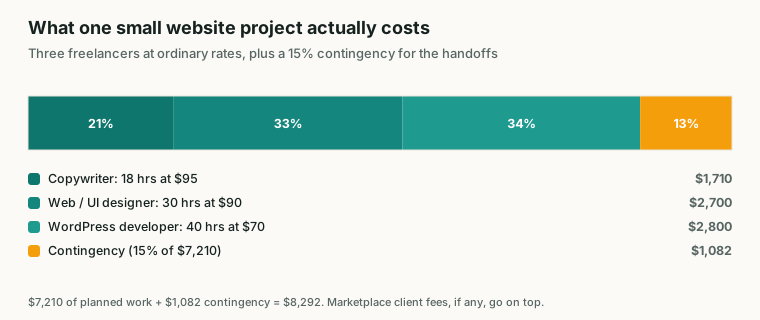
The worked project further down this page: three freelancers plus a 15% contingency. The contingency is not padding; it is the line that pays for the handoffs between them.
| Type of work | Low | Typical | High |
|---|---|---|---|
| Editing / proofreading | $35 | $55 | $85 |
| General blog writing | $30 | $55 | $90 |
| Website and landing page copy | $85 | — | $150 |
| Graphic / brand design | $45 | $75 | $130 |
| UX / UI design | $60 | $100 | $160 |
| WordPress / CMS development | $40 | $70 | $120 |
| Full-stack / software development | $70 | $115 | $200+ |
| SEO specialist | $50 | $90 | $160 |
| Social media management | $35 | $60 | $100 |
| Virtual assistant (general) | $25 | $40 | $65 |
| Niche consulting / strategy | $100 | $175 | $350+ |
Two things decide where in the band a particular person sits. The first is specialization: a writer who knows your industry is not doing harder work than a generalist, but their work is attached to revenue you can measure, and they price for that. The second is where you found them. Rates on large marketplace platforms run materially lower than direct-to-client rates, for reasons that have as much to do with competition as with quality.
If you are budgeting for writing specifically, our freelance writer hourly rate guide breaks the writing bands down further, including the per-word conversion most writers quote in. For a wider view across fields, the freelance rate benchmarks hub collects every benchmark page on the site.
Why a $90 rate is not a $90 salary
The most common reaction to a freelance quote is "that's more per hour than I pay my staff." It usually is, and that is correct, because the two numbers are not measuring the same thing.
An employee's wage is only part of what the employee costs you. The Bureau of Labor Statistics measures this directly in its Employer Costs for Employee Compensation release. For private-industry workers in June 2026, employers paid an average of $46.89 per hour worked in total compensation. Of that, $32.82 was wages and salaries and $14.07 was benefits. Benefits were 30.0% of the total. (BLS, released September 9, 2026; read October 2026.)
So an employee you think of as costing $32.82 an hour actually costs $46.89 before you have bought them a laptop or a desk. A freelancer has to fund every one of those things out of their rate:
- Both halves of payroll tax. An employee's Social Security and Medicare are split with the employer. A freelancer pays both halves themselves through the 15.3% self-employment tax described by the IRS.
- Their own benefits. Health cover, retirement saving and paid time off come out of the rate, because there is no employer to provide them.
- Tools and overhead. Software, equipment, insurance, accounting. Our typical freelance expenses list shows how quickly these add up.
- The hours nobody pays for. A freelancer spends a large share of every week on proposals, invoicing, admin and finding the next client. They can only bill the remainder, so each billed hour has to carry the unbilled ones.
That last point is the one that surprises clients most. A freelancer working a 40-hour week might bill 22 to 28 of those hours. The rate you see is set so that those billed hours pay for the whole week. If you want to see the arithmetic from the freelancer's side, the rate calculator on our homepage shows exactly how an income target, taxes, expenses and billable hours turn into an hourly figure.
The budget worksheet
This is the order I build a freelance budget in, whether I am the one being hired or the one hiring. Do it per freelancer if you are hiring more than one.
- Define the deliverable, not the role. "A 6-page website with copy" can be estimated. "Help with marketing" cannot. If you cannot describe what you will receive, no quote will mean anything.
- Ask for hours, not just a fee. Even if you agree a fixed project price, ask the freelancer roughly how many hours they expect it to take. That tells you whether the price is reasonable and whether they have understood the scope.
- Multiply hours by a rate from the right band. Use the table above as a sense check. A quote far below the low end is a warning sign, not a bargain.
- Add a revision allowance. Check how many revision rounds the quote includes. If your own process usually needs more, budget for the extra hours now.
- Add a contingency. 10% for one freelancer on well-defined work, 15 to 20% when several freelancers depend on each other's output.
- Add fees. If you hire and pay through a marketplace, it may charge you a client-side marketplace or payment-processing fee on top of the freelancer's price. These change, so check the platform's own current fee page rather than trusting a figure from an old article. Direct invoices paid by bank transfer usually carry no fee to you.
- Budget your own time. Briefing, feedback and approvals take hours on your side. On a multi-freelancer project, coordinating the handoffs is a real job.
A worked example: one website, three freelancers
Here is a realistic small-business project, priced with the typical figures from the bands above. A two-person ecommerce shop wants a new six-page website. It needs a copywriter, a web designer and a WordPress developer.
| Freelancer | Estimated hours | Rate | Cost |
|---|---|---|---|
| Copywriter (website copy) | 18 | $95/hr | $1,710 |
| Web / UI designer | 30 | $90/hr | $2,700 |
| WordPress developer | 40 | $70/hr | $2,800 |
| Subtotal | 88 | $7,210 | |
| Contingency (15%) | $1,082 | ||
| Budget | $8,292 |
The arithmetic: 18 × $95 = $1,710; 30 × $90 = $2,700; 40 × $70 = $2,800. Together that is $7,210. Fifteen percent of $7,210 is $1,081.50, rounded to $1,082, which brings the budget to $8,292.
The rates are deliberately ordinary. The copywriter sits near the bottom of the website-copy band, the designer at the typical figure for web and UI design, and the developer at the typical figure for WordPress work. Nobody in this table is expensive.
The 15% contingency, not 10%, is there because this project has three people working in sequence. The developer cannot finish until the designer is done, and the designer works better with final copy. Every time copy changes after the design is approved, both of the later freelancers lose time. That is where multi-freelancer budgets overrun, and it is almost never one person's fault.
If the shop paid through a marketplace, it would add that platform's client fee on top of the $8,292. If it hired directly and paid by invoice, $8,292 is the number.
What happened when I did this myself
In March 2025 I took on a case-study series for a software client and needed a designer to lay out the finished studies. I budgeted 20 hours at $85, which is $1,700, and quoted my client on that basis.
The designer's work was excellent. The actual time was 26 hours, because my client changed the brand colours after the first two layouts were done. Six extra hours at $85 is $510, so the real cost was $2,210, 30% over my line.
I had not added a contingency, because it was "only one freelancer." I absorbed the $510 myself, which on that project meant I did my own part of the work for noticeably less than my normal rate. Since then I add at least 10% to any freelancer line I budget, and 15% if the client has a history of late changes. The freelancer did nothing wrong. My budget did.
Freelancer or employee: comparing the right totals
Comparing hourly figures makes a freelancer look expensive. Comparing totals for the hours you actually need usually tells a different story.
Take the BLS average again. At $46.89 per hour worked, a full-time private-industry employee working about 2,080 hours a year costs roughly $46.89 × 2,080 = $97,531 in compensation. That is before equipment, office space, recruiting and the weeks it takes them to be productive. It is an approximation, because the BLS figure is per hour worked and real schedules vary, but it gives the right order of magnitude.
Now suppose your real need is about 400 hours of design work a year. At a typical $90 rate, a freelancer costs 400 × $90 = $36,000. The freelancer's hourly rate is nearly double the employee's hourly cost, and the total is about a third, because you are not paying for the 1,680 hours you did not need.
The comparison flips as your need grows. At 1,600 hours of steady work a year, the same freelancer costs $144,000, and an employee starts to look sensible. A rough rule:
- Defined projects, uneven workloads, specialist skills you need occasionally: a freelancer is usually cheaper in total.
- Steady, full-time work that will continue for years: an employee is usually cheaper per hour of output.
- Somewhere in between: a retainer with a freelancer often beats both. Our freelance retainer pricing guide explains how those are usually structured.
Cost is only half the decision. Whether the work pays for itself is the other half, and that is a separate calculation, covered in our guide to the ROI of hiring a freelancer.
Red flags in a quote
A good quote is easy to read. These are the things that make me look twice, whichever side I am on:
- A price far below the low end of the band. Either the scope has been misunderstood, or the person cannot sustain the rate and will disappear or rush the work.
- No hours estimate at all, even when asked. A freelancer who cannot estimate hours cannot estimate the price either.
- Unlimited revisions. This sounds generous, but it usually means nobody has thought about where the project ends.
- No written scope. If the deliverable is not written down, every disagreement later will be about what was included.
None of these mean the freelancer is bad. They mean the budget is not yet a budget.
Questions people ask about freelance costs
How much does it cost to hire a freelancer per hour?
It depends mostly on the type of work. In the US direct-to-client market, editing and general writing usually sit around $35 to $90 an hour, design around $45 to $160, web and software development around $40 to $200, and specialist consulting from $100 up past $350. These are editorial ranges built from the bands on this site, not an official average.
Why is a freelancer's hourly rate so much higher than an employee's wage?
Because the rate covers things an employer normally pays separately: both halves of payroll tax through the 15.3% self-employment tax, health cover, software, equipment, and the hours spent on sales and admin that nobody bills for. The BLS reports that benefits alone were 30.0% of private-industry employer compensation costs in June 2026.
How do I estimate the total cost when hiring several freelancers for one project?
Estimate each person as hours multiplied by rate, add them, then add a 10 to 20 percent contingency for revisions and coordination. The handoffs between freelancers are where these projects overrun, so the contingency matters more with three people than with one.
Is it cheaper to hire a freelancer or an employee?
For defined projects and part-time needs, a freelancer is usually cheaper in total even though the hourly rate is higher. For steady full-time work that will last years, an employee usually costs less per hour of output. Compare totals for the hours you actually need.
Questions people ask
- How much does it cost to hire a freelancer per hour?
It depends far more on the type of work than on anything else. In the US direct-to-client market, editing and general writing usually sit around $35 to $90 an hour, design around $45 to $160, web and software development around $40 to $200, and specialist consulting from $100 up past $350. These are editorial ranges built from the bands on this site, not an official average, because no government or industry body publishes a freelance rate.
- Why is a freelancer's hourly rate so much higher than an employee's wage?
Because the rate has to cover things an employer normally pays separately. A freelancer pays both halves of Social Security and Medicare through the 15.3% self-employment tax, buys their own health cover, software and equipment, and cannot bill the hours spent on sales and admin. The BLS reports that benefits alone were 30.0% of private-industry employer compensation costs in June 2026, before the employer even counts idle time.
- How do I estimate the total cost when hiring several freelancers for one project?
Estimate each person separately as hours multiplied by rate, add them, then add a contingency of 10 to 20 percent for revisions and coordination between them. The handoffs are where multi-freelancer projects overrun, so the contingency matters more with three people than with one. Also budget your own time to coordinate, because nobody else is doing it.
- Is it cheaper to hire a freelancer or an employee?
For defined projects and part-time needs, a freelancer is usually cheaper in total even though the hourly rate is higher, because you pay only for hours of output. For steady full-time work that will last years, an employee usually costs less per hour of output. Compare the total for the actual hours you need, not the two hourly numbers.
Put these numbers to work
Use the free freelance rate calculator to turn this into your own hourly rate in under a minute.
Open the calculatorKeep reading
More in Rate Benchmarks, or browse all guides.
Freelance writing rates per word converted properly: what each band really pays hourly at honest output speeds, and when to quote a project fee instead.
ReadFreelance writing rates by format and specialism, with the arithmetic behind each band — and why no authority publishes the 'average' rate everyone quotes.
ReadFreelance marketing rates for 2026 across eight channels, why attributable channels pay 40-70% more, plus retainer bands and the performance-pricing question.
ReadFreelance developer hourly rate bands for 2026 by stack, plus the domain premium that adds 25-40% for exactly the same technical work.
ReadFreelance designer hourly rate bands for 2026 across eight specialties, and why the spread inside one discipline beats the gap between disciplines.
ReadHow many hours do freelancers work each week? Four real working patterns, the billable share of each, and why billable hours plateau near 26.
Read