Freelance Writer Hourly Rate: What Writers Really Earn
Freelance writer hourly rate bands from the real market: the content mill floor, generalist and specialist ranges, and per-word vs hourly math.
Practical guidance, not financial advice. Sukie is a working freelancer, not a licensed accountant or financial advisor. Use this to make a defensible decision, then confirm the specifics for your situation with a qualified professional.

By Sukie · Founder & Writer, FreelanceRateLab
Published August 14, 2026 · 7 min read
The first year I wrote for money, I quoted a client $200 for a "quick" white paper rewrite in October 2019. It took me fourteen hours across two weekends, which works out to $14.29 an hour, and I only know that because I logged the time out of curiosity afterward. I had never once asked what a freelance writer hourly rate was supposed to be. I priced off vibes, and my vibes were calibrated to a part-time retail job.
That number embarrassed me for years. Now I'm glad I wrote it down, because it gave me a habit that changed my business: converting every single fee, no matter how it's structured, back into dollars per hour of my actual life.
This guide is the piece I wish someone had handed me that October. Not a fantasy chart, just what I see writers actually earning, why hourly billing is usually the wrong container for writing work anyway, and how to check whether your own numbers are quietly betraying you.
The Four Bands I Actually See in the Market
Nobody issues official writer salaries, so treat these as field notes from a decade of talking rates with other writers, not survey statistics. The market sorts into four rough bands, and the gaps between them are enormous.
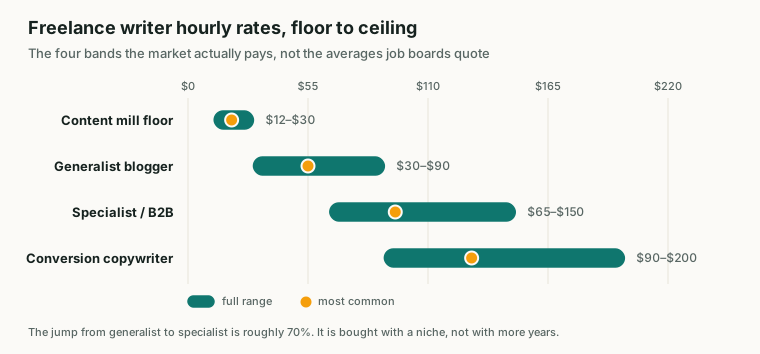
The jump from generalist to specialist is about 70%, and it is bought with a niche.
The content mill floor. Platforms paying $0.02 to $0.05 a word sound survivable until you do the division. A 1,000 word article at $30, with research and revisions, routinely nets under $15 an hour, sometimes under $10. This band exists because there's always someone newer who doesn't know the math yet. I lived here briefly. Nobody should stay.
Generalists. Competent writers with a portfolio but no defined niche mostly land between $30 and $60 an hour in effective terms. It's a real living in some cities and a squeeze in others, and it's where most freelancers plateau, because generalist work is easy to substitute. If you're here and fully booked but still broke, my guide on how to stop undercharging is the companion read.
Specialist B2B writers. Writers who own a commercial niche, think SaaS, fintech, cybersecurity, healthcare marketing, commonly clear $75 to $150 an hour effective. The work isn't harder than generalist work. It's just attached to revenue the client can see, which changes everything about the negotiation.
The apex: technical, medical, legal. Writers with genuine subject-matter credentials, regulatory writing, medical communications, developer documentation, sit above the specialist band, often at $150 an hour effective and up. Entry requires credentials or years of adjacent experience, which is exactly why the rates hold.
Is there an "industry standard" writer rate?
People search for the industry standard hourly rate for a freelance writer hoping for one blessed number to quote. I understand the wish. But writing is not plumbing; there's no licensing board and no union scale, so anyone who hands you a single figure is describing their corner of the market and calling it the whole map.
The closest thing to an official chart exists for editorial work. The Editorial Freelancers Association surveys its members and publishes rate ranges by service, and it's a genuinely useful anchor: most editorial services on that chart, proofreading, copyediting, line and developmental editing, land between the mid $30s and the $60s per hour, with specialized medical and technical work running higher. If you edit as well as write, quoting inside those ranges gives you something concrete to point to when a client flinches.
For writing itself, the honest move is to benchmark by field rather than hunt for one universal number. What a marketing agency pays and what a medical device company pays are different economies wearing the same job title. I break those differences down in my freelance rate by industry guide, and it pairs well with the bands above.
Should you charge per word or per hour?
Here's the structural problem with a freelance writer hourly rate as a billing method: writing is a skill where experience makes you faster, and hourly billing converts your speed into a discount for the client.
In 2021 I wrote a certain kind of product-led blog post in about eight hours. By 2023, the same caliber of post took me four, because I'd written sixty of them. If I'd been billing hourly, my reward for doubling my skill would have been a 50 percent pay cut per article. Instead I was pricing per project, so my effective hourly quietly doubled and no client ever had a reason to object.
Hourly billing sells your time. Per project billing sells your judgment, and judgment is the thing clients actually pay premiums for.
Per word pricing has the same virtue with less negotiation overhead, which is why so much content work is quoted that way. At $0.30 a word, a 1,500 word article pays $450. Finish it in three hours and you've earned $150 an hour. Quote the same job hourly and most clients would balk at half that number, because "$150 an hour" triggers comparisons to lawyers while "$450 for the article" triggers comparisons to results.
The deeper issue is that hourly framing invites clients to manage your minutes instead of your output. The moment a client is thinking about your clock, you've lost the high ground.
When does hourly still win?
I just spent a section arguing against hourly, so let me be fair to it, because there are three situations where I still bill by the hour on purpose.
Editing and rescue work. When a client hands me a 6,000 word mess written by a committee, I cannot responsibly quote flat, because I don't know if it needs a trim or a transplant until I'm inside it. Hourly with a cap protects both of us, and the EFA ranges above give the number legitimacy.
Retainers for availability. One client pays me monthly for a set block of hours covering whatever comes up: edits, briefs, a landing page, an emergency rewrite. The retainer is really priced per month, but hours are the honest accounting unit underneath it, because the deliverables are unknowable in advance.
Strategy calls. When someone wants my brain and not my drafts, an hourly rate is the cleanest container there is. My advisory hour is priced well above my writing average, deliberately, because advice is the most concentrated form of the value.
The pattern: hourly wins when scope is genuinely unknowable. When scope is knowable, price the outcome.
What actually moves a writer up a band?
Every other tactic people sell you, negotiation scripts, confidence work, fancy portfolios, moves your rate by percentages. Specialization moves it by multiples, and it's the only lever I've watched work for basically everyone who pulls it.
My own version: through 2020 I was a generalist averaging somewhere around $45 an hour effective on a good month. In 2021 I committed to data-heavy B2B content, spent real money on the tools to do it properly, and by late 2022 my average effective rate had roughly doubled on work that was, honestly, easier to win. Not because I became twice the writer in eighteen months. Because I became legible to clients whose budgets were attached to revenue instead of to "content."
The ladder looks like this in practice: generalist to niche generalist ("I write for healthcare companies") to problem specialist ("I write conversion-focused content for healthcare SaaS"). Each rung shrinks your pool of competitors and raises the cost of replacing you. The apex bands from earlier, technical, medical, legal, are just the top rungs, where the ladder requires credentials most writers don't have, which is precisely what keeps those rates up there.
If your rate has been flat for two years, this is almost always the reason. You don't have a negotiation problem. You have a positioning problem wearing a negotiation costume.
Sanity-Check Every Fee as an Effective Hourly
Whatever you charge on paper, per word, per project, per retainer, there's one discipline that keeps you honest, and it's the one I started by accident with that $14.29 white paper: translate everything back to effective hourly. Here's the whole method.
- Track actual hours on each project, including the email, the calls, and the revision rounds nobody scopes for.
- Divide the total fee by those hours to get your effective hourly rate.
- Compare that number against your cost floor, not against zero, because your rate also has to carry taxes and the freelance writer expenses that keep the business running.
A $900 article that eats twenty hours is a $45 an hour job in a $150 an hour costume. A $300 piece you finish in ninety minutes is quietly your best client. You cannot see either truth from the invoice alone, and clients certainly won't point it out for you.
I built a habit of running this check before accepting any project, and it's the exact math the freelance rate calculator automates: fee in, honest hours in, effective rate out, next to the floor you actually need. That gap between sticker price and take-home reality is the whole reason FreelanceRateLab exists, because almost every underpaid writer I meet isn't bad at negotiating. They're just pricing from the fee and never looking at the hour.
A freelance writer hourly rate, in the end, isn't really a price you post. It's a diagnostic you run, on every project, forever. The writers who climb are the ones who keep looking at the number even when it's embarrassing. Especially when it's embarrassing. Mine was $14.29, and writing it down was the best pricing decision I ever made.
Questions people ask
- What is the industry standard hourly rate for a freelance writer?
There is no single standard, but the market has recognizable bands. Content mill work often nets under $20 an hour, competent generalists land roughly $30 to $60, specialist B2B writers commonly command $75 to $150, and technical, medical, and legal writers sit above that. For editorial work specifically, the Editorial Freelancers Association publishes surveyed rate ranges, with most editorial services falling between the mid $30s and the $60s per hour. Where you land depends far more on specialization than on experience alone.
- Should freelance writers charge per word or per hour?
For most writing projects, per word or per project pricing beats hourly, because hourly billing punishes you for getting faster. If you quote $0.30 a word on a 1,500 word article and finish in three hours, you have earned $150 an hour without the client ever seeing that number. Hourly still wins for genuinely unpredictable work: heavy editing of messy drafts, advisory retainers, and strategy calls, where scoping a flat fee would be guesswork.
- How do I raise my freelance writer hourly rate?
Specialize first, then reprice. The writers I see doubling their effective rate did not negotiate harder for the same generalist work; they picked a niche where writing moves revenue, built two or three proof pieces, and quoted new clients at the specialist band. Alongside that, translate every project fee back into effective hourly so you can see which clients quietly drag your average down, then replace the lowest one. Raising the rate on identical work has a ceiling. Changing the work does not.
Put these numbers to work
Use the free freelance rate calculator to turn this into your own hourly rate in under a minute.
Open the calculatorKeep reading
More in Rate Benchmarks, or browse all guides.
Freelance developer hourly rate bands for 2026 by stack, plus the domain premium that adds 25-40% for exactly the same technical work.
ReadFreelance designer hourly rate bands for 2026 across eight specialties, and why the spread inside one discipline beats the gap between disciplines.
ReadHow many hours do freelancers work each week? Four real working patterns, the billable share of each, and why billable hours plateau near 26.
ReadHow to measure rate of pay for freelancers if you're the one hiring: a 5-step framework for benchmarking rates, converting to loaded cost, and tracking ROI.
ReadUse a freelance rate calculator automotive pros trust. Real hourly ranges by specialty, hidden expenses, and a worked rate-floor example for auto work.
ReadFreelance completion rate benchmarks by platform and industry. Learn how delivery rate differs from completion rate—and how both affect what you can charge.
Read