Freelance Writer Expenses: Tools, Overhead & ROI Guide
A working writer's honest take on freelance writer expenses: what to spend on tools, the 10-15% overhead rule, a real annual budget, and what pays for itself.
Practical guidance, not financial advice. Sukie is a working freelancer, not a licensed accountant or financial advisor. Use this to make a defensible decision, then confirm the specifics for your situation with a qualified professional.

By Sukie · Founder & Writer, FreelanceRateLab
Updated August 11, 2026 · 7 min read
Freelance writer expenses were the whole of a question a new writer sent me last spring: "how much should I spend on tools as a freelance writer?" She had a wishlist a mile long and a knot in her stomach about all of it.
My honest answer was not a number. It was a question back to her: what do those tools actually make you? Because freelance writer expenses only make sense when you measure them against what they return, not against what your favorite writing newsletter says you "need."
Some tools earn their keep ten times over. Others are expensive comfort blankets. The hard part is telling them apart before you've paid for a year. So let me walk you through how I think about it, with real dollars from my own business.
The Categories That Matter for Writers
Writer spending tends to fall into seven buckets, and each one deserves a different level of scrutiny. I'll go through them the way I'd talk a friend through it over coffee.
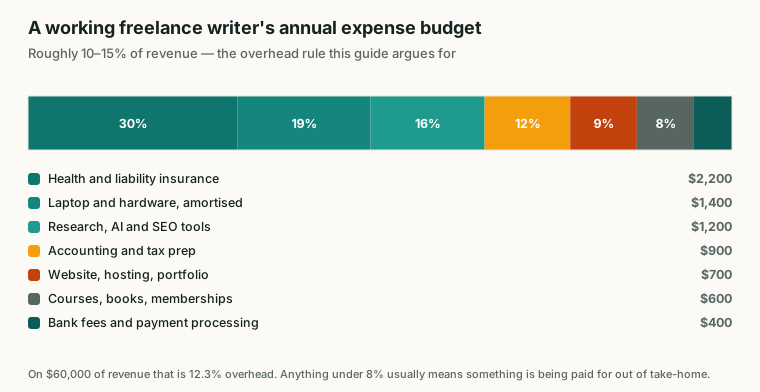
12.3% of a $60,000 revenue year. Under 8% usually means something is coming out of take-home.
Writing software is where most of us start. Scrivener runs about $60 once, Ulysses is roughly $50 a year, and Hemingway Editor is a cheap one-time buy. Honestly, for most working writers a clean word processor and discipline beat a fancy app. I used Scrivener for book-length projects and a plain editor for everything else. Worth it only if your format genuinely needs it.
Research tools are where the money gets real. Statista runs into the hundreds per year, and academic database access can be steep if you're not affiliated with a university. For most writers, free sources, library access, and a good search habit cover ninety percent of needs. I pay for one niche data subscription because my clients pay me to cite hard numbers. If yours don't, skip it.
SEO tools are the category I'd defend hardest. Something like Ahrefs, Semrush, or a lighter option like Keywords Everywhere ranges from $120 a year on the cheap end to over a thousand for the heavy hitters. If you write content marketing, this is often the single tool that wins you better-paying clients. I'll come back to the ROI math on this one because it changed my business.
Editing tools like Grammarly Pro run around $144 a year. I went back and forth on this for ages. What sold me wasn't the grammar catching, it was the consistency it gives me when I'm tired and shipping a 3,000-word draft at 11pm. For a working writer, that's worth it. For an occasional one, the free tier is plenty.
Invoicing and accounting is non-negotiable overhead the moment you have more than two clients. Wave is free, FreshBooks and QuickBooks Self-Employed run $150 to $300 a year. The cost is real but small against the hours it saves at tax time. I happily pay for mine and consider it the least glamorous, most worth-it line on my budget.
Professional development, meaning courses, books, and the occasional conference, varies wildly. I budget a few hundred dollars a year for books and one solid course. This is the category writers either over-romanticize or skip entirely. A $200 course that teaches you to pitch better can pay for itself with one new client, so I treat it as an investment, not a treat.
Workspace and internet is the quiet one. You don't pay it because you're a writer, but you do use a share of it for work. Your home office portion, a faster internet plan, a decent chair, a second monitor: these are legitimate freelance writer expenses even though they don't feel like "tools."
A Real Writer Budget (Annual)
Enough categories. Here's roughly what I actually spend in a year, and why each line survives my own scrutiny.
- SEO subscription: $1,200 (wins me content clients, see ROI below)
- Niche data subscription: $1,400 (clients pay me to cite it)
- Grammarly Pro: $144 (consistency on tired-brain drafts)
- Accounting software: $200 (sanity at tax time)
- Website hosting and domain: $180 (my portfolio and lead source)
- Professional development: $500 (one course, several books)
- Workspace share, internet, hardware amortized: $2,576 (office portion, fast plan, monitor, chair over time)
That totals $6,200 a year. The first time I added it up I winced. Then I did the math that actually matters.
I bill roughly 1,100 hours a year. Not 2,000 working hours, just the hours clients actually pay for, which is the number that counts. So: $6,200 in overhead divided by 1,100 billable hours equals $5.64 per hour of pure overhead cost.
That means before I earn a single dollar of profit, every billable hour has to clear $5.64 just to cover the cost of being in business. If I forgot that and priced like overhead didn't exist, I'd quietly lose almost six dollars an hour. Building that number into your rate is the whole point of the freelance rate calculator on the homepage, and I walk through the underlying math in the rate formula guide.
The 10-15% Rule (And When to Break It)
Here's the rough industry guidance I trust: for an established freelance writer, total overhead should land somewhere around 10 to 15 percent of your revenue. My $6,200 against a $50,000-ish writing year sits right inside that band, which is why it doesn't alarm me anymore.
If your overhead is creeping toward 25 or 30 percent of revenue, something's off. Either you're paying for tools you don't use, or your rates are too low for the business you've built. Both are fixable, but you have to see the percentage first.
That said, the rule is a guide, not a law. There are good reasons to break it.
When you're building a brand-new niche, you'll often spend more for a year or two. Breaking into technical writing or a data-heavy beat might mean a course, a subscription, and a few books before the higher-paying work arrives. That's an investment phase, and 20 percent overhead for a year can be completely rational if it lifts your rate afterward.
You can also spend less than the rule suggests, and that's fine. If you write straightforward blog content with a free word processor and a library card, your overhead might be five percent and your business is perfectly healthy. Lean is not a failure. Don't buy tools to feel professional.
What You Can Deduct vs What Just Costs Money
Here's where I have to be honest about my lane: I'm a working writer, not an accountant. So treat this as a writer's overview, not tax advice, and confirm the specifics with a professional.
The good news is that most of these freelance writer expenses are deductible. Ordinary and necessary business costs, your software, research subscriptions, professional development, and your home office share, generally reduce your taxable profit. The IRS lays out the basics on its business expenses page, and it's worth reading once a year.
But here's the trap I see new writers fall into: a deduction is not a discount that makes a tool free. If you're in a 25 percent effective bracket and buy a $200 tool, you don't get $200 back. You reduce your taxable income by $200, which saves you roughly $50 in tax. You still spent $150 of real money.
So deduct everything you're entitled to, but never buy a tool because "it's a write-off." Buy it because it earns its keep. For the bigger picture on what's deductible and how it fits your numbers, I keep a running freelance expenses checklist and a deeper freelance tax basics guide.
Tools That Pay for Themselves
Talk about ROI gets abstract fast, so here are three real examples with the math worked out.
The SEO subscription. I pay $1,200 a year for it. Two years ago it helped me structure an article that ranked on page one for a buyer-intent term. That single ranking page now sends a steady trickle of leads to the client, who kept me on a $1,500-a-month retainer largely because of it. Even crediting the tool with a fraction of that retainer, the $1,200 is a rounding error against what it returned. That's a tool that pays for itself.
The $200 pitching course. I bought it during a slow quarter, half out of desperation. It reframed how I wrote cold emails, and within six weeks I landed a $3,000 project I directly trace to a better pitch. $200 in, $3,000 out. I've since spent the same $200 each year on professional development without blinking.
The accounting software. Less dramatic, but real. It costs $200 a year and saves me roughly ten hours at tax season. At my effective rate, ten hours of my time is worth far more than $200, and that's before counting the deductions I'd have missed by tracking expenses in a shoebox. Worth every cent.
The pattern across all three is the same: I can point to specific money the tool earned or saved. If you can't draw that line for a subscription, that's your signal. I dig into this lens further in my guide on calculating freelancer ROI.
Questions people ask
- How much should a freelance writer spend on tools?
Most established writers keep total overhead, tools included, in the 10-15% of revenue range. If you bill $60,000 a year, that's roughly $6,000 to $9,000 across software, subscriptions, professional development, and your share of workspace and internet. New writers building a niche often spend more for a year or two; lean writers with simple needs spend less. The honest answer is that a tool is worth its cost only if it makes you faster, gets you better work, or wins you clients you would not have landed otherwise.
- What is freelance writer overhead?
Freelance writer overhead is the ongoing cost of being in business that is not tied to one specific project: writing software, research and SEO subscriptions, editing tools, invoicing and accounting apps, professional development, and your share of workspace and internet. It is the money you spend whether or not a client pays you this month. Tracking it matters because it directly shapes the hourly rate you need to charge to actually take home a living wage.
- Can freelance writers deduct software and subscriptions on taxes?
Generally yes, ordinary and necessary business expenses like writing software, research tools, and professional subscriptions are deductible against your freelance income, which lowers your taxable profit. I am a working writer, not an accountant, so confirm specifics with a tax professional and check the IRS guidance on business expenses. The key is that a deduction reduces tax owed, but it does not make a tool free. You still spent the money.
- How do I calculate my overhead cost per hour?
Add up your total annual business expenses, then divide by the number of hours you actually bill clients in a year. If you spend $6,200 on overhead and bill 1,100 hours, that is $5.64 per billable hour your rate has to cover before you earn a cent of profit. This number belongs in any honest rate calculation, which is exactly what a freelance rate calculator helps you build.
- Are expensive writing tools worth it for freelancers?
Sometimes. A tool is worth it when the math works: if a $200 a year SEO subscription helps you land one ongoing client worth $3,000, the return is obvious. If a $300 app just makes your drafts feel fancier without changing your speed or your income, it is a hobby cost, not a business cost. Judge every subscription by what it earns you, not by how nice it feels to own.
Put these numbers to work
Use the free freelance rate calculator to turn this into your own hourly rate in under a minute.
Open the calculatorKeep reading
More in Money & Taxes, or browse all guides.
Cost to start a freelance business in 2026, itemized: a $0 bootstrap path, a lean $500 budget, a comfortable $2,500 setup, plus the hidden first-90-days gap.
ReadA typical freelance expenses list with realistic annual USD ranges for software, hardware, insurance, fees, and more, so you can benchmark your own overhead.
ReadA freelance business expenses checklist, organized by category, so your rate funds every real cost instead of quietly paying for them out of your take-home.
ReadFreelance tax basics for beginners, answered in plain language: self-employment tax, quarterly payments, set-aside math, and deductions that actually help.
ReadROI of hiring a freelancer, calculated the way finance wants it: loaded cost comparison, four attribution models, and the traps that inflate the number.
ReadFreelance developer hourly rate bands for 2026 by stack, plus the domain premium that adds 25-40% for exactly the same technical work.
Read