Calculating Freelancer ROI: A Two-Sided Guide
Calculating freelancer ROI from both sides: how to frame your fee as a client return, and how to measure your own ROI on tools, niches, and rate hikes.
Practical guidance, not financial advice. Sukie is a working freelancer, not a licensed accountant or financial advisor. Use this to make a defensible decision, then confirm the specifics for your situation with a qualified professional.

By Sukie · Founder & Writer, FreelanceRateLab
Updated August 11, 2026 · 7 min read
Calculating freelancer ROI is a two-faced problem, because ROI is a two-faced number. When a client says "what's the ROI on this?" they mean: if I pay you, what comes back to me? When you ask the same question of your own business, you mean: is this tool, this niche, this unpaid hour actually paying me back? Both matter, and most freelancers only ever think about one of them.
Calculating freelancer ROI well means holding both lenses at once. Your client's ROI is the story that justifies your fee. Your own ROI is the math that tells you where to spend money and where to stop. This guide works through both with real arithmetic, then ties it back to the only thing that actually pays your rent: the number you charge.
Side One: The Client's ROI on Hiring You
Here is the uncomfortable truth I learned slowly. Clients do not pay for your hours, your skills, or your nice personality. They pay because the math works out in their favor. Your fee is an investment line on their spreadsheet, and they are quietly running an ROI calculation whether they say so or not.
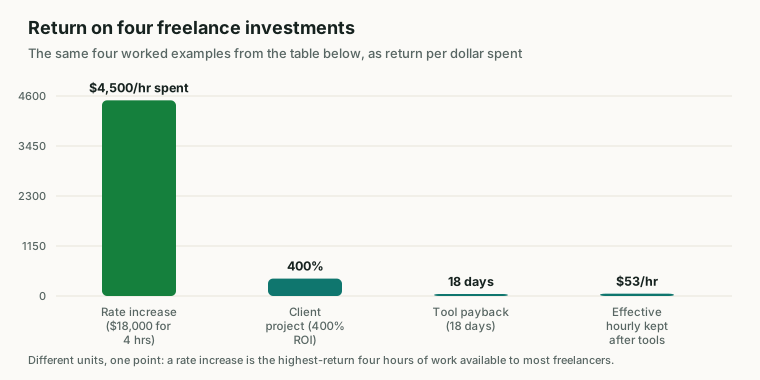
The four worked examples below, side by side. Note which one wins.
The formula they use is simple:
ROI % = (Value gained − Cost) ÷ Cost × 100
So your job in any proposal is to make the "value gained" part visible and large, and the "cost" part feel small by comparison. You are not hiding the price. You are surrounding it with the return.
A worked example: the $5,000 project that returns 400%
Say a SaaS founder hires me to rewrite their landing page and onboarding emails for a flat $5,000. On its own, $5,000 sounds like a big number to a small company. So I don't leave it sitting alone.
Their page converts visitors to trials at 2%, and they get 10,000 visitors a month. That's 200 trials. A new copy and flow lifts conversion to 3%, which is a conservative, believable jump. Now they get 300 trials a month, an extra 100 trials.
Roughly 10% of trials become paying customers at $50 a month, and the average customer stays about a year. So each extra trial is worth about $60 in first-year revenue (10% × $50 × 12 = $60). One hundred extra trials a month is $6,000 a month, but let's be cautious and count just the first four months while the new page beds in.
Four months of lift: 100 trials × $60 × 4 months ≈ $24,000, call it $25,000 with rounding.
Now the ROI is obvious:
($25,000 − $5,000) ÷ $5,000 × 100 = 400% ROI.
The client invested $5,000 and got $25,000 back. That is not an expense. That is the best-performing line item in their quarter. When you can sketch that arc, the conversation stops being about whether $5,000 is "a lot" and starts being about when you can start.
You don't need precise numbers to do this. You need plausible ones the client agrees with. Ask them their traffic, their conversion rate, their customer value. Let them supply the inputs, and the ROI becomes their projection, not your sales pitch.
One caution: never inflate the return to win the deal. If you promise a 400% ROI on numbers nobody believes, you've set a trap for yourself at renewal. I deliberately count only the first four months in the example above, and I round down. A return you can comfortably beat builds the kind of reputation that gets you rehired at a higher rate next time. An oversold projection gets you fired and quietly badmouthed. Conservative math is not weakness; it's the most durable sales tool you have.
Side Two: Your ROI as a Freelancer
Now flip the lens. Every dollar and every hour you put into your own business is an investment, and most freelancers never check whether those investments pay off. Here's where I've found the math most useful.
ROI on a tool
This is the easiest one to get wrong, because tools feel like pure cost. They're not. A tool that saves billable time has a return.
I pay $240 a year for a transcription app. It saves me roughly 50 hours a year of manual cleanup. At my $100 rate, that recovered time is worth $5,000. So:
($5,000 − $240) ÷ $240 × 100 ≈ 1,983% ROI.
The payback period is almost nothing: $240 ÷ ($5,000 ÷ 365 days) ≈ 18 days. After two and a half weeks, the tool is pure profit for the rest of the year. That's the kind of math that makes "expensive software" an easy call. The trap is the reverse: a $50-a-month tool you open twice has a deeply negative ROI, and you should cancel it today.
ROI on a niche
Specializing costs something. You turn down off-niche work for a while and maybe spend unpaid time learning the domain. The return is a higher rate and faster sales.
When I narrowed to fintech content, I gave up maybe $8,000 in declined general work over a quarter (the investment). But my rate went from $90 to $140, and across the next year that premium added about $45,000 on the same hours. ROI on the niche bet: ($45,000 − $8,000) ÷ $8,000 ≈ 463%. Niching almost always pays, but you have to be willing to count the short-term cost honestly.
ROI on raising your rate
This is the highest-leverage move in freelancing, and its ROI is almost comically good because the "investment" is so tiny. A rate increase costs you one afternoon of slightly awkward emails.
Suppose you raise rates 15% across a roster billing $120,000 a year. That's an extra $18,000 annually for a few hours of work. There's almost no other activity with a return like that. If you've never run the numbers behind your current rate, start with the freelance rate calculator so the increase has a defensible floor under it, then follow the sequence in how to raise your rate.
ROI on non-billable time
Not all unpaid hours are equal. Two hours a week on a portfolio piece that lands a $10,000 retainer has a spectacular return. Two hours a week doomscrolling a job board that never converts has none. Run the same ratio on your unpaid time that you'd run on cash, and you'll quietly reallocate your week toward the activities that actually compound.
The hard part is that the highest-ROI unpaid work rarely feels urgent. Writing one strong case study took me about four hours last spring. It has since been the deciding factor in three proposals worth a combined $31,000. That's a return I can't match with any amount of admin or inbox-clearing, yet the admin always screams louder for attention. The fix is to schedule the high-ROI unpaid hours first, before the noisy low-ROI ones can fill the day. Treat your own marketing like a paying client and it starts paying like one.
A Cheat Sheet of ROI Formulas
Keep these four within reach. They cover almost every freelance decision you'll need to size.
| What you're measuring | Formula | Worked example |
|---|---|---|
| Basic ROI % | (Value − Cost) ÷ Cost × 100 | ($25,000 − $5,000) ÷ $5,000 = 400% |
| Payback period | Cost ÷ (Value per day) | $240 ÷ ($5,000/365) ≈ 18 days |
| Effective hourly after a tool | (Income − Tool cost) ÷ Hours worked | ($60,000 − $1,500) ÷ 1,100 ≈ $53/hr kept |
| Return on a rate increase | Extra annual income ÷ Hours to implement | $18,000 ÷ 4 hours = $4,500 per hour spent |
A quick note on that effective-hourly row. Your true take-home rate isn't your sticker rate; it's what survives after tools, software, and overhead. Tracking it is the most honest measure of freelance profitability there is, and it usually argues for charging more, not spending less. The expenses checklist is the companion piece if you want to find every cost that's quietly eroding your return.
How ROI Thinking Justifies a Higher Number
Here's where the two sides meet. The reason ROI matters for your rate is that it reframes the entire pricing conversation. A freelancer who thinks in hours says "I charge $100 an hour, this will take 50 hours, that's $5,000." A freelancer who thinks in ROI says "this will return roughly $25,000 to you, and my fee is $5,000." Same price. Completely different psychology.
Once you've internalized that your fee is the cost term in someone else's ROI equation, raising your number stops feeling greedy. If the return holds, a higher fee just changes a 400% ROI to a 350% ROI, and that's still an easy yes for the client. You're not taking more; you're capturing a fairer slice of the value you create.
This is also why value-based and project pricing tend to beat hourly once you're good. When you get faster, hourly billing punishes you by shrinking the bill on the same result. Pricing to the outcome lets the ROI argument do the work. If that's new territory, hourly versus project pricing walks through the switch, and the industry benchmarks help you sanity-check where your number should land.
The practical workflow looks like this. Set your floor with real numbers. Estimate the client's return in their terms. Price somewhere that keeps their ROI comfortably above 2x while pulling your rate as high as that ceiling allows. Run your inputs through the calculator on the homepage so your floor is grounded, not guessed, and the rest is a conversation about value.
Questions people ask
- What is a good ROI for a client hiring a freelancer?
Most clients want at least a 2x to 3x return, meaning your fee comes back to them two or three times over. A $5,000 project that generates $25,000 in revenue is a 400 percent ROI, which is an easy yes. If you cannot sketch a plausible 2x return, the client is buying on price, not value.
- How do I calculate ROI on a freelance tool or subscription?
Take the value the tool creates in a year, subtract its annual cost, then divide by the cost. A $240-per-year app that saves you 50 hours, billed at $100, creates $5,000 of recovered time. That is ($5,000 - $240) / $240, or roughly 1,983 percent ROI. Payback in days, not months.
- Does raising my rate count as ROI?
Yes, in the sense of return on effort. The work to raise a rate is one uncomfortable conversation. If a 15 percent increase across your roster adds $18,000 a year, the return on that single afternoon of emails is enormous compared to almost anything else you could do with the time.
- How is freelancer ROI different from profit?
Profit is what you keep after costs. ROI is a ratio that tells you how efficiently a specific dollar or hour worked for you. Two freelancers can earn the same profit while one has far better ROI because they reached it with less invested time and money.
- Should I show clients my ROI math?
Show them their ROI, not yours. Frame your fee as a return they receive. Keep your internal ROI on tools and time private; that math is for setting your number, not for the pitch.
- What ROI should I aim to give a client?
Aim to make your fee return at least double, ideally triple. A return below 2x makes the client nervous; a return of 4x or more, like the $5,000-to-$25,000 example above, makes the decision almost automatic. The bigger and more believable the return, the less your price is scrutinized.
- How often should I run my own ROI numbers?
Check tool and subscription ROI once a quarter; it takes ten minutes and usually finds something to cancel. Reassess niche and rate ROI once a year, or any time your calendar fills up faster than you expected, since that's the market telling you your return has room to grow.
- Is ROI the same as my profit margin?
No. Profit margin is the share of revenue you keep. ROI measures how hard a specific investment worked, whether that's a $240 app or an hour of unpaid learning. You can have a healthy margin and still waste money on tools with terrible ROI, which is why both numbers are worth watching.
- Where can I learn the underlying business math?
The U.S. Small Business Administration has a clear, free guide to calculating your costs and profitability that's worth reading before you reprice anything. It's written for small businesses, and as a freelancer you are one. ROI is just a question asked twice. For your clients: does paying me pay off? For you: does this dollar, this tool, this hour pay off? Get fluent in both, and you'll set your rate from a position of evidence instead of nerves, and defend it without flinching.
Put these numbers to work
Use the free freelance rate calculator to turn this into your own hourly rate in under a minute.
Open the calculatorKeep reading
More in Rate Benchmarks, or browse all guides.
Freelance developer hourly rate bands for 2026 by stack, plus the domain premium that adds 25-40% for exactly the same technical work.
ReadFreelance designer hourly rate bands for 2026 across eight specialties, and why the spread inside one discipline beats the gap between disciplines.
ReadHow many hours do freelancers work each week? Four real working patterns, the billable share of each, and why billable hours plateau near 26.
ReadFreelance writer hourly rate bands from the real market: the content mill floor, generalist and specialist ranges, and per-word vs hourly math.
ReadHow to measure rate of pay for freelancers if you're the one hiring: a 5-step framework for benchmarking rates, converting to loaded cost, and tracking ROI.
ReadUse a freelance rate calculator automotive pros trust. Real hourly ranges by specialty, hidden expenses, and a worked rate-floor example for auto work.
Read