How to Raise Freelance Rates Without Losing Your Pipeline
How to raise freelance rates the calm way: a readiness checklist, a step-by-step playbook, and two copy-paste email scripts for new and existing clients.
Practical guidance, not financial advice. Sukie is a working freelancer, not a licensed accountant or financial advisor. Use this to make a defensible decision, then confirm the specifics for your situation with a qualified professional.

By Sukie · Founder & Writer, FreelanceRateLab
Updated August 11, 2026 · 8 min read
I sat on a rate increase for two years because every article I read about how to raise freelance rates treated it as a confidence problem. Take a deep breath, channel your worth, send the scary email. That framing is wrong, and it kept me underpriced the entire time. Raising your rate is a timing and communication problem. If you get the timing right and the words right, bravery barely enters into it.
This guide is the playbook I wish I had. We will check whether you are actually ready, sequence the increase so it never threatens your income, and use two email scripts you can copy, paste, and tweak. Knowing how to raise freelance rates without bleeding clients is a repeatable skill, not a personality trait.
Are You Actually Ready? A Readiness Checklist
A rate increase that arrives before demand does not raise your income. It empties your calendar. So before you touch a single number, look for these signals. The more you can honestly check off, the safer the move.
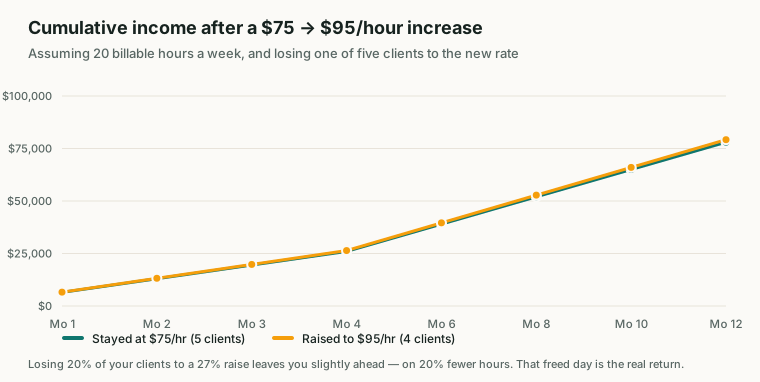
Losing a fifth of your clients to a 27% raise still leaves you ahead — on 20% fewer hours.
- You are booked out. You have a backlog of three to six weeks and you are scheduling new work into next month, not this week.
- Your close rate is high. You win more than half of the qualified proposals you send. If most people say yes immediately, your price is too low.
- You have proof of outcomes. You can name a specific result: a client whose traffic doubled, a launch that hit its number, a project that paid for itself.
- You are turning work away. You have said "I am full" at least once in the last two months. That is the market telling you it would pay more for access.
- Referrals are arriving unprompted. People are sending you clients without being asked. Demand is exceeding supply.
- The work feels easy now. Projects that used to take a week take three days. Your speed is value the old rate does not capture.
If you checked four or more, you are ready. If you checked one or two, the bottleneck is positioning or lead quality, not price, and a raise will hurt. Fix the pipeline first, then come back.
One more reality check before you move: know your floor. Run the numbers in the freelance rate calculator so you are not guessing. If your current rate sits below the floor it produces, this is not a raise. It is a correction, and you should treat it as urgent.
The Playbook: Raise in the Right Order
The single biggest mistake is announcing a new rate to everyone at once. That maximizes risk and gives you no information. Instead, sequence it. Each step de-risks the next.
- Set the new number privately. Use your floor plus your demand signal. If you are slammed and winning most bids, a 20 to 30 percent jump is reasonable. Write it down. Do not soften it before anyone has even heard it.
- Quote the new rate to new clients first. This is the safe laboratory. New prospects have no old number to anchor against, so they react to the price on its own merits. Quote it for two or three weeks and watch what happens.
- Read the responses. If new clients keep saying yes without flinching, your number is still too low and you can push further. If half balk, you have found roughly the right ceiling. This is real freelance rate negotiation data, gathered at zero risk to your existing income.
- Gather your evidence. While the new rate proves itself, collect proof for your current clients: results you delivered, testimonials, the waitlist you now have. You are building the case before you make the ask.
- Notify existing clients, in waves. Start with your healthiest, best-fit client relationships, not your most fragile. Give 30 to 60 days notice. Going in waves means that if your wording lands badly, you can adjust before the next batch.
- Hold the line, then reinvest. Once the new rate is live, protect the capacity it buys you. Fewer hours at a higher rate only works if you actually use the freed time to improve delivery or build your pipeline, not to take on more cheap work.
This order matters because new-client pricing is reversible and existing-client pricing is not. You learn the market's answer before you ever put a relationship at stake.
Script 1: Quoting the New Rate to a New Client
When a prospect asks what you charge, do not apologize, do not over-explain, and do not list three options to seem flexible. State the rate, anchor it to outcomes, and stop talking. Here is the version I use, lightly adapted each time.
Thanks for the detail on the project. Based on what you have described, this is a great fit for how I work.
My rate for work like this is $135 per hour, and a project of this scope typically runs $4,000 to $5,500 depending on the final number of revisions. That includes strategy, the build itself, and two rounds of changes.
Most clients come to me because they want it done right the first time rather than cheaply, and the projects I take on usually pay for themselves within a quarter. If that lines up with what you are after, I have a slot opening in early next month and would be glad to hold it for you.
Notice what that does. It names the number without flinching, frames the price around the result ("pay for themselves"), and ends with mild scarcity ("a slot opening") instead of a plea. You are the calm professional, not the nervous applicant.
Script 2: Telling an Existing Client About an Increase
This is the email people dread. The trick is to make it a routine business update, not a confession. Short, warm, specific, with a clear date and zero guilt.
Hi Maria,
I wanted to give you plenty of notice about a change on my end. Starting July 1, my rate will move to $135 per hour, up from $115. This is the first adjustment I have made in over a year, and it reflects the increased demand on my schedule and the results we have been getting, like the 40 percent jump in your email signups last quarter.
Nothing changes between now and then, and I would love to keep working together at the new rate. If it helps your budget, I am happy to talk through adjusting scope so the monthly total stays where you need it.
Either way, thank you for being a client I genuinely enjoy working with. Let me know if you would like to hop on a quick call.
That email gives a date, a reason tied to their results, a path for budget-conscious clients (adjust scope, do not discount), and a warm close. It reads as confident housekeeping, which is exactly what a rate change should be.
Handling Pushback, and What Not to Do
Some clients will push back. That is normal and not a sign you priced wrong. How you respond decides whether you keep both the client and the rate.
When someone hesitates, the strongest move is to hold the new number and flex the scope instead. "I understand the budget is tight. We could move to a smaller monthly package at the new rate rather than the old rate." You protect your pricing and still give them a yes-able option.
Here is what not to do:
- Do not immediately discount. The moment you cave on the number, you teach every client that your price is a starting bid. The whole increase unravels.
- Do not justify with personal costs. "My rent went up" makes it your problem to absorb. "Demand on my schedule has grown" makes it a market fact they are part of.
- Do not apologize for the increase. "So sorry to do this" signals the price is unfair. It is not. Skip the apology entirely.
- Do not negotiate against yourself. Send the number, then be quiet. Filling the silence with concessions before they have even replied is how good rates die.
- Do not raise everyone at once with no notice. An ambush turns a routine update into a betrayal.
If a client genuinely cannot move and the old rate is below your floor, letting them go is the right answer, not a failure. Every hour spent below your floor is an hour you cannot spend on work that actually pays.
What Happened When I Did This
In March 2024 I was booked six weeks out and still saying yes to everything at $90 an hour. The math was embarrassing. At $90 across roughly 1,100 billable hours a year, I was grossing about $99,000 and burning out to get there.
So I followed this exact order. I quoted $120 to the next three prospects. Two said yes without blinking. That told me $90 had been leaving real money on the table. Then I emailed my five existing clients with a 45-day runway, using a version of Script 2. Four stayed at the new rate. One asked to drop from four articles a month to two, which I happily agreed to, keeping the per-hour number intact.
The result: same calendar, fewer total hours, and my run-rate moved from roughly $99,000 to about $128,000. The client who reduced scope freed up two days a month, which I poured into a productized offer. I lost zero relationships I wanted to keep. The fear had been doing all the talking, and the fear was wrong.
If you want to size your own jump, plug your real billable hours and target income into the freelance rate calculator and compare it against the benchmarks for your field. The U.S. Small Business Administration also has a solid primer on pricing strategy that is worth ten minutes before you reprice your whole roster.
Two companions worth reading before you send anything: how to stop undercharging as a freelancer has the floor calculation you should be raising to, freelance rate negotiation has the scripts for the replies you will get, and freelance pricing psychology explains the four seconds in which most of the increase gets given back.
Questions people ask
- How much should I raise my freelance rate at once?
For existing clients, 10 to 20 percent per cycle is usually absorbed without drama. For new clients you can jump higher, even 30 to 50 percent, because there is no anchor to compare against. The market, not your nerves, sets the ceiling.
- When is the right time to raise freelance rates?
When you are booked out three to six weeks ahead, closing more than half your qualified proposals, and can point to specific results you have delivered. Those three signals together mean demand is outrunning your price.
- How much notice should I give existing clients before a rate increase?
Give 30 to 60 days. That window respects their budgeting cycle, removes the feeling of an ambush, and gives anyone who needs to adjust scope time to do it without panic.
- What do I do if a client says no to the increase?
Stay calm and offer a smaller scope at the old number rather than discounting the new rate. If the old rate is below your real floor, letting that client go frees capacity for better-paying work.
- Should I tell clients my rate calculator says I need more?
No. Use the math privately to set the number, then talk to clients about outcomes and value. Clients pay for results, not for your internal spreadsheet.
- What if I am a beginner and have no leverage to increase a freelance rate?
Then focus on getting booked and proving outcomes first. You cannot negotiate from an empty calendar. Once you have a backlog and a couple of results to point to, the readiness checklist above starts working in your favor.
Put these numbers to work
Use the free freelance rate calculator to turn this into your own hourly rate in under a minute.
Open the calculatorKeep reading
More in Raising Your Rates, or browse all guides.
ROI of hiring a freelancer, calculated the way finance wants it: loaded cost comparison, four attribution models, and the traps that inflate the number.
ReadFreelance developer hourly rate bands for 2026 by stack, plus the domain premium that adds 25-40% for exactly the same technical work.
ReadFreelance designer hourly rate bands for 2026 across eight specialties, and why the spread inside one discipline beats the gap between disciplines.
ReadHow many hours do freelancers work each week? Four real working patterns, the billable share of each, and why billable hours plateau near 26.
ReadTrue hourly rate is what survives tax, unbillable time and overhead. The full trace from a $75 invoice line to the $21 that reaches your account.
ReadCost to start a freelance business in 2026, itemized: a $0 bootstrap path, a lean $500 budget, a comfortable $2,500 setup, plus the hidden first-90-days gap.
Read