Cost to Start a Freelance Business: Real Numbers From $0 Up
Cost to start a freelance business in 2026, itemized: a $0 bootstrap path, a lean $500 budget, a comfortable $2,500 setup, plus the hidden first-90-days gap.
Practical guidance, not financial advice. Sukie is a working freelancer, not a licensed accountant or financial advisor. Use this to make a defensible decision, then confirm the specifics for your situation with a qualified professional.

By Sukie · Founder & Writer, FreelanceRateLab
Published August 18, 2026 · 13 min read
Starting my freelance business in April 2018 cost me exactly $386: a $12 domain, a $24 county trade-name filing, a $150 contract template, and $200 for one hour with a CPA who talked me out of two bad ideas. That is the honest answer to what the cost to start a freelance business looks like when you strip away the panic-buying, and it is a much smaller number than the internet wants you to believe. What almost sank me was not the $386. It was the $9,000 hole that months one through three quietly dug while I waited for my first invoices to clear.
So this guide covers both halves. First, the visible startup costs at three budget tiers, itemized in real 2026 US prices: a $0 bootstrap, a lean $500 setup, and a comfortable $2,500 launch. Then the invisible cost nobody budgets, the early income gap, and how to size your runway so it does not eat you. One boundary before we start: this page is about one-time startup spending and your first 90 days. The recurring costs of running the business live in the freelance expenses checklist, with real annual price ranges in the typical freelance expenses list. Startup is a different animal, and mixing the two is how budgets go wrong.
The only three things you need on day one
Strip everything away and a freelance business requires exactly three things before the first client: a place to receive money that is not your personal checking account, a contract, and a way to invoice.
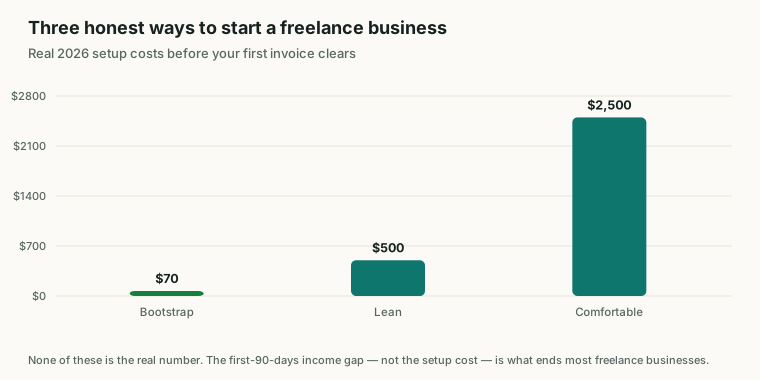
None of these is the real number — the first-90-days income gap is.
The business bank account comes first because commingling money creates a mess that worsens every month you delay. Several US banks offer genuinely free business checking with no minimum balance in 2026, so this can cost zero. Open it before the first payment arrives, not after.
The contract comes second because working without one is the most expensive mistake available to a new freelancer. It does not need to be a $600 custom document yet; a solid purchased template covering scope, payment terms, kill fees, and ownership runs $50 to $200, with free versions available if the budget is truly zero.
Invoicing comes third and is the cheapest: free tiers of mainstream tools handle a handful of clients. What matters is that invoices look professional, state payment terms clearly, and go out the moment work is delivered.
Notice what is not on this list: a website, a logo, an LLC, business cards, a paid portfolio platform. All real, all deferrable. We will get to when each one earns its place.
Tier one: starting with $0
People ask me whether you can start freelancing with no money as if it were a trick question. It is not. The mechanics of a zero-dollar start are boring and completely legitimate.
Operating as a sole proprietor happens automatically the moment you do paid work under your own name; in most situations there is nothing to file and nothing to pay. An EIN, the tax ID that lets you avoid handing your Social Security number to every client, is free directly from the IRS and takes about ten minutes online. Free business checking exists, free invoicing tiers exist, and reputable freelancer organizations publish free contract templates. A portfolio can live on a free page builder until real money arrives.
I watched a friend do exactly this in January 2024. She started a freelance bookkeeping side business with literally $0 spent, landed her first $400 client in week three on a free invoice generator and a template contract, and did not spend a dollar on the business until month two, when she bought a $12 domain out of revenue. Nothing about it looked unprofessional, because the client only ever saw a clean proposal, a clear contract, and a prompt invoice.
The catch with the $0 start is not credibility. It is that free tiers have ceilings, and you will hit them somewhere between client three and client six. That is fine. A ceiling means revenue exists, and revenue is what should fund the upgrade.
Tier two: the lean $500 start, itemized
This is the tier I actually recommend for most people, and it is roughly what my own $386 start looked like adjusted to 2026 prices. You are buying exactly the things that reduce risk or friction, and nothing that exists to make you feel like a business.
| Line item | What you get | Real 2026 cost |
|---|---|---|
| Business checking account | Free-tier account at a mainstream bank | $0 |
| EIN from the IRS | Federal tax ID, direct from irs.gov | $0 |
| Domain name (1 year) | Your name or business name | $10–$15 |
| Trade name / DBA filing | Optional, only if operating under a business name | $10–$100 |
| Contract template | Purchased, freelancer-specific, covers scope and payment | $50–$200 |
| Invoicing tool | Free tier, upgrade later from revenue | $0 |
| One-page portfolio site | Cheap builder plan or static hosting, 1 year | $0–$100 |
| CPA or tax-pro consult (1 hour) | Setup questions answered before mistakes happen | $0–$150 |
| Total | ~$70–$500 |
Two notes on that table. The DBA line only applies if you operate under a name other than your own; freelancing under your legal name skips it. And the CPA hour is the line people cut first, which is backwards. My $200 consult in 2018 is the reason I opened a separate tax savings account in week one instead of discovering quarterly estimated taxes the hard way the following April. Keep that line if you keep any, and read freelance tax basics before the meeting so the hour goes further.
Tier three: the comfortable $2,500 start, itemized
The comfortable tier is for someone leaving a salaried job with savings, who wants the structure done properly on day one rather than retrofitted later. Nothing here is wasted money, but be clear with yourself: every line below the first two is a convenience or a risk reduction, not a requirement.
| Line item | What you get | Real 2026 cost |
|---|---|---|
| LLC formation (state filing fee) | Liability separation, varies enormously by state | $35–$500 |
| Registered agent service (1 year) | Required in most states if you don't self-serve | $0–$150 |
| Lawyer-reviewed contract | Custom or reviewed template for your specific work | $300–$700 |
| Professional liability insurance (1 year) | E&O coverage, priced for a new solo freelancer | $300–$600 |
| Proper website | Domain, a year of hosting, premium template | $150–$400 |
| Accounting software (1 year) | Real books from day one | $120–$400 |
| Equipment top-up | Second monitor, decent mic, chair repair, whatever your gap is | $0–$600 |
| CPA setup engagement | Entity questions, quarterly estimate schedule, chart of accounts | $200–$400 |
| Total | ~$1,500–$3,000 |
The spread on the LLC line surprises everyone: state filing fees genuinely range from around $35 in the cheapest states to $500 at the top, before annual report fees that also vary widely. Insurance varies with your field; a writer pays near the bottom of that range, while anyone whose mistakes can cost clients real money pays nearer the top. If you came here asking how much does it cost to start a freelance business the "proper" way, this table is the ceiling for a solo operation. Anyone quoting five figures to start a one-person service business is selling something.
Registration and legal costs, by structure
Here is the legal cost picture on its own, because it is the part with the widest misinformation. In the US you have three realistic options at the start, and the SBA's business registration guide is the authoritative walkthrough for all of them.
A sole proprietorship is the default and costs nothing to create. You may pay a small fee to register a trade name if you want one, and some cities require a general business license, typically modest. This is where the vast majority of freelancers correctly begin.
An LLC costs a state filing fee ranging from roughly $35 to $500 depending on the state, plus recurring annual or biennial report fees in most states, plus possibly a registered agent. What it buys is separation between business liabilities and personal assets, and some perceived seriousness with larger clients. What it does not buy, contrary to persistent myth, is automatic tax savings, since a single-member LLC is taxed identically to a sole proprietorship by default.
An S corporation election is the third thing you will hear about, usually from someone excited about self-employment tax savings. At startup income levels it is almost always premature: the payroll and compliance overhead costs real money every year, and the math generally only turns favorable once profit is well into six figures. File it under "revisit in year two," not "startup cost."
Whatever structure you choose, get your EIN free from the IRS directly. Third-party sites charge $50 to $300 for a form the IRS small business portal processes for free in minutes. That markup is the purest example of a startup cost that should be $0.
What you can safely defer, and until when
Half the freelance startup costs people budget for are month-six costs wearing a day-one disguise. My deferral list, with the trigger that ends each deferral:
- The LLC. Defer until you have steady revenue or a client whose work carries genuine liability. Trigger: consistent monthly income, or a contract where something going wrong could get expensive.
- The website. A one-page placeholder is plenty while your first clients come from referrals and direct outreach, which they almost always do. Trigger: the first time a prospect you wanted asks to see more and there is nothing to send.
- Paid software. Every category you will eventually pay for has a free tier that survives three to five clients. Trigger: hitting an actual limit, not anticipating one.
- Branding. A logo did not close a single one of my first twenty clients. Trigger: honestly, maybe never for a solo service business.
- Courses and certifications. The skills that got you to the point of freelancing are the skills you sell on day one. Trigger: a specific capability gap a real client actually asked about.
Deferral is not stinginess. It is sequencing. Every dollar not spent in month zero is a dollar of runway in month two, and runway is about to become the whole story.
The startup cost nobody budgets: months one through three
Now the number that dwarfs everything above. When I started in April 2018, my visible startup spending was $386. My income for April, May, and June combined was $2,100, against living costs of about $3,700 a month. The real cost to start a freelance business, for me, was that $9,000 gap, and not one startup-cost article I read beforehand mentioned it.
The gap exists for mechanical reasons, not because new freelancers are bad at their jobs. Finding your first clients takes weeks. Closing them takes more weeks. Then you do the work, then you invoice, then payment terms give the client 15 to 30 more days, and some clients stretch past that. A project you start hunting for in week one frequently becomes cash in week ten. Meanwhile rent does not defer, and neither does health insurance.
So the honest startup budget has two components: the equipment-and-registration budget from the tables above, and a runway budget covering the difference between your living costs and your realistic early revenue for roughly three months. For most people leaving full-time work, that second component is five to twenty times the first one.
Runway math: your rate changes the answer
The size of that income gap is not fixed. It is a function of your rate, which is why startup budgeting and pricing are the same conversation.
Walk through a concrete version. Suppose your household needs $3,500 a month and you estimate 60 billable hours a month in your first quarter, deliberately low because early months are mostly unpaid hunting. At $40 an hour, those hours earn $2,400 a month, leaving an $1,100 monthly gap, about $3,300 over the quarter. At $75 an hour, the same 60 hours produce $4,500 and the gap disappears entirely. Identical effort, wildly different startup cost, and the difference is purely the number you quoted.
This is why underpricing is most dangerous at the very start, exactly when fear pushes rates lowest. Run your numbers through the freelance rate calculator before your first quote: real living costs, realistic early hours, honest expense estimates, and it shows you the floor rate at which your runway math actually closes. A rate that "feels safe" because it wins work fast can quietly triple the real cost to start a freelance business.
A first-90-days spending plan
Budgets fail when they are a single number instead of a sequence, so here is how I would stage spending across the first quarter today, at the lean tier.
Before day one, spend roughly $250: bank account, EIN, contract template, domain, and the tax-pro hour. This is the risk-reduction layer, and it front-loads because mistakes here compound.
In month one, spend close to nothing new. The job in month one is outreach and delivery on free-tier tools, not shopping. The one exception: if a specific tool demonstrably speeds up paid client work you already have, buy the monthly plan, never the annual one.
In month two, revenue starts deciding things. First revenue goes to the tax savings account (a quarter to a third of every payment, no exceptions), then to replacing whichever free tier you have genuinely outgrown. This is usually when invoicing or accounting software earns its subscription.
In month three, reassess structure. If income looks repeatable, price the LLC for your state and get insurance quotes, funded by the business rather than your savings. By now spending is transitioning from startup costs to operating costs, a different budget with its own logic; the expenses checklist takes over from here.
Where the money gets wasted, and the bottom line
Four places I most often watch beginners inflate the cost to start a freelance business, one of them drawn from my own bank statements.
Premium annual software plans bought before the first client, because the discount felt responsible. The discount is real; the waste is paying for twelve months of a tool your month-three self may not use. Incorporation packages from formation mills, which bundle a $35 state filing with $300 of upsells like "EIN acquisition" that the IRS does for free. Branding packages, where a new freelancer spends $800 on identity design for a business whose first ten clients arrive through referrals and never see the style guide. And gear, my 2018 confession: I convinced myself a $340 microphone was a business necessity for client calls that every client attended by phone. It was a purchase about feeling professional, and feeling professional is the most expensive category in freelancing.
The pattern is identical each time: spending that substitutes for the uncomfortable work of finding clients. When a startup purchase feels exciting, check whether it is actually procrastination with a receipt.
Which leaves the bottom line, compressed into the answer I give when someone asks me directly: the cost to start a freelance business in 2026 is $0 to $500 if you sequence purchases sensibly, $1,500 to $3,000 if you want the structure fully built on day one, plus about three months of personal runway, which is the component that actually decides whether the launch survives. The registrations and tools are the cheap part. The bridge to your first reliable invoices is the expensive part, and your rate is the biggest lever you hold over its length.
So start with the three day-one essentials, defer everything that has a deferral trigger, protect runway like the scarce resource it is, and price from arithmetic rather than fear. The rest of this site exists for that last part: the homepage calculator and rate guides take you from "what should I charge" to a defensible number, and the ongoing-cost guides pick up where this startup budget ends.
Questions people ask
- How much does it cost to start a freelance business?
Realistically, between $0 and about $3,000 depending on how you set up. A bare-bones start using free tools, a sole proprietorship, and a free business checking account can genuinely cost nothing. A lean start with a domain, a contract template, and basic registration runs $300 to $500. A comfortable start with an LLC, insurance, a proper website, and an accountant consult lands between $1,500 and $3,000.
- Can I start freelancing with no money?
Yes. Operating as a sole proprietor is automatic and free in most situations, an EIN from the IRS costs nothing, free business checking accounts exist, and free tiers of invoicing tools handle your first clients fine. What you cannot skip is a written contract, and free templates exist for that too. The real constraint when you start with no money is runway, not tooling: you need income arriving before savings run out.
- Do I need an LLC to start freelancing?
No, not on day one. Most freelancers legally begin as sole proprietors by default, which typically costs nothing beyond an optional trade-name filing. An LLC adds liability separation and looks more established, but state filing fees range from around $35 to $500 plus annual fees, per SBA guidance. A common and reasonable path is starting as a sole proprietor and forming the LLC once income is steady.
- What should I buy first when starting a freelance business?
In order: a separate business checking account, a contract template you trust, and a way to send professional invoices. Those three protect your money, your legal position, and your cash flow, and together they can cost under $200. A website, a logo, paid software, and an LLC all matter less than beginners assume and can wait until client money is actually arriving.
- How much runway should I have before going full-time freelance?
Plan for three months of personal living costs on top of your startup budget, because the income gap of months one through three is the largest real cost of starting. Invoices from your first clients often arrive 30 to 60 days after you begin working. If your household needs $3,500 a month, that gap is roughly $8,000 to $10,000 of runway, which dwarfs every equipment and registration line combined.
- Are freelance startup costs tax-deductible?
Generally yes. The IRS allows you to deduct qualifying startup and organizational costs, typically up to $5,000 of each in your first year if your total startup spending stays under the threshold, with the remainder amortized. Registration fees, contract templates, software, and equipment used for the business usually qualify. Keep receipts from day one and confirm the details with a tax professional, because the rules depend on your situation.
- Can I really start freelancing with no money?
Yes, mechanically and legitimately. Sole proprietorship is free and automatic, the EIN is free from the IRS, free business checking exists, and free invoicing tiers handle early clients. The only non-negotiable is a written contract, and reputable free templates cover that. The real constraint of a $0 start is runway, which makes your rate and pipeline the true startup investments.
- Do I need an LLC before my first client?
No. You can legally take paid work today as a sole proprietor in most situations. The LLC's liability separation becomes worth its state fees, roughly $35 to $500 plus annual costs, once revenue is steady or the work carries real risk. Forming one later is straightforward, so deferring costs little.
- What should my very first purchases be?
A business bank account, a contract template, and professional invoicing, in that order; together they can cost under $200. If you add one more, make it an hour with a tax professional, the highest-return $150 to $200 in this entire budget.
- How much runway do I need before quitting my job?
Budget the gap between living costs and realistic early revenue for about three months, because first invoices commonly take 30 to 60 days to become cash. For a $3,500-a-month household starting from zero clients, that is roughly $8,000 to $10,000. A higher rate shrinks this number faster than any cost-cutting can.
- Can I deduct what I spend to start?
Generally yes. The IRS lets you deduct qualifying startup costs, typically up to $5,000 in the first year when total startup spending stays under the threshold, amortizing the rest. Save every receipt from before your first sale and confirm treatment with a tax professional.
Put these numbers to work
Use the free freelance rate calculator to turn this into your own hourly rate in under a minute.
Open the calculatorKeep reading
More in Money & Taxes, or browse all guides.
A working writer's honest take on freelance writer expenses: what to spend on tools, the 10-15% overhead rule, a real annual budget, and what pays for itself.
ReadA typical freelance expenses list with realistic annual USD ranges for software, hardware, insurance, fees, and more, so you can benchmark your own overhead.
ReadA freelance business expenses checklist, organized by category, so your rate funds every real cost instead of quietly paying for them out of your take-home.
ReadFreelance tax basics for beginners, answered in plain language: self-employment tax, quarterly payments, set-aside math, and deductions that actually help.
ReadROI of hiring a freelancer, calculated the way finance wants it: loaded cost comparison, four attribution models, and the traps that inflate the number.
ReadFreelance developer hourly rate bands for 2026 by stack, plus the domain premium that adds 25-40% for exactly the same technical work.
Read