Freelance Tax Basics for Beginners (Asked and Answered)
Freelance tax basics for beginners, answered in plain language: self-employment tax, quarterly payments, set-aside math, and deductions that actually help.
Practical guidance, not financial advice. Sukie is a working freelancer, not a licensed accountant or financial advisor. Use this to make a defensible decision, then confirm the specifics for your situation with a qualified professional.

By Sukie · Founder & Writer, FreelanceRateLab
Updated August 11, 2026 · 8 min read
Freelance tax basics for beginners start with an uncomfortable fact: when a freelancer tells me their "take-home goal," the number is almost always a lie. Not on purpose. It's just that taxes are the single biggest reason a rate that looks fine on paper leaves you broke in April. You quote $60 an hour, you feel good, and then a tax bill shows up that you never set money aside for.
This guide walks through freelance tax basics for beginners as a plain question-and-answer. No jargon dumps. Just the questions I actually had when I went solo, answered so your rate can cover what you owe.
One honest note up front: this is general education, not tax advice. I'm a working freelancer, not a CPA. Rates, thresholds, and due dates change every year, so confirm anything specific with the IRS or a qualified tax professional before you file or pay.
Why do taxes wreck so many freelance budgets?
Because employees never see this part. When you have a W-2 job, your employer quietly withholds income tax and half of your Social Security and Medicare before the money ever hits your account. The take-home number you got used to was already taxed.
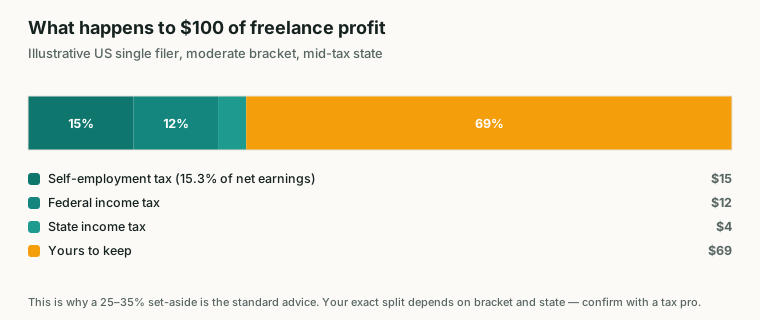
Illustrative only — your split depends on bracket and state. This is why 25–35% is the standard set-aside.
As a freelancer, nobody withholds anything. The full payment lands in your account, it feels like yours, and you spend it. Then the bill is yours alone. That gap between "money I received" and "money I get to keep" is the whole problem, and it's why your rate has to be built with taxes in mind from day one.
My own first year was a small disaster. I made decent money, spent it like it was all mine, and got a bill in April for roughly the cost of a used car that I had not saved a dollar toward. Nothing about it was illegal or unusual. I simply had never been taught that the "raise" from going freelance comes with a job the employer used to do quietly: setting tax money aside. Once I built that into my routine, the fear went away. The rest of this guide is just that routine, broken into questions.
What kinds of taxes does a US freelancer actually face?
There are three buckets most beginners run into. Here they are at a conceptual level, not as exact numbers.
| Tax type | What it covers | Who you pay | Beginner note |
|---|---|---|---|
| Federal income tax | Your overall earnings, taxed in brackets | IRS | Same brackets employees use, but nobody withholds it for you |
| Self-employment tax (FICA) | Social Security + Medicare | IRS | You pay both the employer and employee halves, roughly 15.3% of net earnings |
| State income tax | State-level earnings | Your state | Varies a lot; some states have none, others are significant |
Two big takeaways. First, self-employment tax is the surprise that hits new freelancers hardest, because it's on top of income tax. Second, your state matters enormously. A freelancer in a no-income-tax state and one in a high-tax state can owe wildly different totals on the same income. Always check your own state's rules.
What is self-employment tax, exactly?
This is the one I wish someone had explained before my first year. Self-employment tax is how the self-employed pay into Social Security and Medicare, the system employees call FICA.
At a regular job, that contribution is split: your employer pays one half, you pay the other, and you barely notice. When you freelance, you are both the employer and the employee. So you pay both halves yourself, which currently lands around 15.3 percent of your net self-employment earnings (verify the exact rate on IRS.gov, because it can change).
There is a small mercy built in: you can deduct the employer-equivalent half of self-employment tax when figuring your income tax. It doesn't erase the cost, but it softens it. The point is simply that this tax exists, it's separate from income tax, and you have to plan for both.
How much should I set aside from each payment?
This is the question that matters most for cash flow, so let's do the actual arithmetic.
A safe starting habit for beginners is to set aside 25 to 30 percent of every payment into a separate account the moment it arrives. Treat it like it was never yours.
Here's the math on a single $5,000 invoice:
- Invoice paid: $5,000
- Move 30% to your tax account: $5,000 × 0.30 = $1,500
- Money you actually work with: $5,000 − $1,500 = $3,500
Do that on every invoice and the quarterly tax bill stops being a crisis, because the money is already sitting there. Over a year of $5,000 invoices twice a month, you'd be parking $1,500 × 24 = $36,000 for taxes without ever feeling the shock.
Is 30 percent the perfect number for everyone? No. A lower earner with strong deductions might over-save at 30 percent; a higher earner in a high-tax state might need more. But for a beginner, over-saving is a far gentler mistake than under-saving. You can always sweep the leftover into savings after you file. Confirm your real percentage with a tax pro.
When you set your hourly rate, that buffer has to be baked in, not bolted on. If you want $3,500 of usable income per $5,000 invoice, you can't price as if you keep all $5,000. The same logic runs through the freelance rate calculator formula: your gross target has to be larger than your take-home target by enough to cover tax.
What are quarterly estimated taxes, and when are they due?
Because nobody withholds for you, the IRS generally doesn't want to wait until April. If you expect to owe roughly $1,000 or more for the year, you're usually expected to pay estimated taxes four times a year. Skip them and you can get hit with an underpayment penalty even if you eventually pay in full.
The four periods typically fall on roughly these dates:
| Payment | Covers income from | Usually due around |
|---|---|---|
| Q1 | January – March | mid-April |
| Q2 | April – May | mid-June |
| Q3 | June – August | mid-September |
| Q4 | September – December | mid-January (following year) |
Important caveat: these dates and the dollar threshold shift, and they slide when a due date lands on a weekend or holiday. Do not trust this table as gospel. Confirm current deadlines and amounts on the IRS estimated taxes page every year.
The good news: if you've already been moving 25 to 30 percent of each payment into a separate account, paying quarterly is almost boring. You log in, you pay, the money was waiting. The pain only shows up for people who spent the whole payment and have to find the tax money from nowhere.
One trick that made quarterly payments painless for me: I treat the four due dates like client invoices on my own calendar, with a reminder a week before each one. When the reminder fires, I open my tax savings account, look at what's there, and pay what I owe (or a careful estimate of it). Because the money never lived in my spending account, paying it feels like moving cash from one pocket to another, not losing it. If your income is lumpy, that separate account is also a sanity check: watching it grow tells you your set-aside percentage is roughly right, and watching it run thin tells you to bump the percentage up before the bill lands.
Which deductions actually help?
Deductions reduce the income you're taxed on, which lowers what you owe. But chasing deductions you don't qualify for is how people invite trouble. Focus on the legitimate ones tied to real business spending:
- Software and tools you use for the work (design apps, accounting software, your project tools).
- Home-office deduction, if you have a space used regularly and exclusively for business and you meet the rules.
- Business mileage and travel for client work.
- Health insurance premiums for the self-employed, which can be deductible in many cases.
- The deductible half of self-employment tax, mentioned earlier.
- Equipment like your computer, plus a share of phone and internet used for business.
The habit that makes all of this work is unglamorous: keep business and personal money in separate accounts, and save receipts. A deduction you can't document is a deduction you can't safely claim. For a fuller walk-through of what counts, see the freelance expenses checklist, and remember that the expenses you deduct are also the ones your rate has to cover in the first place.
I'll say it again because it's a YMYL topic: which deductions apply to you depends on your situation. Treat this list as a starting map, then confirm specifics with a professional.
How do taxes change the rate I should charge?
Here's where it all connects. Say your honest take-home target is $70,000, and your effective tax rate works out to about 30 percent. Your gross target isn't $70,000, it's:
$70,000 ÷ (1 − 0.30) = $70,000 ÷ 0.70 ≈ $100,000 gross
Now spread that over realistic billable hours. If you can bill 1,100 hours in a year:
$100,000 ÷ 1,100 ≈ $91 per hour
If you'd priced off the $70,000 take-home figure without the tax gross-up, you'd have landed near $64 an hour and quietly underpriced yourself by about $27 every hour, all year. That's the lie in the take-home goal, made visible.
This is exactly why I run the numbers through the freelance rate calculator with the tax buffer included, instead of eyeballing it. The calculator turns "taxes" from a scary April surprise into one input you plan around.
The whole game is simple to say and easy to skip: figure out roughly what you'll owe, set it aside from every single payment, pay on schedule, and price your work so the tax buffer is already inside your rate. Do that, and tax season turns into a non-event. For the broader picture of how all your costs feed your number, start at the homepage calculator, then read freelance rate after taxes for the gross-up multiplier and freelance business expenses checklist for the deductions side, or browse the rest of the guides hub. And again, gently: this is general education, so confirm your specifics with the IRS and a tax professional.
Questions people ask
- How much of each freelance payment should I set aside for taxes?
A common starting buffer is 25 to 30 percent of every payment moved into a separate savings account. Your real number depends on your income, state, and deductions, so confirm it with a CPA or the IRS withholding tools.
- What is self-employment tax and why do I owe it?
Self-employment tax is the freelancer version of Social Security and Medicare (FICA). As both employer and employee you pay both halves, roughly 15.3 percent on net self-employment earnings, on top of regular income tax. Verify current rates on IRS.gov.
- Do I really have to pay taxes four times a year?
If you expect to owe roughly $1,000 or more, the IRS generally expects quarterly estimated payments rather than one April payment. Skipping them can trigger an underpayment penalty. Check the current threshold and due dates on IRS.gov.
- Which freelance tax deductions actually help?
The ones tied to real business spending: software, the home-office deduction if you qualify, business mileage, health insurance for the self-employed, and the deductible half of self-employment tax. Keep receipts and ask a tax pro about your situation.
- Is this guide tax advice?
No. This is general education for beginners. Tax law, rates, and due dates change, so confirm your specifics with the IRS and a qualified tax professional before you file or pay.
- Do I need to register a business or get an EIN to pay taxes?
Not necessarily. Many freelancers operate as sole proprietors and report income on their personal return. An EIN or formal structure can have benefits, but it isn't required just to owe and pay taxes. Ask a tax pro whether a structure makes sense for you.
- What happens if I just don't pay quarterly?
You may owe an underpayment penalty plus interest, on top of the tax itself. The system is built to be paid as you earn. If you've fallen behind, the IRS has guidance and payment options, so don't ignore it.
- Should my tax buffer change as I earn more?
Often yes. Higher income can push more of it into higher brackets, so a flat 25 percent that worked at a lower income may not be enough later. Revisit your percentage each year and adjust your rate accordingly.
- Where do I get the official, current numbers?
Straight from the source: the IRS Self-Employed Individuals Tax Center at irs.gov. For your personal situation, pair that with a CPA or enrolled agent.
Put these numbers to work
Use the free freelance rate calculator to turn this into your own hourly rate in under a minute.
Open the calculatorKeep reading
More in Money & Taxes, or browse all guides.
Cost to start a freelance business in 2026, itemized: a $0 bootstrap path, a lean $500 budget, a comfortable $2,500 setup, plus the hidden first-90-days gap.
ReadA working writer's honest take on freelance writer expenses: what to spend on tools, the 10-15% overhead rule, a real annual budget, and what pays for itself.
ReadA typical freelance expenses list with realistic annual USD ranges for software, hardware, insurance, fees, and more, so you can benchmark your own overhead.
ReadA freelance business expenses checklist, organized by category, so your rate funds every real cost instead of quietly paying for them out of your take-home.
ReadFreelance developer hourly rate bands for 2026 by stack, plus the domain premium that adds 25-40% for exactly the same technical work.
ReadFreelance designer hourly rate bands for 2026 across eight specialties, and why the spread inside one discipline beats the gap between disciplines.
Read