How to Stop Undercharging as a Freelancer (Rate Floor)
Learn how to stop undercharging as a freelancer with a rate floor formula, 5 warning signs, and a 4-step plan to raise your rate this week.
Practical guidance, not financial advice. Sukie is a working freelancer, not a licensed accountant or financial advisor. Use this to make a defensible decision, then confirm the specifics for your situation with a qualified professional.

By Sukie · Founder & Writer, FreelanceRateLab
Updated August 11, 2026 · 8 min read
If you want to know how to stop undercharging as a freelancer, start where I did. I quoted $60 an hour on a project that took me 40 hours. The client paid $2,400, thanked me, and moved on. Six months later I found out they had billed that exact deliverable to their own client for $18,000.
That gap is not unusual. It is the undercharging tax, and I paid it for years without noticing.
If you have ever felt that quiet sting after sending an invoice, this guide is for you. Learning how to stop undercharging as a freelancer is not about greed. It is about staying in business long enough to get good at the work you love.
5 Signs You're Undercharging Right Now
You do not need a spreadsheet to spot the symptoms. Your own gut has been keeping score. Here are the five signs I see most often, in myself and in every freelancer who asks me to look at their numbers.
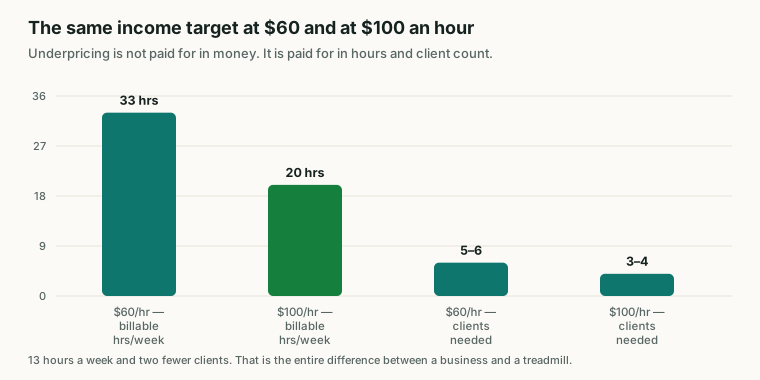
Underpricing is paid for in hours and client count, not in money.
1. Clients never push back on your price. When every single quote gets an immediate yes, your price is too low. A healthy rate gets the occasional "can you do better?" Total silence means you left money on the table before the conversation even started.
2. You feel resentful mid-project. That flash of "why am I doing all this for so little?" around hour 20 is not a character flaw. It is your nervous system reporting that the trade is unfair. Resentment is a pricing signal, not a mindset problem.
3. You avoid detailed scope conversations. When you are underpriced, every extra request feels like a threat, so you skip the awkward scope talk and just absorb the work. Confident pricing makes scope conversations easy because you know what each addition is worth.
4. You're fully booked but broke. This is the cruelest sign. Your calendar is jammed, you are working weekends, and your bank account still flinches at every bill. Volume is hiding a broken rate. More work at the wrong number just means more exhaustion.
5. You keep adding "just a little more" for free. One extra revision here, a quick favor there. Each freebie tells the client your time is worth zero, and they believe you. Scope creep is undercharging wearing a friendly mask.
If two or more of these feel personal, you are not imagining it. The good news is that the fix is arithmetic, not therapy.
Why Undercharging Is a Trap, Not a Strategy
The most common defense of low rates is "I charge less so I get more clients." It sounds reasonable. It is wrong.
Low rates do not attract more of the good clients. They attract the price-shoppers, the ones who haggle hardest, miss payment dates, and treat you as disposable. The clients who value quality are often suspicious of a price that looks too cheap.
Here is the math that broke the spell for me. At $60 an hour, I needed roughly 33 billable hours a week just to hit my income target. At $100 an hour, I needed 20. Those 13 extra hours every week were not free. They were my evenings, my health, and my ability to find better clients.
Lay the two scenarios side by side and the treadmill becomes obvious:
| At $60/hr | At $100/hr | |
|---|---|---|
| Billable hours to hit target | ~33/week | ~20/week |
| Clients needed to fill that | 5 to 6 | 3 to 4 |
| Time left for marketing | almost none | a full day |
| Risk if one client leaves | severe | manageable |
| Burnout trajectory | months | far slower |
Same income, completely different life. The low-rate column is the one where you are always one cancelled project away from a panic, with no time to fix it. The higher-rate column is the one where you can breathe, market, and choose your clients.
Charging less does not buy you volume. It buys you a treadmill. You run faster to stay in the same place, and you have no time left to market, learn, or rest. To go deeper on why volume rarely fixes a broken rate, see my guide on calculating freelancer ROI.
There is also a ceiling problem. There are only so many hours in a week, so a low hourly rate caps your income no matter how hard you hustle. Doubling your rate is the only move that scales without breaking your body.
The Rate Floor: The Number You Cannot Go Below
Your rate floor is the lowest hourly rate that still keeps you in business. Go below it on a project and you are literally paying for the privilege of working. This single number is the backbone of how to stop undercharging as a freelancer.
The formula is straightforward:
(Annual income target + taxes + business expenses + unpaid time cost) ÷ real billable hours = rate floor
Let me work it with real numbers from my own year.
- Income target: $70,000
- Taxes set aside (roughly 25 percent): $23,000
- Business expenses (software, gear, insurance): $9,000
- Unpaid time cost (admin, marketing, sales): already accounted for by lowering billable hours
Add the first three: $70,000 + $23,000 + $9,000 = $102,000. That is what my business needs to bring in.
Now the trap most people fall into. They divide by 2,080 hours, the full-time year, and get $49 an hour. But you do not bill 2,080 hours. Between admin, sick days, and dry spells, I bill closer to 1,100. Self-employment tax rates are no joke either, and the IRS guidance on estimated taxes is worth reading before you set any number.
So the real math is $102,000 ÷ 1,100 billable hours = $93 an hour. That is my floor. Quoting $60 was not a small mistake. It was charging two-thirds of what the work actually cost me to deliver.
Run your own numbers in the freelance rate calculator on the homepage, then check your assumptions against billable hours explained and the freelance rate calculator formula. If billable hours are new to you, realistic billable hours per day will save you from the 2,080-hour fantasy.
A 4-Step Plan to Raise Your Rate Right Now
Knowing your floor is useless until you act on it. Here is the exact sequence I use.
Step 1: Calculate your floor today. Do not "do it this weekend." Open the freelance rate calculator and get your real number in ten minutes. You cannot negotiate from a price you have not defined.
Step 2: Quote your real rate to the next new client. New clients have no anchor, so this is the painless place to start. When they ask your rate, state it plainly: "My rate for this scope is $95 an hour." No apology, no justification, no nervous discount. Silence after the number is your friend.
Step 3: Give existing clients notice. For current clients, a 15 to 25 percent bump with 30 days notice almost never causes a problem. Try this email: "Hi [Name], starting [date] my rate will move to $90 an hour to reflect current demand and the scope of our work. I value our partnership and wanted to give you plenty of notice." Then stop typing. Do not undercut yourself in the next line.
Step 4: Protect your scope. Pair every rate with a written scope so the "just a little more" requests have a clear price. For switching off the hourly treadmill entirely, read hourly vs project pricing and freelance retainer pricing. The step-by-step script lives in how to raise your rate.
If your floor exposed missing expenses, the freelance expenses checklist and freelance tax basics will plug the leaks. You can also benchmark against freelance rate by industry to confirm your new number is fair, not greedy.
What Happens When You Raise (From Experience)
Here is the part I was most scared of, and the part that surprised me most.
When I finally raised my rate from $60 to $90, I had a whole disaster movie running in my head. Clients storming off. An empty calendar. Eating instant noodles by spring. I genuinely lost sleep over sending three emails.
What actually happened: two of my three clients replied "sounds good" within an hour. The third asked a single question about timing and then agreed. Nobody left. Nobody was offended. The catastrophe I had rehearsed for years never showed up.
The mistake I made was waiting so long. I had assumed my low price was the only reason anyone hired me. It was not. They hired me for the work, and the work was worth far more than I was charging.
A few months later I quoted $110 to a new client without flinching. They said yes the same day. The only thing that had changed was my willingness to say the number out loud.
There was a second-order effect I did not expect, too. Charging more made me better at the work. When a client is paying $110 an hour, you show up differently. You scope tighter, you communicate more clearly, you stop saying yes to vague requests at 9pm. The higher rate did not just pay me more; it quietly raised the standard of everything I delivered, which made the next rate increase even easier to justify. Undercharging had been keeping my work small in ways I could not see from the inside.
That is the real lesson in how to stop undercharging as a freelancer. The barrier is almost never the client. It is the quiet belief that you should apologize for the cost of your own expertise. You should not.
Questions people ask
- How do I know if I'm undercharging as a freelancer?
The clearest signs are that no client ever pushes back on your price, you feel resentful mid-project, and you stay fully booked but still struggle to pay yourself. If two or more of those are true, you are almost certainly priced below your rate floor.
- What is a rate floor and how do I calculate it?
Your rate floor is the lowest hourly rate that still covers your income target, taxes, business expenses, and unpaid working time. Calculate it as (annual target + taxes + expenses + unpaid time cost) divided by your real billable hours. If a project pays below that number, you lose money taking it.
- Will I lose clients if I raise my rates?
Usually far fewer than you fear. When I raised mine, most clients said fine without negotiating. The ones who leave over a 15 to 25 percent increase were rarely profitable anyway, which frees up time for better-paying work.
- How much should I raise my rate at once?
For existing clients, a 10 to 25 percent increase with 30 days notice is usually accepted without friction. For new clients, quote your real rate floor or higher from the first conversation, since you have no anchor to overcome.
- Does charging less actually get me more clients?
No. Low rates attract price-shoppers who churn and demand the most, while forcing you to take on more volume just to break even. A sustainable rate attracts clients who value the work and lets you do fewer, better projects.
Put these numbers to work
Use the free freelance rate calculator to turn this into your own hourly rate in under a minute.
Open the calculatorKeep reading
More in Setting Your Rate, or browse all guides.
True hourly rate is what survives tax, unbillable time and overhead. The full trace from a $75 invoice line to the $21 that reaches your account.
ReadFreelance hourly rate from salary, converted honestly: gross up for self-employment tax, replace benefits, add expenses, and divide by real billable hours.
ReadRealistic billable hours per day for most freelancers sit at 4 to 6, not 7 or 8. See why the daily target matters, the math, and how to raise it sanely.
ReadFollow the freelance rate calculator formula step by step with one real example: a UX designer turning an $85,000 take-home goal into an hourly rate.
ReadBillable hours for freelancers are never the same as hours worked. See the real week, the efficiency math, and what it does to your rate.
ReadROI of hiring a freelancer, calculated the way finance wants it: loaded cost comparison, four attribution models, and the traps that inflate the number.
Read