Project-Based Pricing: How I Build a Fixed Quote, Line by Line
Project-based pricing, built step by step: estimate hours, add management time and contingency, set deposits and change orders, with a real $8,900 quote.
Practical guidance, not financial advice. Sukie is a working freelancer, not a licensed accountant or financial advisor. Use this to make a defensible decision, then confirm the specifics for your situation with a qualified professional.

By Sukie · Founder & Writer, FreelanceRateLab
Published October 18, 2026 · 9 min read
Project-based pricing is a single fixed number for a defined outcome, and the client pays that number however long the work takes you. The quote below is the one I sent a physiotherapy clinic in March 2026 for a six-page website: $8,900, fixed, 40% up front. It took me 76 hours, which works out to about $117 an hour against an internal rate of $95.
Two years earlier I had quoted almost the same job at $4,800 because the number "felt right". That one took 88 hours. $4,800 ÷ 88 = $54.55 an hour, a little over half what I needed. The difference between those two projects is not talent or luck. It is a method, and this guide is that method, written out so you can copy it.
If you are still deciding whether to charge a fixed fee at all, read hourly vs project pricing or the broader comparison of freelance pricing models first. This page assumes you have decided, and now need to produce a number you will not regret.
The quote, line by line
Every fixed price I send starts as a private spreadsheet of hours. The client never sees the hours. They see phases, deliverables and one total.
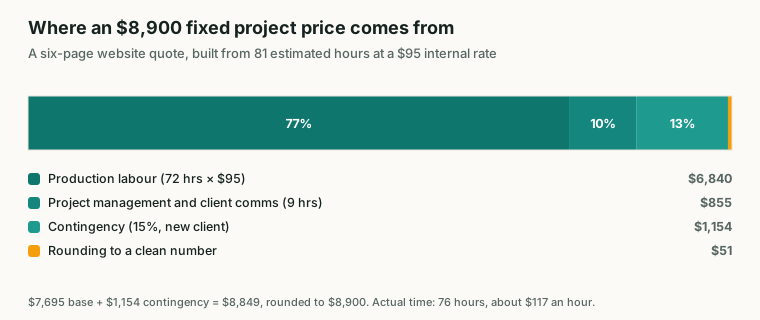
The March 2026 clinic website quote. Production labour is 77% of the price; the rest is the time and risk that gut-feel quotes leave out.
Here is the internal sheet behind that quote, at my $95 internal hourly rate:
| Phase | Estimated hours | Cost at $95/hr |
|---|---|---|
| Discovery call, brief and written scope | 4 | $380 |
| Sitemap and wireframes | 8 | $760 |
| Visual design, six pages | 18 | $1,710 |
| Build and CMS setup | 22 | $2,090 |
| Content loading and copy edits | 6 | $570 |
| Two rounds of revisions | 8 | $760 |
| QA, launch and handover session | 6 | $570 |
| Production subtotal | 72 | $6,840 |
| Project management and client comms (12%) | 9 | $855 |
| Base price | 81 | $7,695 |
| Contingency (15%, new client) | — | $1,154 |
| Rounded to a clean number | — | $51 |
| Quoted fixed fee | $8,900 |
The $95 itself is not arbitrary. It comes from my income target, taxes, expenses and realistic billable hours, run through the freelance rate calculator formula. If you do not have an internal rate yet, get one from the calculator before you quote anything. Project-based pricing without a floor rate underneath it is just guessing in larger units.
Building the number: six steps
Step 1: Write the scope before you estimate it
I cannot estimate a project I have only heard described on a call. So the first deliverable, even before a quote, is a one-page scope: what is included, what is explicitly not included, how many revision rounds, what the client supplies and by when.
For the clinic, the "not included" list did more work than the "included" list: no copywriting from scratch, no booking-system integration, no photography, no ongoing maintenance. Each of those exclusions was a conversation I would otherwise have had in week five, unpaid.
Step 2: Break the work into phases you have done before
Estimate in chunks of 2 to 20 hours. Anything bigger than that is too vague to estimate honestly; split it. "Build the site" is a guess. "Build and CMS setup, 22 hours" is an estimate I can check against the last three sites I built.
This is also where your own records pay off. If you have never tracked hours on fixed-fee work, start now, even when the client never sees them. My estimate for the build phase is good because I have the actual numbers from previous builds, not because I am naturally good at estimating.
Step 3: Add the time nobody lists
Emails, check-in calls, chasing assets, scheduling, invoicing. On my projects this runs between 10% and 15% of production time, so I add 12% as its own line. It is the most commonly forgotten cost in a project quote, and it is the reason so many fixed-fee projects quietly end up at a lower rate than planned. My guide to billable hours breaks down where this time goes in a normal week.
Step 4: Multiply by your internal rate
72 + 9 = 81 hours. 81 × $95 = $7,695. This is the price if every estimate is exactly right, which it never is.
Step 5: Add contingency for estimating error
$7,695 × 15% = $1,154. More on choosing that percentage below.
Step 6: Round, then sanity-check against value
$7,695 + $1,154 = $8,849, rounded up to $8,900. Then the last question: is this sensible for what the outcome is worth to the client? The clinic expected the new site to take its online bookings off the phone and email, and a single physiotherapy patient on a treatment plan is worth several hundred dollars to them. $8,900 was easy to justify. If the value side had come out smaller than my cost side, I would have reduced the scope, not the rate.
A note on contingency: it is not padding
Contingency pays for your estimating error: the build phase that takes 26 hours instead of 22, the CMS plugin that misbehaves. It does not pay for the client changing their mind. That is what a change order is for, and mixing the two is how contingency gets eaten in the first fortnight.
The percentages I actually use:
- 10% for repeat work with a client whose habits I know.
- 15% for a new client on work I have done many times.
- 20 to 25% when there is a genuine unknown: an inherited codebase, a third-party integration, a client who has not decided what they want.
These are my ranges, from my own project records. No standards body publishes a "correct" contingency for freelance work, and I would be wary of anyone who quotes one as if it were official.
If a project needs more than 25%, the scope is not ready to be priced. Sell a small paid discovery phase first, then quote the rest once the unknowns are known.
Getting paid: deposits and milestones
A fixed price shifts the risk of overruns onto you. A deposit and milestone schedule shifts some of the risk of non-payment back. Here is the schedule from the clinic contract:
| Milestone | Share | Amount | Trigger |
|---|---|---|---|
| Deposit | 40% | $3,560 | Signed agreement, before any work starts |
| Design approval | 30% | $2,670 | Client signs off the page designs |
| Launch | 30% | $2,670 | Site live, handover session done |
| Total | 100% | $8,900 |
Three rules I hold to:
- No deposit, no start date. A booked slot in my calendar is something I cannot sell to anyone else, and the deposit is what pays for that.
- Milestones are tied to approvals, not dates. If the client takes six weeks to approve designs, the second payment waits, but so does my next phase, and the contract says the timeline moves with them.
- Final payment before files or credentials change hands on anything where handover is a clear event.
For larger builds, such as a software developer taking on a three-month project, I would split it into monthly or per-sprint milestones and take the first one in advance. Large deposits also bunch income into one quarter, which matters at tax time. The IRS says individuals, including sole proprietors, generally have to make estimated tax payments if they expect to owe tax of $1,000 or more when they file, so set aside your tax share of each deposit when it lands, not when the project ends. The freelance tax basics guide walks through the set-aside math.
The change-order clause that protects the margin
Every fixed-fee contract I sign has a paragraph like this one:
Work outside the scope in Section 2, including additional pages, features, or revision rounds beyond the two included, will be quoted separately as a change order before it begins. Change orders are billed at $95 per hour or at a fixed price agreed in writing, and may extend the delivery date.
It does two things. It tells the client, before anything goes wrong, that "can you just add…" has a price. And it gives me a calm, pre-agreed answer when they ask, instead of an awkward negotiation in the middle of the project.
On the clinic project, the client asked for a seventh page, a team page, in week three. That became a $570 change order: six hours, quoted and approved in one email. Without the clause I would probably have done it for free to keep the peace, and my $117 effective rate would have dropped to $8,900 ÷ 82 = $108.54.
When project-based pricing is the wrong choice
A fixed fee is a bet that you can estimate the work. Do not take the bet when:
- The client cannot describe the outcome yet. Sell discovery first.
- The work is open-ended support, where the volume depends on what the client sends you. That is a retainer; see freelance retainer pricing.
- You have never done this kind of work and have no hours to compare against. Do the first one hourly, record the hours, and quote the second one as a fixed fee.
If you are unsure which side of that line a job falls on, the comparison in project-based vs hourly rate covers who carries which risk under each model.
After the project: check the quote against reality
The part almost everyone skips is going back. When a fixed-fee project closes, divide what you were paid by the hours you actually spent:
- Clinic site: ($8,900 + $570 change order) ÷ (76 + 6) hours = $9,470 ÷ 82 = $115.49 an hour.
- My internal rate: $95. Effective rate came in 22% above it.
Then compare each phase's actual hours with its estimate. On this project the build phase ran 3 hours under and revisions ran 2 hours over. I have now raised my revisions estimate for six-page sites from 8 to 10 hours. Doing this after every project is what makes the next quote more accurate, and it is the only honest way to say your quotes are "experience-based".
FAQ
What do you call project pricing that is built from hours?
It is still a fixed fee, often called a fixed bid. You estimate hours privately, multiply by your internal rate, add contingency and quote one number. If the client pays per hour up to a ceiling instead, that is capped hourly or "not-to-exceed" pricing, which is a different arrangement.
How much deposit should I ask for on a fixed-price project?
I take 40% from new clients and 30% from repeat clients. Below about 25% the deposit stops covering the early phases if the project dies; above 50% many clients hesitate.
Should a paid sample project be credited toward the full project?
It can be, if you agree it in writing before the sample starts. I credit a paid sample when the client signs within 30 days. Unpaid tests I decline.
How much contingency should a project quote include?
My range is 10% for repeat work, 15% for a new client on familiar work, and 20 to 25% when the scope has real unknowns. Scope changes go through change orders, not contingency.
What if the project takes far fewer hours than I estimated?
You keep the difference. That is the reward for carrying the overrun risk, so do not discount after the fact.
Can I combine a fixed project price with a retainer?
Yes, and for small-business clients it is often the best structure. Quote the build as a fixed project, then offer a monthly retainer for maintenance and small changes after launch. Keep them as two separate agreements so neither one absorbs the other's risk.
Questions people ask
- What do you call project pricing that is built from hours?
It is still a fixed fee, often called a fixed bid. You estimate the hours privately, multiply by your internal rate, add contingency, and quote one number. The client pays that number whether the work takes fewer or more hours. If the client pays per hour up to a ceiling instead, that is capped hourly or not-to-exceed pricing, which is a different arrangement.
- How much deposit should I ask for on a fixed-price project?
I take 40% up front on new clients and 30% on clients I have worked with before. Below about 25% the deposit stops covering the cost of the early phases if the project dies, and above 50% many clients balk. A software developer taking on a multi-month build can reasonably ask for the first milestone in advance as well.
- Should a paid sample project be credited toward the full project?
It can be, if you decide in writing before the sample starts. I credit a paid sample against the full fee when the client signs within 30 days, because it rewards a quick decision and the sample work usually becomes part of the final deliverable anyway. Never credit an unpaid test; just decline those.
- How much contingency should a project quote include?
My working range is 10% for repeat work with a known client, 15% for a new client on familiar work, and 20 to 25% when the scope has real unknowns. These are my own ranges, not a published standard. Contingency covers estimating error; scope changes go through a change order instead.
- What if the project takes far fewer hours than I estimated?
You keep the difference. That is the reward for carrying the risk of overruns, and it is the main reason experienced freelancers prefer fixed fees. Do not offer a discount after the fact; the client agreed to a price for an outcome, not for your hours.
- Can I combine a fixed project price with a retainer?
Yes, and for small-business clients it is often the best structure. Quote the build as a fixed project, then offer a monthly retainer for maintenance and small changes once it launches. The project price covers a defined outcome; the retainer covers ongoing, unpredictable requests. Keep them as two separate agreements so neither one absorbs the other's risk.
Put these numbers to work
Use the free freelance rate calculator to turn this into your own hourly rate in under a minute.
Open the calculatorKeep reading
More in Pricing Models, or browse all guides.
ROI of hiring a freelancer, calculated the way finance wants it: loaded cost comparison, four attribution models, and the traps that inflate the number.
ReadFreelance retainer rates by discipline and hour band: real 2026 monthly ranges for writers, designers, developers, and VAs, plus the discount ceiling.
ReadThere are 4 freelance retainer structures and each works differently. Learn which fits your client type before you sign anything.
ReadFreelance day rate vs hourly rate, compared side by side. See the math, when each model protects you, and how to set a day rate clients will accept.
ReadProject-based vs hourly rate explained: how each model works, who carries the risk, and which one actually protects your margin. With real dollar examples.
ReadMonthly retainer pricing for part-time freelancers: how to size hours around a day job, price evenings higher, and avoid over-committing time you don't have.
Read