What Is a Day Rate — And What Does One Actually Buy?
What is a day rate, exactly? A plain definition, what a 'day' really means, how day rates are calculated, and what they cost in seven disciplines.
Practical guidance, not financial advice. Sukie is a working freelancer, not a licensed accountant or financial advisor. Use this to make a defensible decision, then confirm the specifics for your situation with a qualified professional.

By Sukie · Founder & Writer, FreelanceRateLab
Published September 16, 2026 · 7 min read
What is a day rate? It is one fixed price for one working day of your time. The client books the day; you do not bill against a clock inside it. That is the whole definition — and almost every dispute about day rates comes from the two words people skip over, which are "a day."
What a "day" actually means
Nobody delivers eight hours. A booked day realistically contains six to seven hours of delivery, wrapped in the standing-up, the settling-in, the "while you're here" conversation, and the twenty minutes at the end that never quite become anything.
This matters because clients often hear "day rate" and mentally convert it to eight hours of output at your hourly rate, then feel short-changed when the day contains a lunch. Head that off in one sentence in the proposal:
A standard day is 7.5 hours of availability between 09:00 and 17:30, typically containing 6–7 hours of delivery work. Days are booked in advance and confirmed in writing.
Two lines, and it eliminates the most common day-rate argument before it starts.
What day rates cost
Here is what the market pays in 2026 across the disciplines where day rates are common. These are direct-to-client figures for independent freelancers, not agency-billed rates.
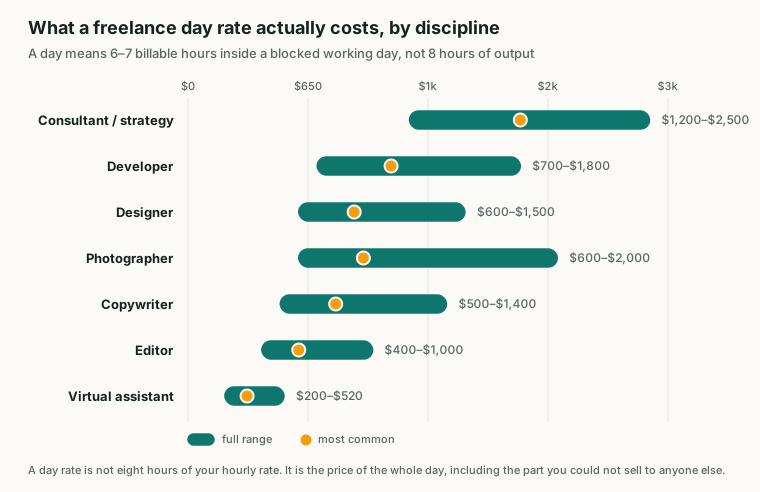
Seven disciplines where day-rate booking is standard. The gold marker is the most common figure.
| Discipline | Low | Typical | High |
|---|---|---|---|
| Consultant / strategy | $1,200 | $1,800 | $2,500 |
| Developer | $700 | $1,100 | $1,800 |
| Photographer | $600 | $950 | $2,000 |
| Designer | $600 | $900 | $1,500 |
| Copywriter | $500 | $800 | $1,400 |
| Editor | $400 | $600 | $1,000 |
| Virtual assistant | $200 | $320 | $520 |
Run the sanity check on any row: divide the typical figure by 6.5 delivery hours. A $900 designer day is $138 an hour of delivery, against a typical designer hourly rate near $90–$110. That gap of roughly 25–40% is not greed. It is the price of the day you removed from the market.
Why a day rate is not eight times your hourly rate
This is the calculation almost everyone does first, and it undercharges reliably.
Eight times hourly pays you for hours worked. It does not pay you for what booking a day actually costs you, which is three separate things:
Exclusivity. A booked Tuesday cannot be sold to anyone else, including the client who calls on Monday with something urgent and lucrative. You are selling a call option on your own week and the client is not paying a premium for it.
Fragmentation. A single booked day in the middle of a week does not leave you with a clean four days of deep work. It leaves you with two two-day blocks, which are worth less. Anyone who has tried to do serious design or engineering work in a week punctuated by client days knows this cost is real and is never on the invoice.
Irrecoverability. If the client cancels on Friday for a Monday booking, that Monday is almost never resellable. Hourly work can be rescheduled; a booked day cannot.
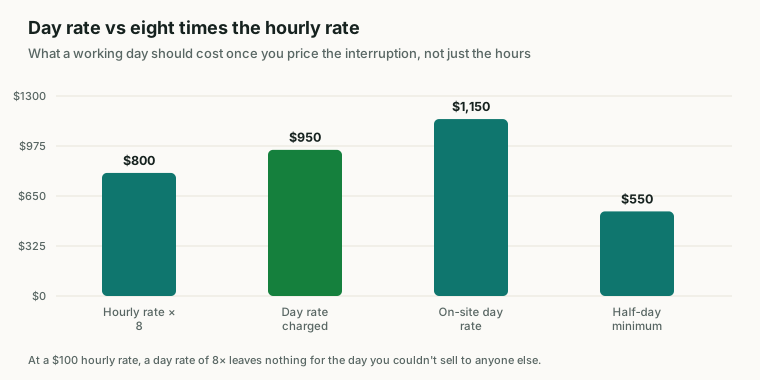
At a $100 hourly rate, 8× leaves nothing for the day you could not sell to anybody else.
The workable formula:
Day rate = (hourly rate × 8) × 1.15 to 1.25
On-site day rate = day rate × 1.15 to 1.25 again, for travel, context loss, and being visible all day
Half-day rate = day rate × 0.55 to 0.65 — never 0.5
At a $100 hourly baseline that gives $920–$1,000 remote, $1,060–$1,250 on site, and $550–$620 for a half day. Those are the numbers in the chart above, and they are the ones I use.
If you do not yet have a defensible hourly baseline to build from, get that first — everything above is a multiplier on a number that has to be right. The freelance rate calculator formula builds it from income target, tax, expenses and realistic billable hours, and the calculator itself will do it in a minute.
When a day rate is the wrong unit
Day rates are not universally better, and reaching for one on the wrong kind of work causes its own problems.
Short reactive tasks. If a client needs 40 minutes of your attention twice a week, a day rate is absurd and an hours-bank retainer is the right shape. Forcing a day rate here means either you overcharge or, far more commonly, you quietly do the work for free because invoicing a full day feels ridiculous.
Work with genuinely unknown duration. A day rate is a fixed price per day but the number of days is the estimate, and on open-ended work that estimate carries all the same risk a fixed project fee does. If nobody can say whether this is three days or eleven, bill hourly until the shape is clear.
Deliverable work you are fast at. If you can produce the thing in four hours and the client cares only about the thing, a day rate caps you at one day's money for what a project fee would have paid more for. Speed is an asset that day rates partially waste — the same argument hourly vs project pricing makes about hourly billing.
The test is simple. Is the client buying your output, or your presence? Presence takes a day rate. Output takes a project fee. Uncertainty takes an hourly rate.
What to do when a client asks for a "discounted" multi-day booking
This request is constant and it deserves a considered answer rather than a reflex in either direction.
A five-day block genuinely is worth something to you: one sales conversation instead of five, one context load instead of five, guaranteed revenue instead of hoped-for revenue. A modest discount is economically rational, and refusing on principle costs you money.
What is not rational is discounting the first booking. The efficiencies above only materialise once the relationship exists. My own rule, arrived at after giving away too much too early:
- First booking, any length: full rate. No exceptions.
- Blocks of 5+ days, after a first engagement: up to 10% off.
- Standing monthly commitment: treat it as a retainer and price it as one, which usually lands lower per day but higher per year.
Say the reasoning out loud. "I don't discount a first booking because we don't know yet how we work together — but once we've done one, I'm happy to look at block rates." Clients find that entirely reasonable, because it is.
The four clauses that make day rates safe
Day rates are simple to quote and easy to lose money on, and the difference is almost entirely contractual. Four clauses do the work.
Booking confirmation. Dates are held only when confirmed in writing. Verbal holds are not holds. This sounds officious until the first time you turn down work for a day that then evaporates.
Cancellation window. The standard I use, and see used widely: full charge inside 48 hours, 50% inside seven days, free beyond that. Clients accept this readily because it is obviously reasonable; freelancers omit it constantly and then absorb the cost silently.
Overtime definition. What happens when the day runs to 19:30? Either it does not, or it bills at 1.5× the hourly equivalent. Decide before it happens, because deciding during is a bad conversation.
Expenses and travel. Local travel absorbed, distant travel at half rate or as a line item, overnights at cost. State it. The most profitable-looking day rate I ever quoted became a break-even day once I had paid for a hotel I had not thought to mention.
For the general principle underneath all four, the Small Business Administration's guidance on contracting is blunt and correct: terms that are not written down are not terms.
So — what is a day rate? A fixed price for a booked working day, containing six to seven hours of delivery, priced at roughly 15–25% above eight times your hourly rate to cover the exclusivity you are selling. It suits multi-day and on-site work and suits short reactive tasks badly.
If you are weighing it against billing by the hour for a specific engagement, freelance day rate vs hourly rate runs the comparison with worked numbers on both sides. If the underlying question is really which pricing model should I use at all, start with hourly vs project pricing. And if you are not certain your hourly baseline is right — which is the number every figure on this page is derived from — start there.
Questions people ask
- What does a day rate mean?
A day rate is a single fixed price for one working day of your time, regardless of how many hours inside that day are spent on delivery. The client books the day; you do not bill against a clock. It is the standard unit for on-site work, multi-day engagements, and any situation where the client wants a predictable number rather than a running total.
- How many hours is a day rate?
Usually 7 to 8 hours of availability containing 6 to 7 hours of actual delivery, but the honest answer is that a day rate buys a day, not a quantity of hours. Define it in writing anyway — 'a standard day is 7.5 hours between 9 and 5.30, UK time' prevents most of the disputes that day rates otherwise generate.
- How does a day rate work in practice?
The client books specific dates, you block them, and you invoice per booked day whether or not the day fills. Most freelancers require the dates to be confirmed in writing and apply a cancellation window — commonly full charge inside 48 hours, half charge inside a week — because a cancelled booked day usually cannot be resold at short notice.
- Is a day rate just eight times the hourly rate?
No, and pricing it that way loses money. Eight times hourly compensates you for hours worked but not for the day you removed from the market. Most freelancers set a day rate at roughly 15 to 25 percent above 8x hourly, which prices the exclusivity as well as the labour.
- What is a half-day rate?
Typically 55 to 65 percent of the full day rate, never 50 percent. A half day still costs you the context switch, the travel if any, and usually the ability to sell the other half to anyone else. Pricing a half day at exactly half a day is the most common day-rate mistake.
- What are agency day rates?
Agencies typically bill client-facing day rates of £900 to £2,500 (or $1,100 to $3,000) for senior specialists, of which the individual doing the work receives roughly 40 to 55 percent if contracting through them. If you are quoted an agency day rate, that number includes the agency's margin, account management and risk.
- Do day rates include travel time?
Usually not, and it should be stated explicitly. Common practice is that travel inside the local area is absorbed, travel beyond it is charged at half rate or as a separate line, and overnight stays are billed at cost plus an out-of-hours uplift. Silence on this point is how a profitable booking becomes an unprofitable one.
- Should a beginner freelancer use a day rate?
Only for work you have done before and can size confidently. Day rates transfer the risk of a slow day to you, which is fine once your estimates are reliable and dangerous before that. Start hourly, log everything for a few months, then move the repeatable work onto day rates.
- Are day rates better than hourly rates?
They are better for multi-day, on-site, or block-booked work, and worse for short reactive tasks. The deciding question is whether the client is buying your output or your availability. If they need you present and reserved, day rate. If they need a discrete task done, hourly or project.
Put these numbers to work
Use the free freelance rate calculator to turn this into your own hourly rate in under a minute.
Open the calculatorKeep reading
More in Setting Your Rate, or browse all guides.
True hourly rate is what survives tax, unbillable time and overhead. The full trace from a $75 invoice line to the $21 that reaches your account.
ReadFreelance hourly rate from salary, converted honestly: gross up for self-employment tax, replace benefits, add expenses, and divide by real billable hours.
ReadLearn how to stop undercharging as a freelancer with a rate floor formula, 5 warning signs, and a 4-step plan to raise your rate this week.
ReadRealistic billable hours per day for most freelancers sit at 4 to 6, not 7 or 8. See why the daily target matters, the math, and how to raise it sanely.
ReadFollow the freelance rate calculator formula step by step with one real example: a UX designer turning an $85,000 take-home goal into an hourly rate.
ReadBillable hours for freelancers are never the same as hours worked. See the real week, the efficiency math, and what it does to your rate.
Read